Un-Australianism
2005In a parody of a formal political address, former Australian rules footballer Sam Kekovich sits at a desk in front of an Australian flag and delivers a passionate, satirical speech. He condemns what he calls a "creeping tide of un-Australianism," which includes minor cultural shifts like wearing decorative flip-flops instead of plain ones, the use of the word "thong" for G-string swimwear, and the consumption of foreign or vegetarian food instead of lamb on Australia Day. He invokes patriotic symbols like the ANZACs ("diggers") and the song "Waltzing Matilda" to argue that eating lamb is a core part of Australian identity. He concludes by urging Australians, including tourists ("backpackers"), to reject this "un-Australianism" by hosting a lamb barbecue on Australia Day.
Watch the advertisement
Historical and topical context
Campaign year: 2005 Assumed or known release period: January 2005 Primary context year: 2004 Likely topical context window: July 2004 to January 2005 Confidence in those dates: High
The ad was released into the political and cultural environment of mid-2000s Australia, a period largely defined by the conservative government of Prime Minister John Howard (1996-2007).
Reference: The re-election of the Howard Government. Evidence in the ad: The entire premise of a "state of the nation" address, the stern patriarchal tone, and the focus on defending "great traditions" against perceived outside threats parodies the conservative, nationalist rhetoric prevalent during this era. Likely relevance at release: The federal election of October 2004 saw the Howard government returned to power for a fourth term, cementing a sense of conservative national identity. The ad's satirical tone tapped directly into the mainstream political discourse, making its parody of a "strong leader" defending the nation's values immediately recognizable. Confidence: High External verification needed: No
Reference: Debates on Multiculturalism vs. a "Traditional" Australian Identity. Evidence in the ad: Kekovich's explicit condemnation of "exotic, foreign, and often vegetarian cuisine" (00:38) in favour of lamb chops, and his suggestion that "hippy vegetarians" who disagree should "get stuffed" and leave the country (01:09). Likely relevance at release: The Howard years were marked by ongoing public debates about multiculturalism, national identity, and integration. The ad satirises the "culture wars" viewpoint that saw multicultural influences (particularly food) as a threat to a core Anglo-Australian identity. Kekovich’s rant gives voice to a satirical, exaggerated version of this anxiety. Confidence: High External verification needed: No
Reference: The "Thong" Language Debate. Evidence in the ad: The specific complaint about people calling G-string swimwear "thongs" when in Australia the word traditionally referred to flip-flop footwear (00:19). Likely relevance at release: This was a minor but common cultural grievance in the 2000s, often cited as an example of unwelcome American cultural influence. By elevating this trivial complaint to a matter of national importance, the ad creates a highly relatable and humorous piece of satire. Confidence: High External verification needed: No
Reference: The use of the ANZAC legend in public discourse. Evidence in the ad: "Do you think the diggers in the trenches were fighting for tofu sausages?" (00:49). Likely relevance at release: Invoking the sacrifice of Australian soldiers (ANZACs or "diggers") to add moral weight to a political or commercial argument was, and remains, a common trope in Australian public life. The ad satirises this by applying it to something as mundane as a menu choice. The complaints made to the Advertising Standards Board about this specific line show how effectively it mimicked real-world rhetoric. Confidence: High External verification needed: No
Campaign meaning
Creative premise
The campaign's creative premise was to invent a satirical patriot, the "Lambassador," to deliver a series of "state of the nation" addresses. In this first installment, former footballer Sam Kekovich launches a bombastic, politically incorrect tirade against anything deemed "un-Australian," framing the simple act of eating lamb on Australia Day as the ultimate test of national loyalty.
Message
Explicit message:
- You should serve and eat lamb on Australia Day.
- Failing to do so is "un-Australian."
Strongly implied message:
- A "true" Australian identity is traditional, simple, and rooted in Anglo-centric customs (like BBQs), not "foreign" or "new-age" influences.
- Multiculturalism, vegetarianism, and even minor changes in language are threats to this traditional identity.
- Patriotism requires defending these simple traditions with exaggerated, almost aggressive passion.
Tentative interpretation:
- The ad gently mocks its own target audience. While it satirises overly serious nationalists, it also affectionately plays to a stereotype of a certain kind of "old-school" Australian male, making them feel seen while laughing at the absurdity of the character.
Role of lamb
Lamb is positioned as more than just a product; it is the central symbol of Australian identity and tradition. It is the culinary antidote to the "creeping tide of un-Australianism." Eating lamb becomes a ritual of patriotic affirmation, a way to connect with the nation's past (the "diggers," "Waltzing Matilda") and secure its future. It is the unifying force that separates "us" (real Australians) from "them" (vegetarians, people who eat foreign food).
Worldview evidence
[Patriotism as Duty]
Classification: Explicit Evidence: The entire speech, culminating in the line "So don't be un-Australian. Serve lamb on Australia Day" (01:22). Meaning at release: The ad explicitly links the consumption of a specific product to a national, patriotic duty. It frames the choice of what to eat on a public holiday as a question of national identity. Possible contemporary difference: This style of overt, jingoistic marketing has become a signature of the campaign, but the initial directness was novel and established the tone for all subsequent ads.
[Skepticism of Multiculturalism]
Classification: Strongly implied (through satire) Evidence: "indulging their pierced tastebuds in all manner of exotic, foreign, and often vegetarian cuisine" (00:38). Meaning at release: The ad satirises a real anxiety within parts of the Australian community in 2004 that the rise of multiculturalism was eroding a traditional, singular national identity. By listing "pizza" and "number 42 with rice" as a "disgrace," the ad parodies this fear.
[Nostalgia for a Simpler Past]
Classification: Strongly implied Evidence: "What's wrong with rubber thongs in simple primary colours?" (00:17). Meaning at release: The character's grievances are all rooted in change. He longs for a time before decorative flip-flops, before the meaning of "thong" changed, and before Chinese takeaway and pizza were mainstream. This reflects a satirical take on a nostalgic longing for a perceived simpler, more homogenous past.
Humour, tone and satire
- Tone: The tone is mock-serious, bombastic, and satirical. Kekovich delivers the lines with the gravitas of a world leader announcing a major crisis, which creates a comedic contrast with the triviality of his complaints.
- Principal joke mechanisms: The primary mechanism is hyperbole. Minor cultural grievances (footwear, food choices) are treated as existential threats to the nation, justifying extreme reactions like capital punishment.
- Targets of satire: The ad has a dual target. The primary target is the jingoistic, culturally insecure nationalist who sees foreign influence everywhere. The secondary, more affectionate target is the "Aussie bloke" stereotype. It also gently satirises "long-haired, dole-bludging types" and "soap-avoiding, pot-smoking, hippy vegetarians" (01:08) as part of the character's worldview.
- Affectionate parody versus genuine criticism: The campaign is a parody of a certain type of Australian conservatism, but it is affectionate enough that the target demographic can laugh along with it. It criticises the absurdity of the extreme views, but not necessarily the underlying sentiment of wanting to preserve tradition.
Campaign evidence summary
Core message
The core message is that eating lamb on Australia Day is a patriotic duty. The ad satirically frames this simple consumer choice as the primary defence against a "creeping tide of un-Australianism," which includes everything from multicultural food to changes in fashion and language.
Values supported by this ad
- Tradition
- Patriotism (as defined by the character)
- Simplicity
- Conformity to a national identity
- Humorous irreverence
Role of lamb
Lamb is the sacred symbol of Australian identity. It is the food of patriots, soldiers, and historical folk heroes. Choosing to eat lamb is presented as an act of cultural preservation and a rejection of "un-Australian" foreign and modern influences.
Most important topical or historical elements
- Parody of the conservative, nationalist political rhetoric of the Howard Government era (1996-2007).
- Satirical engagement with contemporary "culture war" debates around multiculturalism and national identity.
- Reference to the minor but relatable cultural grievance concerning the Americanisation of the word "thong."
Uncertainties
- The symbolic meaning, if any, of the Christmas Island flag on the desk.
- The exact wording on the desk crest is unreadable.
Themes and connections
This advertisement belongs to Era 1 — The Kekovich Doctrine.
Keyframe gallery
4 representative frames, in chronological order.
-

00:20 · opening The scene is a single, continuous shot of Sam Kekovich, a middle-aged white man in a suit and tie, sitting at a large wooden desk. He is positioned as a head of state or news anchor. -
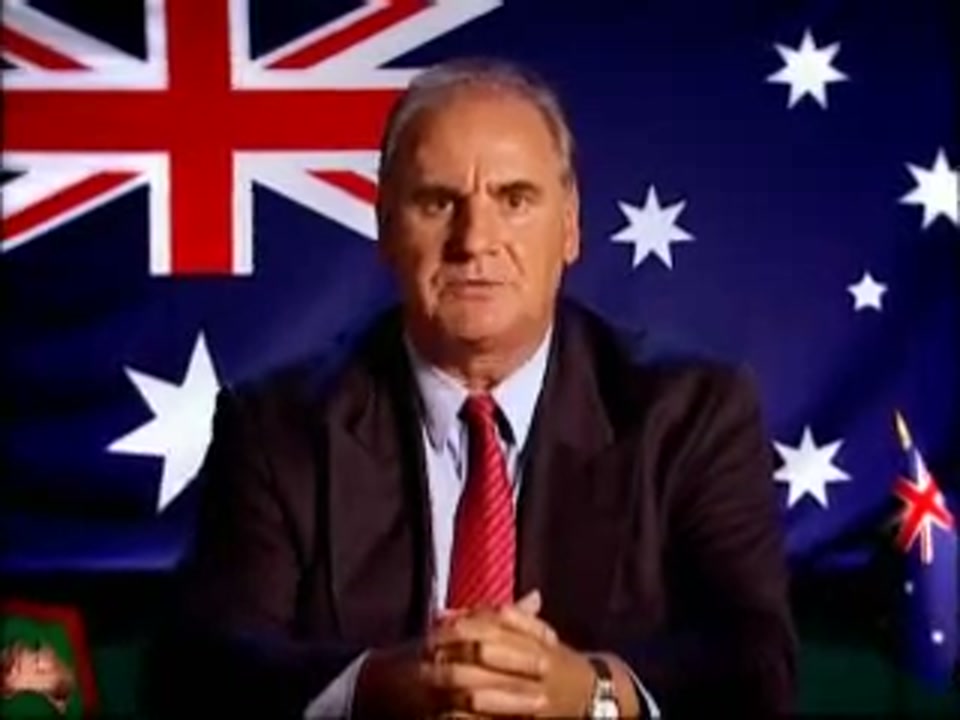
00:32 · food shot The shot remains the same. Kekovich's expression becomes more intense and incredulous as he lists various non-lamb foods. His eyebrows raise in mock-disbelief. -
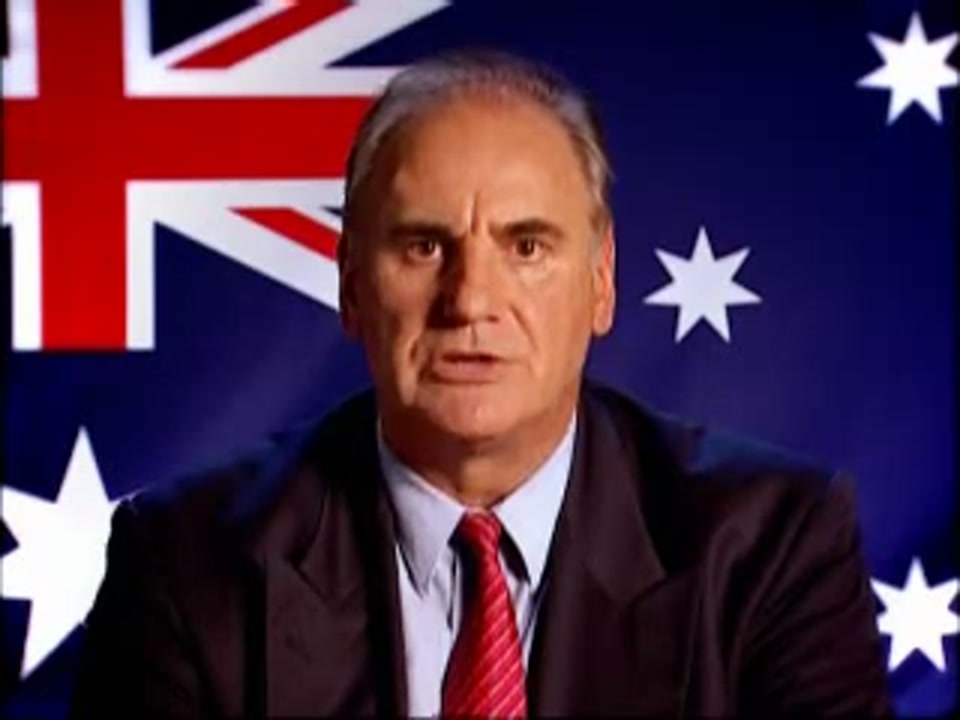
01:01 · food shot Kekovich leans forward slightly, adopting an even more earnest and solemn tone, as if imparting a sacred truth. -

01:21 · brand frame Kekovich's expression is now one of firm, resolute instruction. He is giving a direct command to the nation. The shot remains fixed. At the very end, white text appears over the lower third of the screen.
Scene-by-scene account
Show full scene breakdown
[00:00 - 00:27]
Visuals
The scene is a single, continuous shot of Sam Kekovich, a middle-aged white man in a suit and tie, sitting at a large wooden desk. He is positioned as a head of state or news anchor. Behind him is a large Australian flag (the national flag, which includes the British Union Jack). On his desk are two miniature flags: the same Australian flag and the flag of Christmas Island (green and blue with a Golden Bosun bird). To his left is a small, shield-shaped crest featuring a map of Australia with a lamb chop inside it; the motto beneath is unreadable. The lighting is dramatic and serious. Kekovich looks directly at the camera with a severe expression, speaking with forceful sincerity.
Dialogue and audio
An orchestral, patriotic-sounding version of "Advance Australia Fair" plays softly in the background.
Kekovich: "There's nothing worse than being un-Australian. I should know, I've been Australian all my life. And I'm sickened by the creeping tide of un-Australianism eroding our great traditions. Like our custom of eating lamb on Australia Day. Un-Australianism is everywhere. For example, people wearing those plastic brightly coloured flip-flop shoes with flowers on them. What's wrong with rubber thongs in simple primary colours? And if I hear another person say 'thong' when they mean those swimming costumes puny Brazilian blokes wear up their bums, I'll do my block. Sadly, the scourge of un-Australianism has even infected our national day."
[TXT says: "puny Brazilian bles" / audio says: "puny Brazilian blokes"]
On-screen text
None.
Meaning and context
Directly observable: The speaker, Sam Kekovich, presents himself as a patriotic authority figure decrying changes to Australian traditions. He specifically criticises certain fashion choices (decorative flip-flops), the changing use of language ("thong"), and the failure to eat lamb on Australia Day as "un-Australian."
Likely interpretation at release: The ad is a satire of jingoistic, conservative talkback radio hosts or politicians. Kekovich's persona is that of a "lambassador," a new term for the campaign. The humour comes from the massive overreaction to trivial cultural issues. The "thong" debate was a genuine, minor cultural grievance in the mid-2000s, relating to the Americanisation of the word for footwear (flip-flops) to mean G-string underwear, which many Australians found amusingly frustrating.
Verification needed: The specific reason for the Christmas Island flag's inclusion is unclear. The motto on the desk crest is unreadable.
[00:27 - 00:49]
Visuals
The shot remains the same. Kekovich's expression becomes more intense and incredulous as he lists various non-lamb foods. His eyebrows raise in mock-disbelief.
Dialogue and audio
The patriotic music continues softly.
Kekovich: "A balanced Australia Day diet should consist of a few nice juicy lamb chops and beer, and perhaps a bit of pavlova for those with a sweet tooth. Yet you get your long-haired, dole-bludging types who are indulging their pierced tastebuds in all manner of exotic, foreign, and often vegetarian cuisine. Chicken burger value meals, pizzas, a number 42 with rice. It's an absolute disgrace! And people ask why we need capital punishment."
On-screen text
None.
Meaning and context
Directly observable: Kekovich defines a "proper" Australia Day meal (lamb chops, beer, pavlova) and contrasts it with "un-Australian" foreign and vegetarian foods. He uses stereotypes ("long-haired, dole-bludging types") to describe those who eat these other foods and hyperbolically connects their food choices to the need for capital punishment.
Likely interpretation at release: This section satirises anxieties about multiculturalism and the decline of a traditional, Anglo-centric Australia. The list of foods—pizza (Italian/American), "number 42 with rice" (generic suburban Chinese takeaway), and chicken burgers (American fast food)—represents the everyday multicultural reality of Australian cuisine in 2004, which the character finds threatening. The call for capital punishment over food choice is the core of the joke, highlighting the absurdity of the character's worldview.
[00:49 - 01:14]
Visuals
Kekovich leans forward slightly, adopting an even more earnest and solemn tone, as if imparting a sacred truth.
Dialogue and audio
The tone is grave as he speaks about soldiers, then becomes more dismissive and angry when addressing vegetarians.
Kekovich: "Do you think the diggers in the trenches were fighting for tofu sausages? No! They were thinking of grabbing a lamb chop off the barbie with their bare fingers, sustaining third-degree burns, then sticking their hands in a relieving esky to fish out a cold one. Look at our national song, 'Waltzing Matilda'. It's about a bloke trying to get a nice bit of lamb into his tucker bag, not spicy chicken wings! The soap-avoiding, pot-smoking, hippy vegetarians may disagree with me, but they can get stuffed! They know the way to the airport. And if they don't, I'll show them."
On-screen text
None.
Meaning and context
Directly observable: The speaker invokes the memory of Australian soldiers ("diggers") and the folk song "Waltzing Matilda" to sanctify the act of eating lamb. He dismisses vegetarians with insults and suggests they should leave the country.
Likely interpretation at release: This section parodies the common political tactic of using the ANZAC legend to validate a contemporary viewpoint. The graphic, slightly masochistic description of the barbecue experience is a humorous nod to "tough" Australian masculinity. The command for dissenters to "get stuffed" and go to the airport echoes real political rhetoric of the time, particularly from conservative commentators discussing immigration and cultural debates. The misinterpretation of "Waltzing Matilda" (which is about a sheep thief) is a further layer of the satire.
[01:14 - 01:29]
Visuals
Kekovich's expression is now one of firm, resolute instruction. He is giving a direct command to the nation. The shot remains fixed. At the very end, white text appears over the lower third of the screen.
Dialogue and audio
The music swells slightly, becoming more triumphant and conclusive.
Kekovich: "So the message is clear, even for you backpackers. Roll out the barbie, ensure the gas bottle's filled, stack the fridge full of lamb and prepare the invitation list. So don't be un-Australian. Serve lamb on Australia Day. You know it makes sense." (Music ends with a flourish). Kekovich: "I'm Sam Kekovich."
On-screen text
[01:26] We love our Lamb
Meaning and context
Directly observable: Kekovich summarises his argument into a clear call to action: eat lamb on Australia Day. He explicitly includes tourists ("backpackers") in his address. The campaign slogan "We love our Lamb" appears, and he identifies himself by name.
Likely interpretation at release: The ad concludes by making its commercial purpose explicit. The inclusion of "backpackers" broadens the joke, suggesting that this "patriotic duty" is something even temporary visitors should observe. The final line, "I'm Sam Kekovich," solidifies his role as the face of the campaign, the "Lambassador."
Verification and uncertainties
- Uncertain dialogue: The TXT transcript incorrectly transcribes "blokes" as "bles" (00:23). This has been corrected based on the audio.
- Unclear on-screen text: The motto on the desk crest is illegible.
- Uncertain references: The reason for the inclusion of the Christmas Island flag is not obvious from the context of the ad itself. It may be a random prop or an obscure in-joke.
- Topical claims needing release-period research: The analysis relies on the understanding that the ad was released in January 2005, making the political and cultural context of 2004 primary. This includes the October 2004 federal election and ongoing debates about multiculturalism.