Address to the Nation
2006In a mock-presidential address from a stately office, former AFL footballer Sam Kekovich diagnoses a spate of "un-Australian behaviour" over the past year. He attributes a series of national failings and scandals—involving models, beach violence, and cricketers—to a single cause: insufficient lamb consumption. Kekovich lists various negative Australian stereotypes he says are not essential to the national character, such as boorishness and heavy drinking. He concludes by prescribing the true path to being Australian: hosting a barbecue, serving juicy lamb chops, and inviting everyone over, regardless of background. The ad culminates in the slogan: "Don't be un-Australian. Serve lamb on Australia Day."
Watch the advertisement
Historical and topical context
- Campaign year: 2005
- Assumed or known release period: January 2005
- Primary context year: 2004
- Likely topical context window: July 2004 to January 2005
- Confidence in those dates: High
The ad was released in January 2005, a time when the John Howard-led conservative government had recently won a fourth term in the October 2004 federal election. The national mood was shaped by ongoing involvement in the Iraq War, domestic debates about national identity, and a number of high-profile media stories that the ad directly references. This ad was the first in a long-running and highly successful series that made Sam Kekovich the "Lambassador" and inextricably linked lamb with Australia Day.
Reference: Australian model in trouble in Asia. Evidence in the ad: "Australian models holidaying in Asia would get in a lot less trouble if they carried a couple of lamb chops in their handbags." (00:12) Likely relevance at release: This is a thinly veiled reference to the arrest of Schapelle Corby in Bali, Indonesia, on 8 October 2004, for importing cannabis. The story dominated the Australian media in late 2004 and into 2005, becoming a national obsession. Confidence: High External verification needed: No
Reference: Beach violence. Evidence in the ad: "Lamb could have prevented the buff-heads perpetrating violence on our beaches." (00:18) Likely relevance at release: This does not refer to the well-known Cronulla Riots, which occurred in December 2005. Instead, it taps into existing public anxiety and media reports during 2004 about tensions and violence at Sydney beaches involving youths, often framed along ethnic lines, which were precursors to the 2005 riots. Confidence: Medium External verification needed: Yes (to identify specific 2004 incidents that may have informed the line).
Reference: The Ashes and cricketer scandals. Evidence in the ad: "...we might not have lost the Ashes if our cricketers picked up lamb chops instead of mobile phones. Why on earth did they dispatch lurid text messages to English trollops..." (00:23) Likely relevance at release: The "text messages" are a clear reference to scandals involving cricketer Shane Warne, who had a history of sending lewd messages. The "lost the Ashes" comment is satirical. Australia held the Ashes at the time of release and the highly anticipated 2005 series in England was still months away. The ad humorously pretends this future loss is a forgone conclusion due to the team's poor moral character. Confidence: High External verification needed: No
Reference: Bird Flu. Evidence in the ad: "...mishaps spread across the land like bird flu through a Chinese chicken coop..." (00:35) Likely relevance at release: The H5N1 strain of avian influenza was a major global news story in 2004, with significant outbreaks in Asia raising fears of a potential pandemic. The reference would have been immediately understood by the audience. Confidence: High External verification needed: No
Campaign meaning
Creative premise
The ad's creative premise is a satirical "Address to the Nation" by a populist, straight-talking cultural commentator (Sam Kekovich). He humorously diagnoses Australia's moral decline, evidenced by recent tabloid scandals, as a direct result of a national lamb deficiency. This allows the brand to absurdly position its product as the solution to all of Australia's problems and the key to restoring the national character.
Message
Explicit message:
- Eating lamb is a core part of the Australian national identity. (00:42)
- Australians should serve lamb on Australia Day to avoid being "un-Australian." (01:21)
- Being Australian involves inclusivity and mateship, not negative stereotypes. (01:13)
Strongly implied message:
- True patriotism is simple and is found in shared, everyday rituals like a barbecue, not in jingoism or boorish behaviour.
- Lamb is a social lubricant that brings diverse people together.
- A sense of humour about national failings and stereotypes is a key Australian trait.
Tentative interpretation:
- The ad gently critiques the simplistic, populist rhetoric of some politicians and media figures by embodying it in an exaggerated form. Kekovich's "solution" is a parody of overly simple answers to complex social problems.
Role of lamb
Lamb functions on multiple levels:
- Product: It is the item being sold, explicitly promoted for consumption on Australia Day.
- Symbol: It represents authentic, traditional Australian values.
- Plot Device: It is the comical cause of, and solution to, all the "un-Australian" problems listed in the ad.
- Social Unifier: The act of sharing lamb at a barbecue is presented as the ultimate ritual of mateship and multicultural inclusion.
Worldview evidence
Patriotic Nationalism
Classification: Explicit Evidence: The entire premise of the ad, from the flag and Kekovich's "My fellow Australians" opening to the final plea not to be "un-Australian" and to celebrate "the best bloody country on earth." Meaning at release: The ad taps into a strong sense of national pride, but frames it through the accessible, everyday ritual of a barbecue rather than more formal or political expressions of patriotism.
Inclusive Mateship
Classification: Explicit Evidence: "Invite everyone over. If you can't pronounce their name, just call them 'mate'." (01:15) Meaning at release: This line directly presents a vision of Australian mateship that is casually multicultural and welcoming. It suggests that the simple, informal act of sharing food and using a friendly moniker is enough to bridge cultural divides.
Rejection of Negative Stereotypes
Classification: Explicit Evidence: The list of behaviours that being Australian doesn't require, such as binge drinking, being a bad sport, and having poor taste. (00:46 - 01:06) Meaning at release: The ad actively distances the brand and its concept of "Australian-ness" from the negative "ocker" caricature, instead promoting a more positive and responsible (though still laid-back) version of the national character.
Satire of Populism
Classification: Strongly implied Evidence: The use of a mock-presidential format, the bombastic tone, and the absurdly simplistic link between eating lamb and solving complex social issues. Meaning at release: By creating a parody of a populist leader, the ad humorously critiques the tendency to offer simple, jingoistic solutions to real-world problems. The joke works because the audience knows that lamb won't actually solve beach violence or stop cricketers from misbehaving.
Humour, tone and satire
- Tone: The tone is bombastic, mock-serious, and satirical. Kekovich's deadpan delivery of absurd lines creates a consistent comedic effect.
- Principal joke mechanisms:
- Parody: The ad is a direct parody of official political addresses.
- Hyperbole: The central conceit that lamb can solve all national problems is an extreme exaggeration.
- Irony: The ad lists negative stereotypes while claiming they are not what defines Australia, thereby acknowledging their existence in a self-deprecating way.
- Celebrity Persona: It leverages Sam Kekovich's existing public image as a blunt, "politically incorrect" figure.
- Targets of satire: The ad satirises national anxieties (losing sporting prowess, social division), public figures caught in scandals (models, cricketers), cultural clichés (binge drinking, bad fashion), and the very nature of populist political rhetoric. The criticism is generally affectionate and aimed at shared cultural touchstones.
Campaign evidence summary
Core message
The ad's core message is that the authentic Australian identity is found in the simple, inclusive ritual of a shared lamb barbecue. It posits that eating lamb, especially on Australia Day, is a patriotic act that unifies the nation and wards off the "un-Australian" behaviours and moral failings seen in contemporary society.
Values supported by this ad
- Patriotism and national pride.
- Inclusive and multicultural "mateship."
- The barbecue as a central cultural ritual.
- Self-deprecating humour.
- A rejection of negative "ocker" stereotypes in favour of a more positive national character.
Role of lamb
Lamb is presented as a national sacrament. It is both the product being advertised and the symbolic cure for societal ills, the key ingredient for national unity, and the centrepiece of the ultimate Australian activity: the Australia Day barbecue.
Most important topical or historical elements
- The arrest of Schapelle Corby in Bali in October 2004.
- Public scandals involving cricketer Shane Warne.
- General social anxiety about beach violence and tensions in the year preceding the Cronulla Riots.
- The establishment of the "Serve Lamb on Australia Day" slogan as a major annual marketing event.
Uncertainties
- The specific incidents of "beach violence" from 2004 that the ad may be referencing remain unclear without further research.
- The title "Address to the Nation" is an interpretation, as no official title was supplied with the source video.
Themes and connections
This advertisement belongs to Era 1 — The Kekovich Doctrine.
Keyframe gallery
7 representative frames, in chronological order.
-
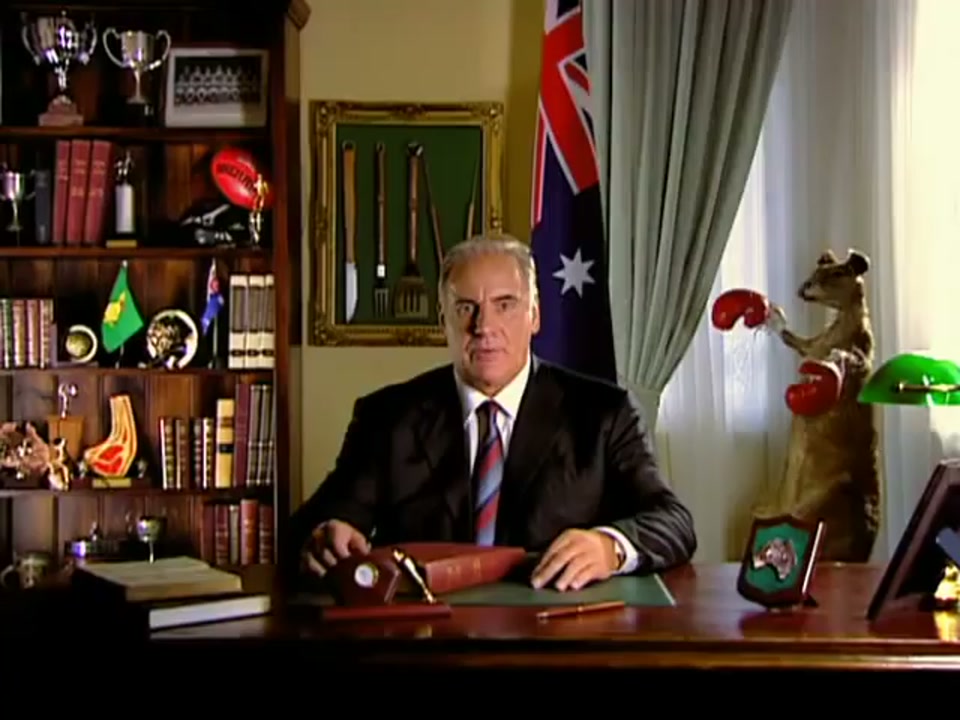
00:05 · opening The scene opens on Sam Kekovich, a middle-aged man in a dark suit, seated at a large, polished wooden desk. -
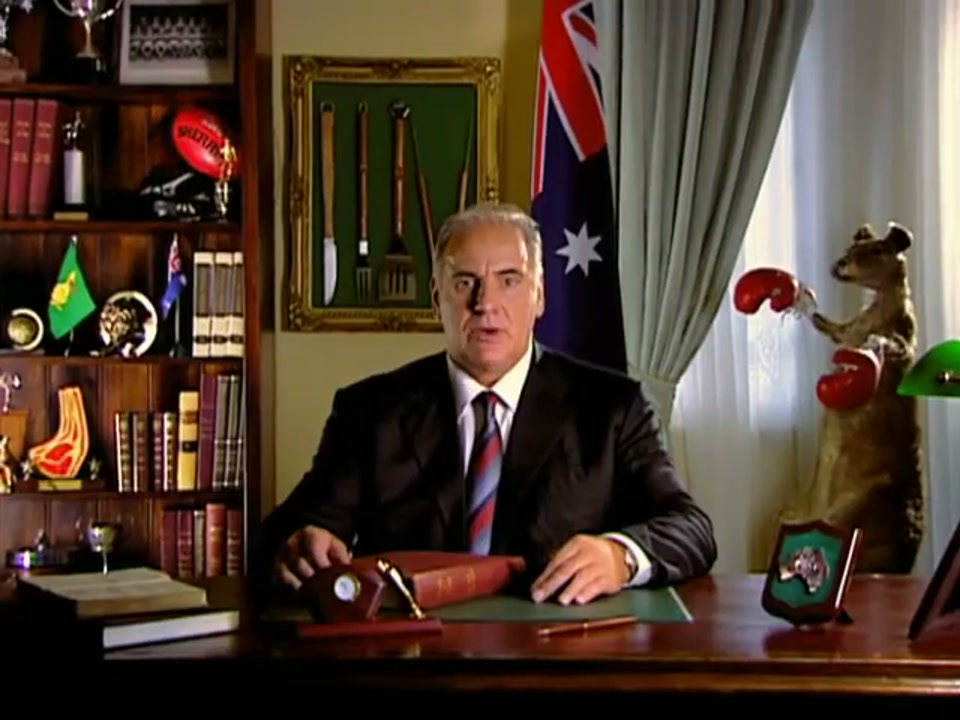
00:17 · food shot The shot remains a medium close-up of Kekovich at his desk. He delivers his lines with deadpan seriousness, gesturing occasionally to emphasise his points. -
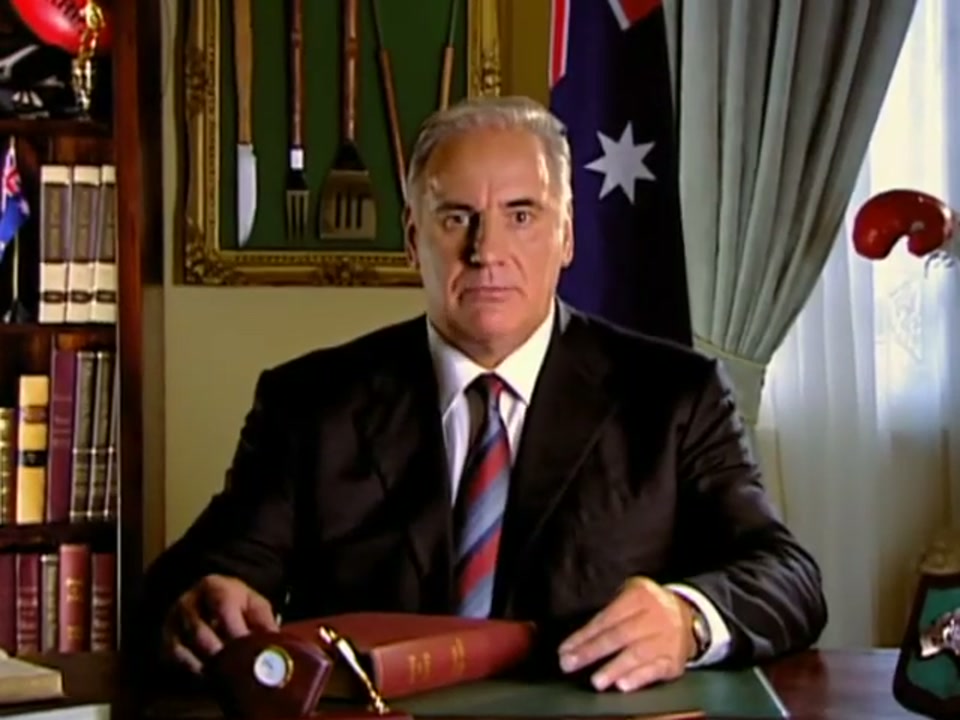
00:45 · title card The camera slowly zooms in on Kekovich's face, increasing the intensity of his address. His expression remains dead serious, adding to the comedic effect of his increasingly absurd list of behaviours. -
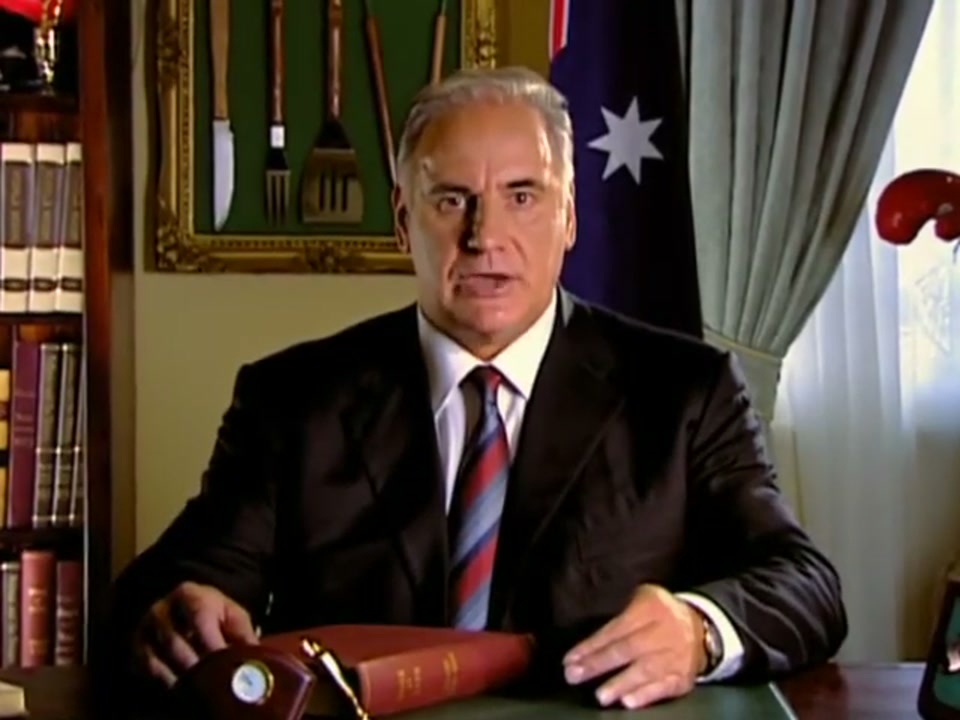
00:53 · title card The camera slowly zooms in on Kekovich's face, increasing the intensity of his address. His expression remains dead serious, adding to the comedic effect of his increasingly absurd list of behaviours. -
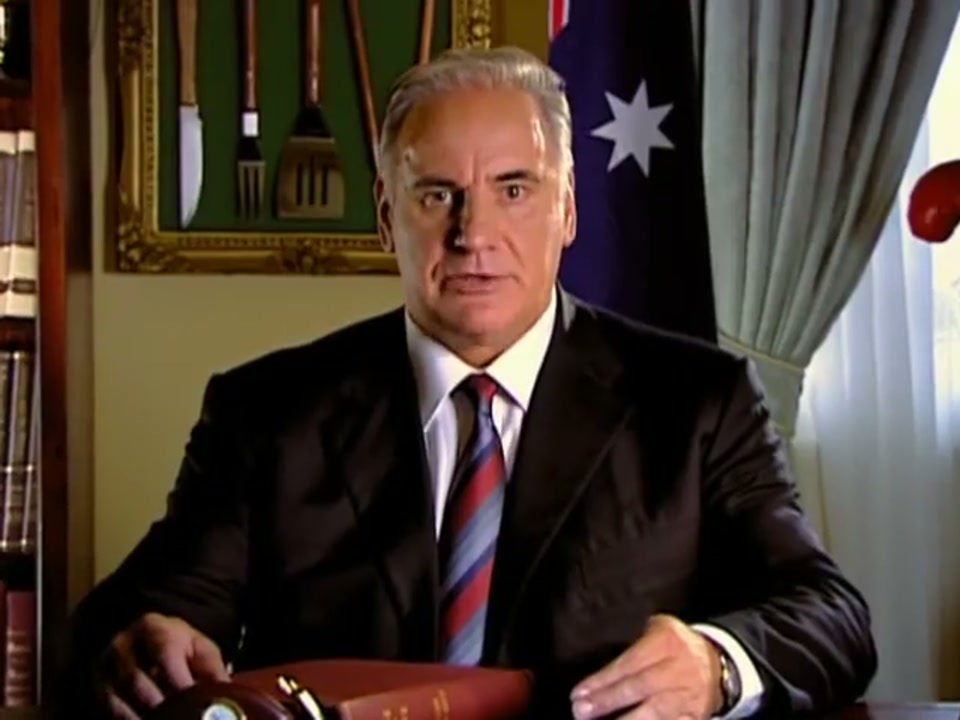
01:00 · title card The camera slowly zooms in on Kekovich's face, increasing the intensity of his address. His expression remains dead serious, adding to the comedic effect of his increasingly absurd list of behaviours. -
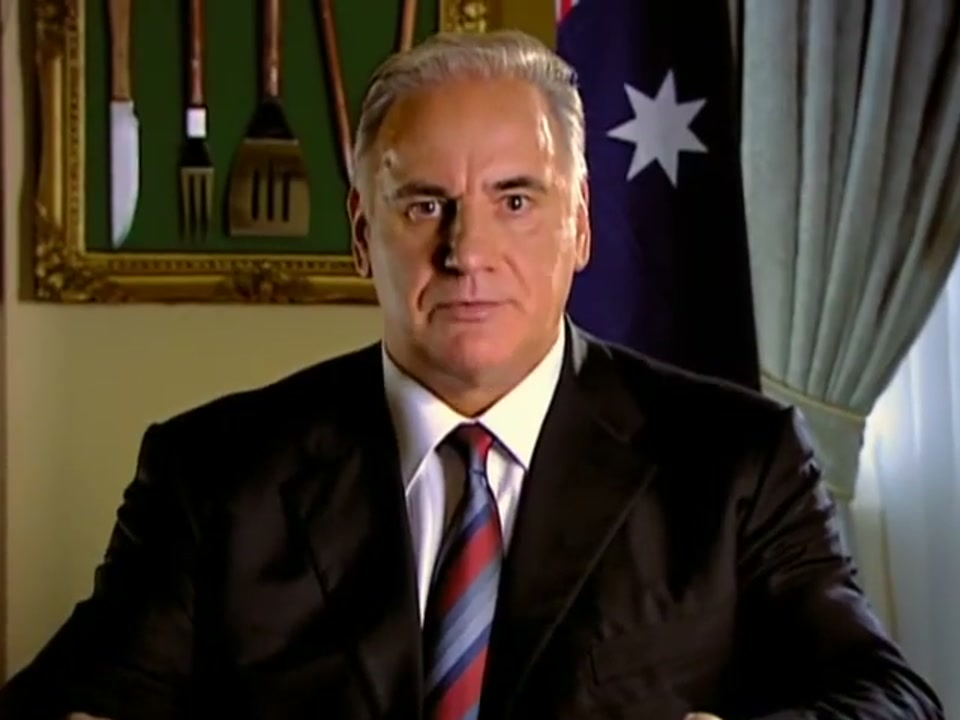
01:12 · food shot The close-up on Kekovich is at its tightest. He delivers his final instructions with the conviction of a visionary leader, before breaking into a slight, knowing smile for the first time. -
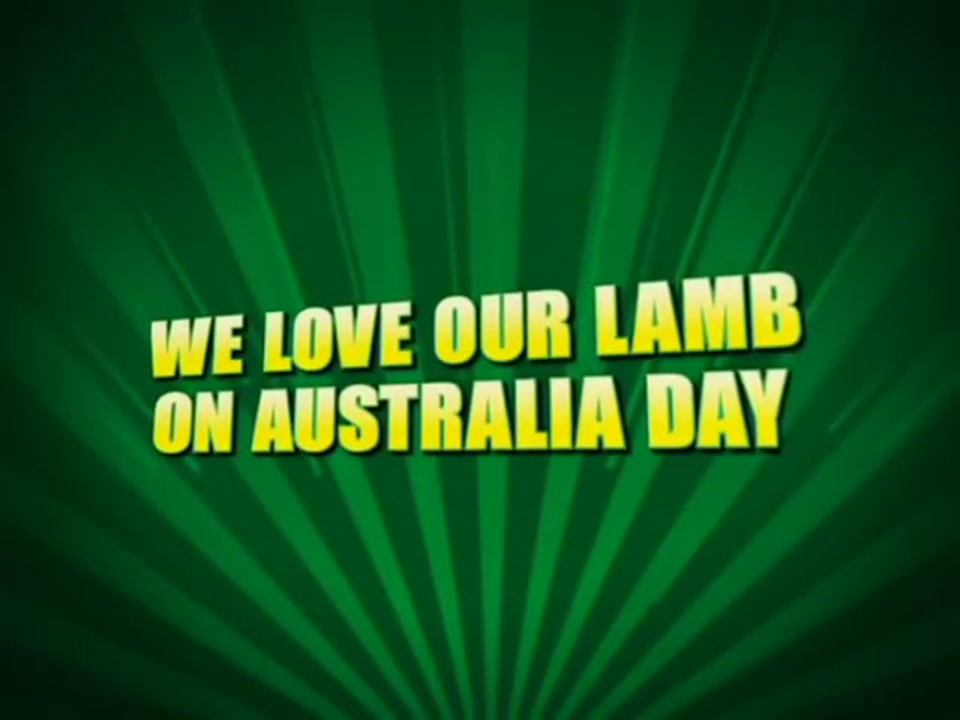
01:29 · brand frame The screen cuts to a green and gold background with radiating light beams, the classic Australian sporting colours. Bold, yellow, 3D text appears.
Scene-by-scene account
Show full scene breakdown
00:00 - 00:11
Visuals
The scene opens on Sam Kekovich, a middle-aged man in a dark suit, seated at a large, polished wooden desk. The setting is a formal, wood-panelled office designed to look like that of a Prime Minister or Governor-General. An Australian flag stands behind him. The bookshelf is filled with leather-bound books, sporting trophies, and a Sherrin football. Other symbolic props are visible: a framed set of barbecue tools (tongs, fork, knife), a taxidermied boxing kangaroo, and a model of a T-bone steak or lamb chop on the shelf. Kekovich looks directly at the camera with a serious, almost stern, expression.
Dialogue and audio
Speaker (Sam Kekovich): "My fellow Australians. Instances of un-Australian behaviour over the past year was enough to make me choke on my lamb chops. And it was all down to one thing: not enough lamb."
The audio begins with mock-ceremonial, patriotic brass band music, which continues softly under the dialogue.
On-screen text
None.
Meaning and context
Directly observable: A man styled as a national leader is delivering a formal address to the nation. He identifies a national problem ("un-Australian behaviour") and blames it on a lack of lamb. The setting is deliberately loaded with symbols of Australian sport, politics, and barbecue culture.
Likely interpretation at release: The scene is a clear parody of a "state of the nation" address. Sam Kekovich was a well-known, outspoken, and often controversial former football star and media personality. Casting him as a pseudo-political leader was intended to be humorous and satirical. The opening lines establish the ad's central comedic premise: that eating lamb is the foundation of Australian identity and its absence is the root of all social ills.
00:11 - 00:38
Visuals
The shot remains a medium close-up of Kekovich at his desk. He delivers his lines with deadpan seriousness, gesturing occasionally to emphasise his points. His expression is one of grave concern for the nation's moral fabric.
Dialogue and audio
Sam Kekovich: "For example, Australian models holidaying in Asia would get in a lot less trouble if they carried a couple of lamb chops in their handbags. Lamb could have prevented the buff-heads perpetrating violence on our beaches. It's bloody hard to bash someone with a cutlet. And we might not have lost the Ashes if our cricketers picked up lamb chops instead of mobile phones. Why on earth did they dispatch lurid text messages to English trollops when plenty of Aussie sheilas would gladly target their middle stump? Yet as mishaps spread across the land like bird flu through a Chinese chicken coop, what were we doing about it?"
[TXT says: "English TR" / Audio clearly says: "English trollops"]
On-screen text
None.
Meaning and context
Directly observable: Kekovich links three specific negative events from the previous year to a lack of lamb, offering hyperbolic solutions. He uses colloquial and crude language ("buff-heads," "bloody hard," "trollops," "Aussie sheilas") in stark contrast to the formal setting.
Likely interpretation at release: This section contains the ad's most direct topical references, all from the primary context window of late 2004.
- "Australian models holidaying in Asia": This is a strong and immediate reference to Schapelle Corby, a former beauty student arrested in Bali in October 2004 for cannabis trafficking. The case was a massive media story. The line about carrying contraband "in their handbags" (Corby's was a bodyboard bag) is a direct, albeit dark, joke about the incident.
- "Violence on our beaches": This likely refers to general, ongoing tensions at Sydney beaches that were a recurring media topic, rather than a single event. These tensions would later culminate in the major Cronulla Riots in December 2005, well after this ad's release. The line taps into a pre-existing public anxiety.
- "Lost the Ashes" / "lurid text messages": This is a multi-layered reference. The "text messages to English trollops" is a clear allusion to scandals involving cricketer Shane Warne. The "lost the Ashes" line is comedically premature. Australia still held the Ashes and was not due to play for them until mid-2005. The line humorously frames the anticipated tough 2005 series as a loss foretold by the team's moral failings.
- "Bird flu": The H5N1 avian flu was a major global health story throughout 2004, creating widespread public concern.
Verification needed: The exact "beach violence" incidents being referenced from 2004.
00:38 - 01:08
Visuals
The camera slowly zooms in on Kekovich's face, increasing the intensity of his address. His expression remains dead serious, adding to the comedic effect of his increasingly absurd list of behaviours.
Dialogue and audio
Sam Kekovich: "Bugger all. It's time to remind ourselves of what lies at the core of our national identity: a lamb chop on a barbie. Being Australian doesn't mean you have to call the opposition captain a wanker, even if he is. Or smother everything in tomato sauce 'til it resembles an outpatient in a casualty ward. Or pull on a pair of budgie smugglers, I'd prefer you didn't. And you don't have to spend every Friday night on the piss 'til your best friend looks like Elle Macpherson, throw up in a cab, then trip over the garden gnome before passing out on your front lawn."
[TXT says: "outpa" / Audio says: "outpatient"] [TXT says: "garden name" / Audio says: "garden gnome"]
On-screen text
None.
Meaning and context
Directly observable: Kekovich defines "true" Australian identity by negating a series of negative cultural stereotypes: boorishness in sport, unsophisticated eating habits (tomato sauce), questionable fashion choices ("budgie smugglers"), and binge drinking to excess.
Likely interpretation at release: This section uses self-deprecating humour, listing widely recognised, if unflattering, Australian clichés. "Budgie smugglers" (brief, tight male swimwear) and getting "on the piss" (getting drunk) are classic examples. The reference to supermodel Elle Macpherson is used as a punchline for the "beer goggles" effect. The comedy comes from a "national leader" acknowledging and then rejecting these behaviours as essential to Australian identity.
01:08 - 01:26
Visuals
The close-up on Kekovich is at its tightest. He delivers his final instructions with the conviction of a visionary leader, before breaking into a slight, knowing smile for the first time.
Dialogue and audio
Sam Kekovich: "In fact, to be as Australian as I am, don your apron. Mine says 'Chop Gun'. Whack some nice juicy lamb chops on the barbie, invite everyone over. If you can't pronounce their name, just call them 'mate'. And celebrate living in the best bloody country on earth. So don't be un-Australian. Serve lamb on Australia Day. You know it makes sense. I'm Sam Kekovich."
On-screen text
None.
Meaning and context
Directly observable: Kekovich presents the solution to the nation's problems: a multicultural barbecue centered on lamb. He explicitly links eating lamb with patriotism and inclusivity ("invite everyone over... call them mate"). He identifies himself by name at the end.
Likely interpretation at release: This is the core message of the campaign. It positions the lamb barbecue as a unifying national ritual that transcends cultural differences, boiled down to the quintessentially Australian term "mate". The "Chop Gun" apron is a parody of the film Top Gun, reinforcing the hyper-masculine but self-aware tone. The explicit link to Australia Day established a commercial tradition that would last for years.
01:26 - 01:31
Visuals
The screen cuts to a green and gold background with radiating light beams, the classic Australian sporting colours. Bold, yellow, 3D text appears.
Dialogue and audio
The patriotic brass band music swells to a triumphant finish.
On-screen text
"WE LOVE OUR LAMB ON AUSTRALIA DAY"
Meaning and context
Directly observable: The ad concludes with a clear branding message and slogan, using national colours.
Likely interpretation at release: The end card solidifies the ad's call to action, cementing the connection between lamb, Australia Day, and national pride. The green and gold visuals are an unmistakable appeal to Australian patriotism.
Verification and uncertainties
- The analysis file's internal metadata labels the campaign year as 2005; the archive filename (2006) is treated as canonical, following the master campaign analysis.
- Uncertain dialogue:
- [TXT says: “English TR”] is correctly identified from audio as “English trollops”.
- [TXT says: “outpa”] is correctly identified from audio as “outpatient”.
- [TXT says: “garden name”] is correctly identified from audio as “garden gnome”.
- Uncertain identities or references: The "models holidaying in Asia" is confidently linked to Schapby Corby. The cricketer reference is confidently linked to Shane Warne.
- Topical claims needing release-period research:
- The reference to "lost the Ashes" has been clarified as a satirical, forward-looking joke, as the series loss occurred after the ad's release.
- The "violence on our beaches" reference has been identified as likely referring to general tensions in 2004, not the 2005 Cronulla Riots.
- Remembered background facts requiring external verification: The fact that this was the first Sam Kekovich "Lambassador" ad is supported by multiple media sources.
- Other: The filename was not provided, so the title "Address to the Nation" is an editorial choice based on content.