Address to the Nation (Australia Day Party)
Work title in the source analysis: "Address to the Nation".
2007In a parody of a formal political address, former AFL footballer and media personality Sam Kekovich speaks to the nation about the creeping threat of "un-Australianism." He frames this as a national crisis, equating it with not eating lamb. Throughout the speech, a montage shows Kekovich travelling the country, interacting with various Australians, and comically righting "un-Australian" wrongs. He announces the formation of the "Australia Day Party" (ADP), a satirical political movement whose platform is to fight un-Australianism by ensuring every Australian eats lamb on Australia Day, January 26. The speech culminates in a parody of Martin Luther King Jr.'s "I Have a Dream" speech, reimagined around lamb consumption, and ends with a call to "Vote Lamb."
Watch the advertisement
Historical and topical context
- Campaign year: 2007
- Assumed release period: January 2007
- Primary context year: 2006
- Likely topical context window: July 2006 – January 2007
- Confidence in dates: High
The ad was released into a national mood of sporting triumph and ongoing political debate. The primary context is the preceding year, 2006, under the conservative government of Prime Minister John Howard.
Reference: The term "un-Australian".
- Evidence in the ad: It is the central rhetorical device used by Kekovich throughout the speech.
- Likely relevance at release: The term was heavily popularised in political discourse during the Howard government era (1996–2007) to criticise opponents and enforce a particular vision of national identity. By 2007, its overuse had made it a target for satire. The ad hijacks the term for a comedic, commercial purpose.
- Confidence: High
- External verification needed: No
Reference: The retirement of Ian Thorpe.
- Evidence in the ad: "the early retirement of our greatest Olympic swimmer" blamed on "gold medal-hungry Yanks."
- Likely relevance at release: Thorpe, a national hero, announced his shock retirement on November 21, 2006, citing a lack of motivation. The event was major news. The ad taps into the public's sense of loss and comically misattributes it to American interference, playing on a familiar trope of sporting rivalry.
- Confidence: High
- External verification needed: No
Reference: The 2006-07 Ashes cricket series.
- Evidence in the ad: The policy to "keep The Ashes permanently in Australia" by making a new urn from BBQ ashes, and the sledge against a "burnt Pommy stump."
- Likely relevance at release: This was extremely topical. Australia completed a 5-0 "whitewash" victory over England on January 5, 2007, just before Australia Day. The victory was a source of significant national pride, especially after losing the previous series in 2005. The ad perfectly captures this triumphant mood.
- Confidence: High
- External verification needed: No
Reference: The nuclear power and climate change debate.
- Evidence in the ad: Kekovich's policy to "reduce global warming" by powering barbecues with "uranium" and his dismissal of the "tree-hugging... lobby."
- Likely relevance at release: In 2006, Prime Minister John Howard initiated a major public debate about adopting nuclear power as a response to climate change, which was a contentious issue. The ad satirises this complex policy debate by applying it to the absurd context of barbecues and mocking environmentalist opponents.
- Confidence: High
- External verification needed: No
Reference: Reality TV scandals.
- Evidence in the ad: "...as prevalent as exposed genitals on a reality television show."
- Likely relevance at release: The 2006 season of Big Brother Australia was embroiled in a major controversy dubbed "turkey-slap," which involved male housemates engaging in behaviour construed as sexual assault against a female housemate. While not literally "exposed genitals," the incident led to a police investigation and widespread public debate about decency on television, making the reference highly recognisable.
- Confidence: Medium (The reference is to a general trope, but the 2006 Big Brother incident was the most prominent example).
- External verification needed: Yes, to confirm the specific "exposed genitals" phrasing doesn't refer to a different, more literal incident.
Campaign meaning
Creative premise
The ad's creative premise is to satirise Australian political discourse by creating a fake political party, the "Australia Day Party." This party, led by the bombastic "Lambassador" Sam Kekovich, frames the simple act of eating lamb on Australia Day as the ultimate patriotic duty and the solution to all of the nation's problems, from youth fashion to foreign policy and climate change.
Message
Explicit message:
- You should eat lamb on Australia Day. [2:23]
- Not eating lamb is "un-Australian." [2:51]
- The "Australia Day Party" is a movement to encourage this. [1:21]
Strongly implied message:
- Australian national identity is best expressed through shared, simple, everyday rituals (like a backyard BBQ) rather than through bombastic political rhetoric.
- The obsession with defining things as "un-Australian" is absurd and worthy of ridicule.
- Lamb is a great equaliser that can unite a diverse Australia, even bringing together traditionalists and their cultural opponents ("lentil-eaters").
Tentative interpretation:
- The ad gently critiques a perceived rise in jingoism and moral panic in public life by applying its language to a ridiculous cause.
- By parodying both left-wing ("alfalfa-munching lobby") and right-wing (the political rhetoric) stereotypes, the campaign positions lamb as a unifying force above the political fray.
Role of lamb
Lamb is the central hero and symbol of the entire ad. It is not just a product but the physical embodiment of "Australianism." It functions as:
- A political platform: The entire manifesto of the "Australia Day Party" revolves around lamb cuts replacing tax cuts.
- A cultural symbol: It is positioned as the authentic Australian food, contrasted with "un-Australian" tofu and mung beans.
- A comedic prop: It is used in visual gags, such as being eaten like an ice cream and given as a hospital gift.
- A social unifier: The ultimate message is that sharing lamb at a barbecue on Australia Day is the act that will unite the nation.
Worldview evidence
Patriotism is best expressed through shared experience, not political posturing
- Classification: Strongly implied
- Evidence: The entire ad contrasts Kekovich's over-the-top political speech with the simple, appealing imagery of backyard gatherings, barbecues, and community. The solution to division isn't politics, but a party.
- Meaning at release: A gentle mockery of the Howard-era's frequent use of patriotic rhetoric, suggesting true "Australianness" is found in lifestyle and community, not in political loyalty tests.
A healthy suspicion of authority and pomposity
- Classification: Strongly implied
- Evidence: The ad is a feature-length parody of a politician. Kekovich's "address to the nation" is bombastic, illogical, and self-important, encouraging the audience to laugh at, rather than respect, the political performance.
- Meaning at release: Taps into a classic Australian "larrikin" trait of puncturing the egos of those in power and refusing to take officialdom too seriously.
Inclusivity, on Australian terms
- Classification: Explicit (but satirical)
- Evidence: 2:45 - "I have a dream that lamb can unite Australians of all colours and creeds, even hairy-legged, sandal-wearing lentil-eaters."
- Meaning at release: This is a joke, but it carries a message. It acknowledges a diverse Australia but humorously insists that unity is achieved when minorities (in this case, vegetarians) conform to the majority tradition (eating lamb). It’s a parody of assimilationist attitudes.
- Possible contemporary difference: This kind of joke at the expense of vegetarians and stereotyped "lefties" is a staple of the campaign, but the framing might be read as less inclusive and more divisive by some contemporary audiences.
Humour, tone and satire
- Tone: The primary tone is mock-serious and bombastic, using the gravitas of a political address for a comedic purpose.
- Principal joke mechanisms:
- Political Parody: The entire structure—from the lectern and blue curtain to the "listening tour" montage and authorised disclaimer—is a sustained parody of an election campaign.
- Hyperbole: Elevating the choice of what to eat on a public holiday to a matter of grave national security and cultural survival.
- Satire: The ad satirises jingoistic political language, moral panics (reality TV, youth fashion), and the tendency to frame complex issues (climate change, immigration) in overly simplistic, populist terms.
- Cultural Stereotypes: It uses affectionate, recognisable stereotypes of politicians, farmers, veterans, "pommies," "yanks," and "tree-huggers."
- Targets of satire: The main target is the self-important and often divisive nature of political rhetoric itself. It also lovingly pokes fun at Australian culture's own obsessions with sport, barbecues, and a suspicion of outsiders or non-conformists. The criticism is affectionate rather than sharp; it laughs with the culture it is sending up.
Campaign evidence summary
Core message
The ad frames eating lamb on Australia Day as the ultimate act of patriotism. It satirises political discourse by creating a fake political party whose entire platform is to combat the "un-Australian" threat of not eating lamb, presenting it as the one true solution to all the nation's cultural and political divisions.
Values supported by this ad
- Pragmatic, grassroots community over formal politics.
- The backyard barbecue as a core national ritual.
- A larrikin sense of humour and suspicion of authority.
- Sporting rivalry and national pride.
- A form of unity based on a shared, simple tradition.
Role of lamb
Lamb is the hero and central symbol, representing Australian identity, cultural authenticity, and social unity. It is the core of a satirical political platform and the cure for the fictional disease of "un-Australianism."
Most important topical or historical elements
- The political rhetoric of the John Howard era (the term "un-Australian").
- The shock retirement of swimmer Ian Thorpe in November 2006.
- Australia's 5-0 "whitewash" victory in the 2006-07 Ashes cricket series.
- The 2006 national debate on nuclear power as a response to climate change.
- Parody of Martin Luther King Jr.'s "I Have a Dream" speech.
Uncertainties
- The exact nature of the "exposed genitals on a reality television show" reference, although it almost certainly relates to general media panic and likely the 2006 Big Brother "turkey-slap" incident.
- The reference to "gas attacks on the Aussie cricket team in London," which appears to be a satirical invention rather than a reference to a real event.
Themes and connections
This advertisement belongs to Era 1 — The Kekovich Doctrine.
Keyframe gallery
8 representative frames, in chronological order.
-
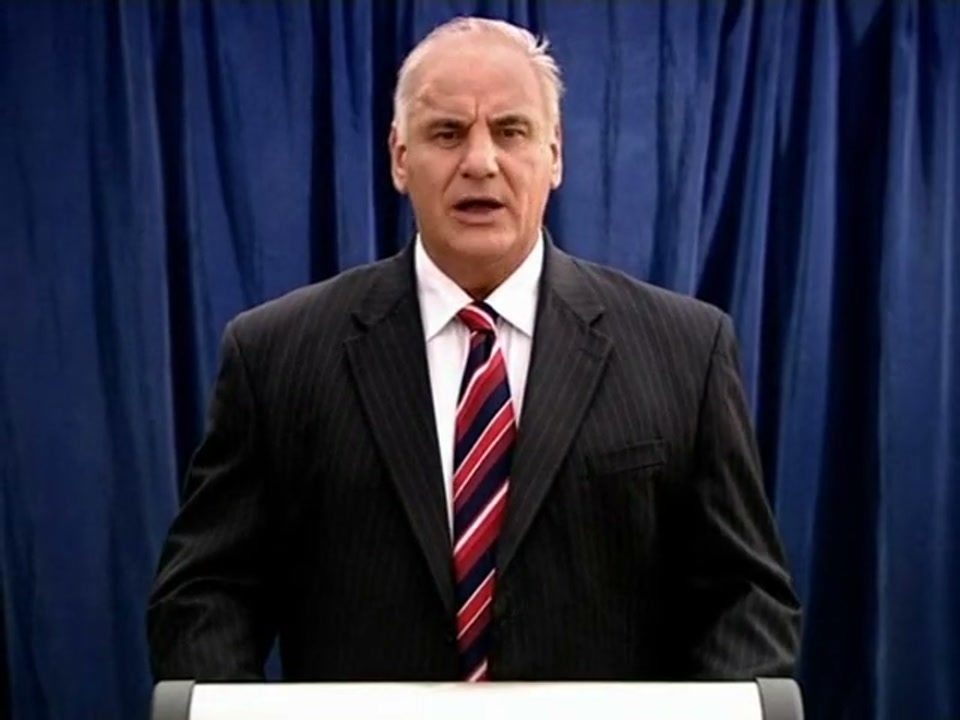
00:07 · opening The ad opens with a title card on a deep blue background, resembling an official government broadcast. -
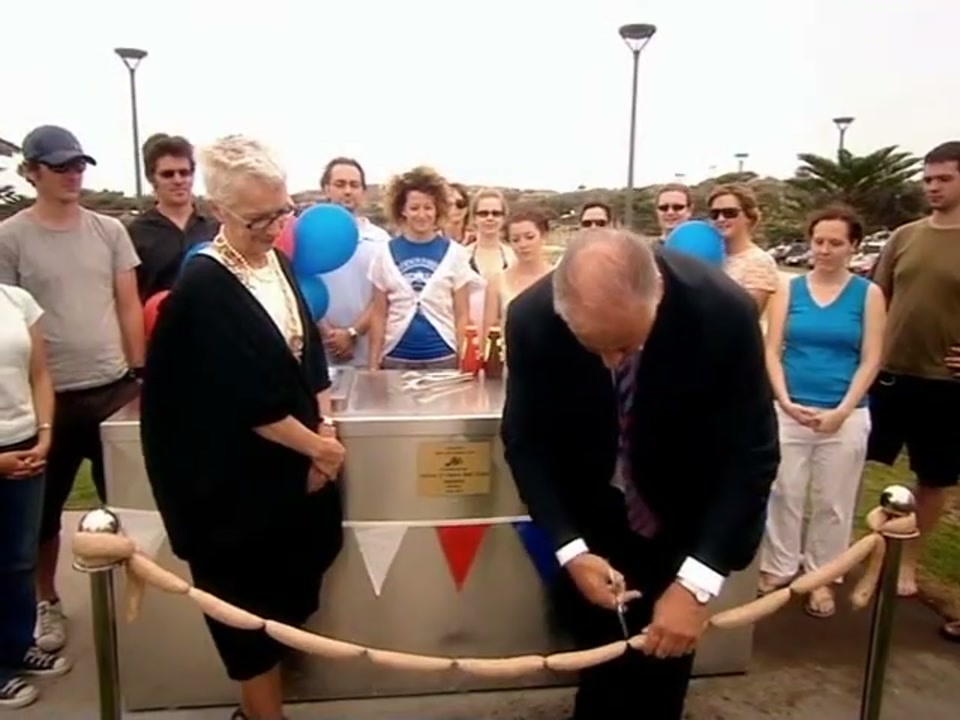
00:19 · food shot A montage begins. Kekovich, looking pensive, walks along a beach eating a lamb cutlet like an ice cream. He is then shown at a public event, cutting a "ribbon" made of sausages to open a public barbecue. -
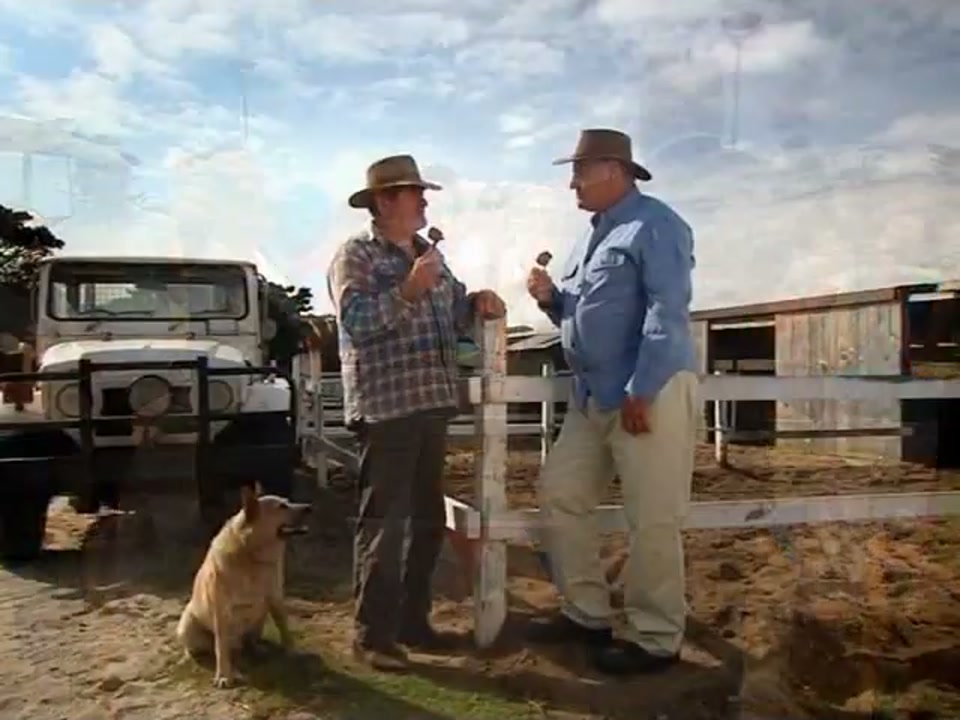
00:23 · food shot A montage begins. Kekovich, looking pensive, walks along a beach eating a lamb cutlet like an ice cream. He is then shown at a public event, cutting a "ribbon" made of sausages to open a public barbecue. -
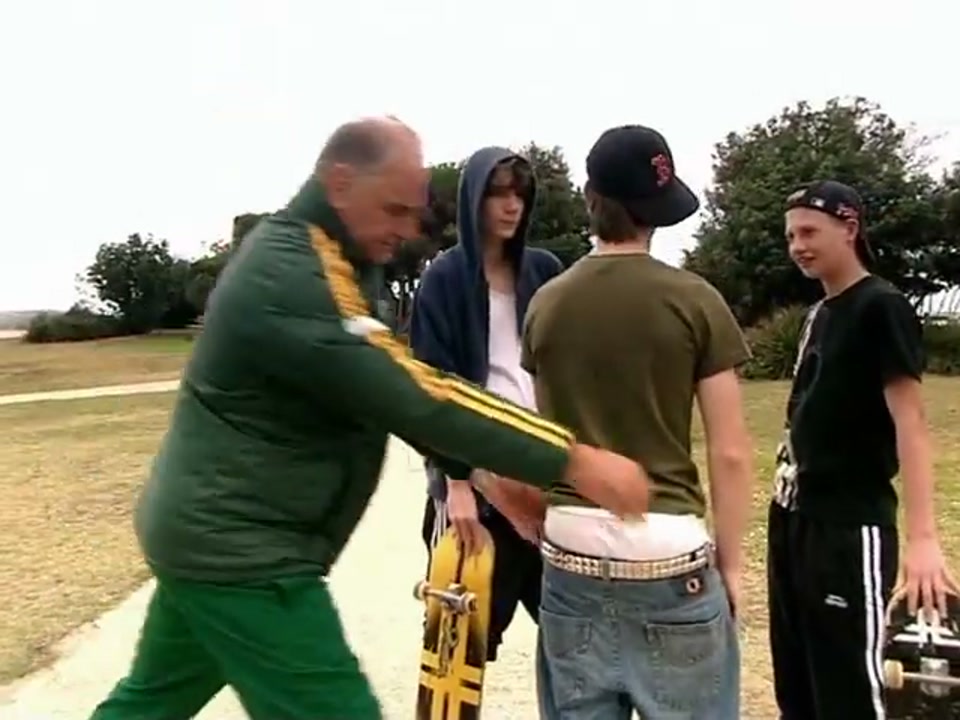
00:37 · standard Kekovich, now in a green and gold Australian tracksuit, walks purposefully with minders. He approaches a group of teenage skateboarders. -
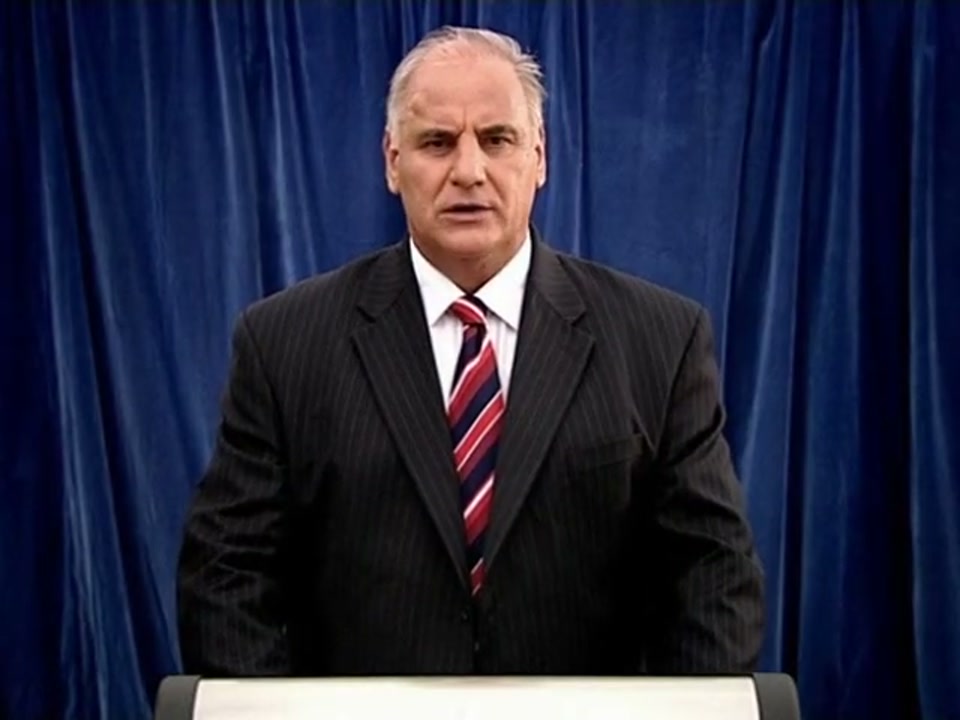
01:00 · food shot Kekovich is back at the lectern. The scene then cuts to a bumper sticker reading "I ❤️ LA," which a hand covers with a sticker of Australia shaped like a lamb chop, reading "LAMB". -
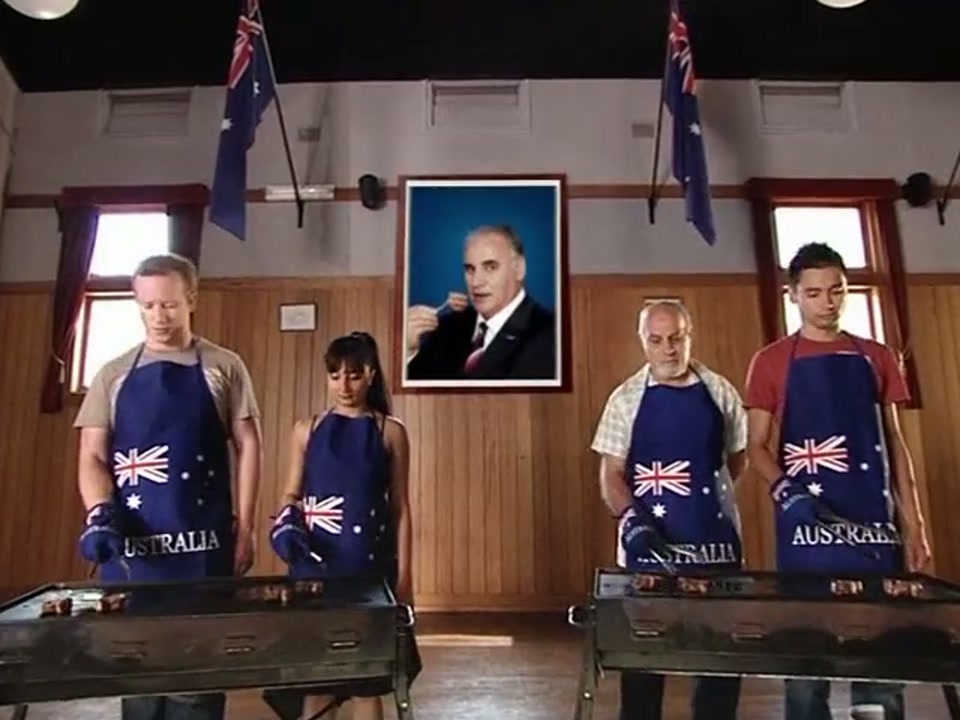
01:39 · title card Kekovich continues his speech. The on-screen text "ADP Australia Day Party" appears with a logo of the Southern Cross morphing into a lamb chop. -
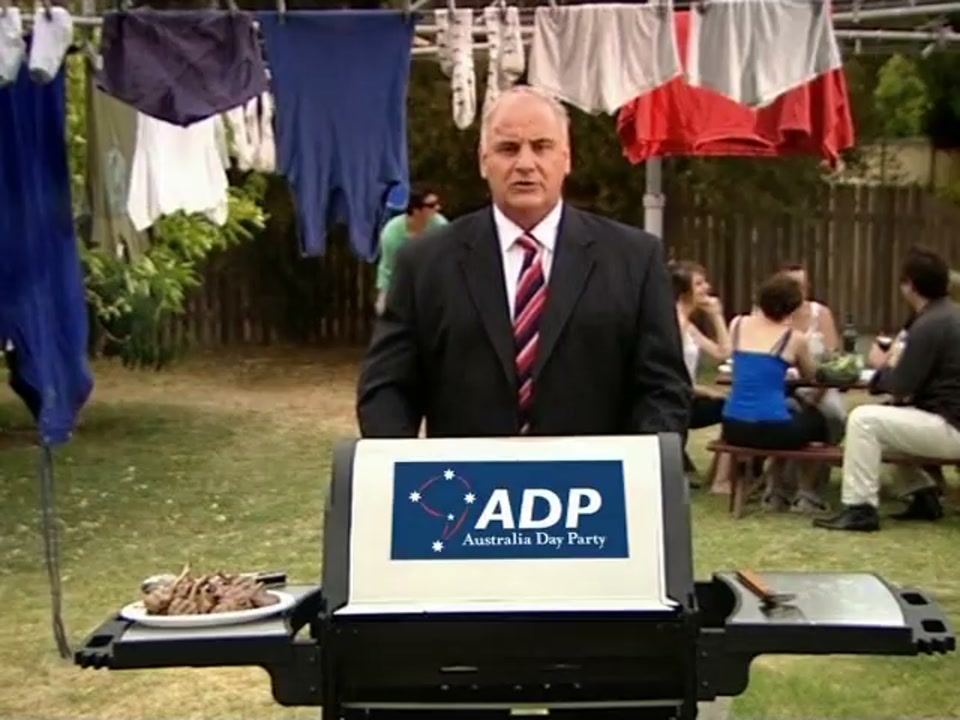
02:23 · brand frame The speech moves from the formal lectern to a quintessential Australian backyard, with a Hills Hoist clothesline and a barbecue. People are playing backyard cricket in the background. -
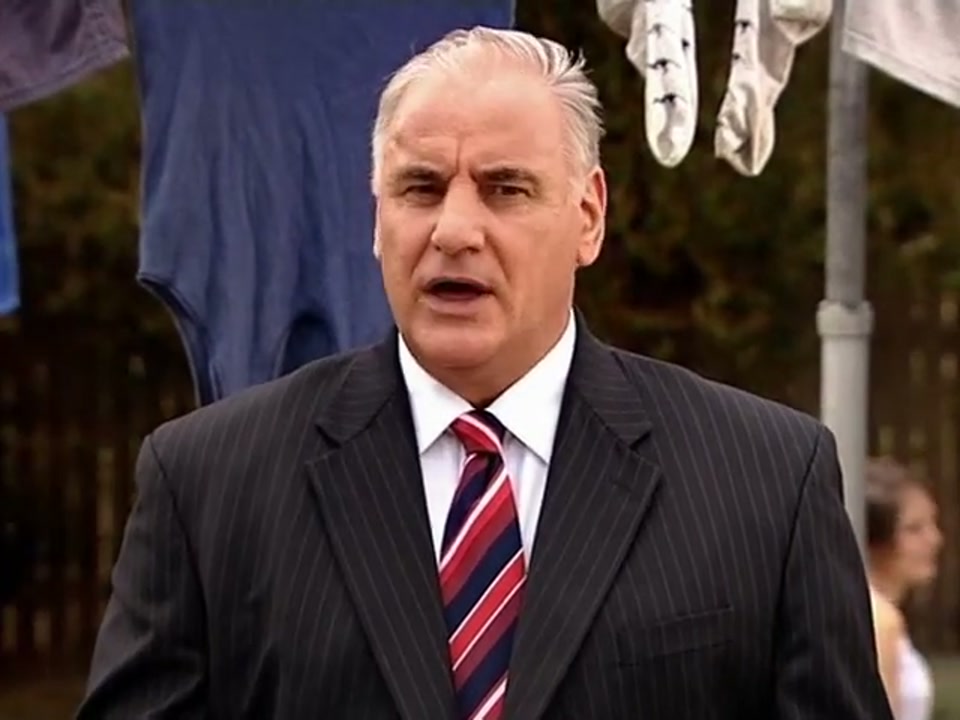
02:36 · brand frame The speech moves from the formal lectern to a quintessential Australian backyard, with a Hills Hoist clothesline and a barbecue. People are playing backyard cricket in the background.
Scene-by-scene account
Show full scene breakdown
00:00–00:15
Visuals The ad opens with a title card on a deep blue background, resembling an official government broadcast. It then cuts to Sam Kekovich, a middle-aged man in a pinstripe suit, standing seriously at a lectern against a blue curtain backdrop. The framing is tight and formal, mimicking a prime ministerial address.
Dialogue and audio (Patriotic, fanfare-style music plays) Kekovich: "In this election year, Australians are faced with a stark choice: allow un-Australianism to flourish, or take a stand against it, before it becomes as prevalent as exposed genitals on a reality television show."
On-screen text "An address to the nation by Sam Kekovich"
Meaning and context Directly observable: Kekovich, presented as a political figure, frames "un-Australianism" as a national threat and makes a satirical comparison to reality TV scandals. Likely interpretation at release: The style is a direct parody of political broadcasts, particularly those of then-Prime Minister John Howard, who often invoked nationalistic themes. The reference to "exposed genitals on a reality television show" is a likely nod to controversies surrounding the show Big Brother Australia in 2006, which involved moments of sexual explicitness that generated significant media outrage. This immediately establishes the ad's satirical and topical tone. Verification needed: Specific details of the Big Brother 2006 controversy.
00:15–00:32
Visuals A montage begins. Kekovich, looking pensive, walks along a beach eating a lamb cutlet like an ice cream. He is then shown at a public event, cutting a "ribbon" made of sausages to open a public barbecue. He socialises with farmers, a mother and baby, an elderly war veteran, and a patient in a hospital, to whom he presents a gift-wrapped rack of lamb instead of flowers.
Dialogue and audio Kekovich: "I love Australia. Her far horizons, her jewelled sea. [TXT says: "her dueled sea"] The Aussie people, and our Australian way of life. In the past year, I've travelled all over this wide brown land. I've met a few people, both young and old, and listened to what they had to say."
Meaning and context Directly observable: The visuals parody a politician's "listening tour," showing Kekovich connecting with a cross-section of Australian society. The humour comes from the constant presence of lamb, replacing traditional symbols (a ceremonial ribbon becomes sausages, a hospital gift becomes a rack of lamb). Likely interpretation at release: The dialogue directly quotes and paraphrases lyrics from Australian patriotic songs, including the national anthem "Advance Australia Fair" ("our home is girt by sea" which implies a jewelled sea) and "I Love a Sunburnt Country" ("a wide brown land"). The sausage ribbon-cutting is a visual gag playing on the trope of a politician opening a public facility, replacing it with a quintessential Australian BBQ item.
00:32–00:39
Visuals Kekovich, now in a green and gold Australian tracksuit, walks purposefully with minders. He approaches a group of teenage skateboarders. He physically pulls up the low-slung jeans of one of the boys, whose underwear is showing.
Dialogue and audio Kekovich: "I've seen firsthand the devastation un-Australianism has caused. And frankly, I've had a gutful."
Meaning and context Directly observable: Kekovich physically corrects what he deems an "un-Australian" trend (sagging pants), positioning himself as a hands-on enforcer of traditional values. Likely interpretation at release: This is a visual joke satirising moral panic over youth culture. Sagging pants were a common, imported American fashion trend often criticised by social conservatives. Kekovich's aggressive "correction" is a comically authoritarian response to a trivial issue.
00:39–01:07
Visuals Kekovich is back at the lectern. The scene then cuts to a bumper sticker reading "I ❤️ LA," which a hand covers with a sticker of Australia shaped like a lamb chop, reading "LAMB".
Dialogue and audio Kekovich: "The desecration of the Australian flag was bad enough. Imagine if people started burning lamb chops as well. An un-Australianism played a role in the greatest disaster to befall our nation since tofu: the early retirement of our greatest Olympic swimmer. Is there anything more un-Australian than those gold medal-hungry Yanks, who try to poison a big-hearted Aussie champion with the lure of Hollywood just to stop him racing? It's like Phar Lap all over again. That's the danger of too much LA, and not enough L-A-M-B."
Meaning and context Directly observable: Kekovich absurdly equates tofu and an athlete's retirement with national disasters. He blames American influence ("Yanks," "Hollywood," "LA") for luring away an Australian hero. Likely interpretation at release: This section is dense with topical and cultural references:
- "Early retirement of our greatest Olympic swimmer": This is a direct reference to swimmer Ian Thorpe, one of Australia's most celebrated athletes, who announced his surprise retirement in November 2006. The "lure of Hollywood" is a satirical exaggeration of the opportunities available to him outside of swimming.
- "Phar Lap": A legendary Australian racehorse from the 1930s who died mysteriously in the United States. His death is a cornerstone of Australian sporting folklore, often attributed to poisoning by American gangsters. Kekovich links Thorpe's "loss" to this foundational story of Australian talent being tragically undone by Americans. The topic had renewed interest in 2006 due to new scientific analysis of the horse's death.
- "I ❤️ LA / LAMB": A clear and simple visual gag contrasting Los Angeles with lamb, symbolising the choice between American culture and Australian identity.
01:07–02:11
Visuals Kekovich continues his speech. The on-screen text "ADP Australia Day Party" appears with a logo of the Southern Cross morphing into a lamb chop. He shakes hands with a butcher in his shop, where "VOTE LAMB" posters are visible. A montage of proposed "policies" follows: extraditing terrorists to fill BBQ gas bottles, a group of diverse migrants happily using barbecue tongs, and Australian cricketers creating a new "Ashes" urn from barbecue coals.
Dialogue and audio Kekovich: "...We need to throw lamb at it instead. So men and women of Australia, it's time. It's time for the Australia Day Party... Our multi-pronged lamb plan will take tax cuts off the table and dish out lamb cuts instead. Extradite the terrorists who plan gas attacks on the Aussie cricket team in London, and put their skills to good use filling barbecued gas bottles... Scrap English tests for migrants. Who cares if they use their tongue, as long as they can use their tongs!... Speaking of tests, there's one way to keep The Ashes permanently in Australia: make our own! The ashes from a good lamb barbie are a lot better than some burnt Pommy stump anyway. And reduce global warming by finding alternatives to fossil fuels to power barbies. Uranium, for example... If the koala-suit-wearing, tree-hugging, alfalfa-munching lobby has a problem with that, they can chain themselves to the nearest plane. I hear North Korea's nice this time of year."
On-screen text "ADP Australia Day Party" "VOTE LAMB" (on posters) "THE ASHES" (on the urn)
Meaning and context Directly observable: Kekovich outlines the satirical political platform of the "Australia Day Party," where all national problems are solved with lamb. Likely interpretation at release:
- "Gas attacks on the Aussie cricket team in London": This is likely a satirical exaggeration, possibly referencing general anxieties about terrorism post-7/7 London bombings, but no specific plot against the cricket team was prominent in 2006.
- "Keep The Ashes permanently in Australia": A hugely topical reference. The 2006-07 Ashes cricket series against England had just concluded on January 5, 2007, with Australia winning in a dominant 5-0 "whitewash" to regain the trophy. The ad cleverly plays on the national euphoria. "Pommy stump" is a lighthearted sledge against the English team. "Pommy" is slang for an English person.
- "Uranium... global warming... tree-hugging lobby": This directly taps into a major political debate of 2006. The Howard Government was actively promoting a debate on introducing nuclear power (using Australia's vast uranium reserves) as a solution to climate change, a move fiercely opposed by environmental groups. Kekovich's dismissive line about North Korea is a parody of the hardline rhetoric used against protestors.
02:11–03:01
Visuals The speech moves from the formal lectern to a quintessential Australian backyard, with a Hills Hoist clothesline and a barbecue. People are playing backyard cricket in the background. Kekovich delivers his final monologue, which directly parodies Martin Luther King Jr.'s "I Have a Dream" speech.
Dialogue and audio Kekovich: "...the lamb-led recovery has to start at the grassroots. Next to the Hills Hoist, with the Australia Day Party... On January 26th, all Australians should gather in backyards around the nation, throw some lamb chops on the barbie, and have an Australia Day party of their own. My fellow Australians, I have a dream that by Australia Day 2007, no Australian child will be living without a nice, juicy lamb chop. And I have a dream that on Australia Day, mung beans and lamb chops can sit together, side-by-side on the same plate—as long as it's not mine. And I have a dream that lamb can unite Australians of all colours and creeds, even hairy-legged, sandal-wearing lentil-eaters. So don't be un-Australian. Vote lamb on Australia Day. You know it makes sense. I'm Sam Kekovich."
On-screen text "ADP Australia Day Party" logo on lectern/BBQ. "votelamb.com.au" "Authorised by D. Thomason for the Australia Day Party. Spoken by S. Kekovich."
Meaning and context Directly observable: Kekovich explicitly calls for a national barbecue on Australia Day and concludes with a speech parodying a famous civil rights address to promote lamb. Likely interpretation at release:
- "Hills Hoist," "backyard cricket": These are iconic symbols of Australian suburban life, grounding the campaign in a relatable, traditional setting.
- "I have a dream": A direct and unmistakable parody of Martin Luther King Jr.'s 1963 speech. The humour comes from applying its grand, visionary rhetoric to the trivial matter of lamb versus mung beans and "lentil-eaters" (a stereotype for vegetarians). It satirises the co-opting of serious political language for minor cultural grievances.
- "votelamb.com.au": The creation of a mock campaign website furthered the political parody.
- Authorisation disclaimer: This is a legally required element for political advertising in Australia, and its inclusion is the final touch on the satire.
Verification and uncertainties
- Uncertain dialogue:
- [00:17] TXT says: “her dueled sea.” Audio is clearly: “her jewelled sea.”
- Likely TXT errors: Numerous phonetic spellings ("un-Australianism" as "Australian ISM," "Phar Lap" as "far laap"). The provided transcript is of very low quality and required significant correction against the audio.
- Uncertain identities or references:
- Confirm the specific "exposed genitals" reference from 2006 reality TV.
- Confirm there was no actual terror plot against the Australian cricket team in London in 2006 that this might be referencing. (Likely satirical invention).
- Topical claims needing release-period research:
Ian Thorpe's retirement date(Confirmed: November 2006).2006-07 Ashes results and end date(Confirmed: 5-0 victory, ended Jan 5, 2007).Details of the 2006 nuclear power debate in Australia(Confirmed: Major issue promoted by the Howard government).
- Remembered background facts requiring external verification:
Sam Kekovich's established role as the "Lambassador"(Confirmed, this was the third year of his campaign).The general association of the term "un-Australian" with the Howard government(Confirmed).