Happiness Index
2026The advertisement begins in the office of Sam Kekovich, the "Leader of Australia's Merriment & Bliss," who is outraged to learn that Australia has dropped out of the top 10 in the World Happiness Report for the first time, landing at 11th place. He tasks his team with proving to a visiting delegation of stern "International Happiness Auditors" that Australia deserves to be in the top 10. The team takes the auditors on a tour of Australia, showcasing various aspects of the Australian lifestyle, such as its beaches, wildlife, multiculturalism, and social quirks. The tour is a series of comedic mishaps and cultural misunderstandings, with the auditors remaining unimpressed by the evidence presented. The climax occurs at a large, free public barbecue, where the auditors are finally won over not by data, but by the taste of Australian lamb and the powerful sense of community it fosters. Convinced, the lead auditor signals that Australia will likely regain its top 10 status. The ad concludes with the tagline, "Share the Lamb."
Watch the advertisement
Historical and topical context
- Campaign year: 2026
- Assumed or known release period: January 2026
- Primary context year: 2025
- Likely topical context window: March 2025 - January 2026
- Confidence in those dates: High
The primary topical reference for this advertisement is the real-world release of the 2025 World Happiness Report.
Reference: Australia dropping out of the top 10 in the World Happiness Report.
Evidence in the ad: The entire premise is based on this event. Dialogue explicitly states, "Australia has dropped out of the top 10 happiest countries list for the first time ever" (00:12) and "Yep, we're 11th" (00:20).
Likely relevance at release: This was a genuine news item in the primary context year. News reports from March 2025 confirm that Australia slipped from 10th place in 2024 to 11th place in the 2025 report. The ad directly taps into this media moment, framing it with mock-seriousness as a national crisis that lamb can solve. The timing of the ad's release in January 2026 was perfect for responding to the March 2025 news.
Confidence: High
External verification needed: No
Reference: General national mood and cultural touchstones of 2025.
Evidence in the ad: The ad features numerous timeless Australian cultural references (Bunnings sausage sizzles, wheelie bin cricket, "togs," "mate," etc.) rather than specific, fleeting events from 2025. A review of major Australian news stories from 2025 shows a focus on politics (a federal election), crime, and economic issues, none of which are directly referenced in the ad's jokes.
Likely relevance at release: The ad's strength is its reliance on perennial cultural truths rather than transient news headlines (beyond the core happiness index premise). This gives it a broader, more enduring appeal.
Confidence: High
External verification needed: No
Campaign meaning
Creative premise
The campaign uses a satirical narrative in which Australia's fall from the top 10 of the World Happiness Index is treated as a national emergency. A stuffy, international auditing body is taken on a tour to "prove" Australia's happiness, not through statistics, but through a series of chaotic and humorous displays of its unique cultural identity. The premise positions lamb as the ultimate, undeniable evidence of Australian happiness, capable of overriding any formal data or cultural misunderstanding.
Message
Explicit message:
- Australia dropped to 11th on the World Happiness Report in 2025.
- Australia has unique cultural traits, including free healthcare, a deep Indigenous history, a casual approach to life, and a love of public barbecues.
- The campaign's tagline is "Share the Lamb."
Strongly implied message:
- True national happiness is not found in economic data or international rankings, but in shared experiences, community, and togetherness.
- Lamb is the quintessential Australian social lubricant, the key ingredient that brings diverse people together and creates genuine happiness.
- Australian culture, with all its quirks and contradictions, is a source of pride and is superior to the sterile, bureaucratic methods of other nations.
Tentative interpretation:
- The ad subtly critiques a growing global trend of quantifying every aspect of life, suggesting that the most important things—like mateship and community—are immeasurable.
- There's a gentle mockery of other countries (Luxembourg, Egypt, Sweden, Finland, New Zealand, the UK) to reinforce a sense of Australian exceptionalism.
Role of lamb
Lamb functions as both the plot device and the hero of the story. Initially, it's a comedic prop on Sam Kekovich's desk. Throughout the tour, it's absent, highlighting the failure of other cultural elements to impress the auditors. In the climax, lamb becomes the magic bullet. It is the physical embodiment of "100% real Australian happiness" (02:28), capable of inducing a quasi-spiritual experience in the auditor. Lamb is therefore positioned not just as a food, but as the essential catalyst for the ad's core values: togetherness, community, and authentic Australian joy.
Worldview evidence
National Pride & Competitiveness
Classification: Explicit
Evidence: 00:25 - "Australia's the best country on Earth! And when there's a competition, we're in it to win it!"
Meaning at release: This line explicitly states a core theme. The entire ad satirises Australia's desire to be #1, even in subjective rankings.
Larrikinism & Anti-authoritarianism
Classification: Strongly implied
Evidence: The entire premise of challenging the "International Happiness Auditors" with sausage sizzles and beach trips. The final joke dismissing Canberra (02:58).
Meaning at release: The ad celebrates a distinctly Australian anti-authoritarian streak, favouring informal, grassroots culture over formal institutions and bureaucracy. True happiness and identity come from the people, not the government or foreign experts.
Multiculturalism as a Competitive Sport
Classification: Strongly implied
Evidence: 01:25 - Celebrating the "world's oldest living continuous cultures" is immediately followed by the competitive sledge, "Sucked in, Egypt!"
Meaning at release: The ad proudly showcases Australia's multicultural identity, including its First Nations heritage, but frames it with the same jingoistic, competitive humour used elsewhere, implying even diversity is something Australia can "win" at.
The Sanctity of the Barbecue
Classification: Strongly implied
Evidence: 02:10 - The tour culminates at a "national network of free, public barbecues," which ultimately convinces the auditors when all else fails.
Meaning at release: The BBQ is presented as the ultimate expression of Australian egalitarianism and community ("Nothing makes us happier than being together," 02:43). It's the sacred site where the sacrament of lamb is shared and national unity is forged.
Humour, tone and satire
- Tone: The tone is satirical, bombastic, and affectionately self-deprecating. It's simultaneously proud and mocks that same pride.
- Principal joke mechanisms:
- Juxtaposition: Placing the formal (auditors, government department) against the informal (BBQ on a desk, togs at the shops).
- Exaggeration: Treating a drop in a social science ranking as a national security-level crisis.
- Irony & Understatement: Presenting clear disasters (dangerous animals, underwhelming landmarks) as points of pride, like offering "free healthcare" as the upside of a venomous platypus attack.
- Targets of satire:
- Primary: Australia's own cultural anxieties, its obsession with its global standing, and its quirky national habits.
- Secondary: The bureaucratic, data-driven approach of international organisations and the perceived seriousness of other (mostly European) nations.
- Affectionate parody versus genuine criticism: The ad is almost entirely affectionate parody. It laughs with Australians about their national character, not at them. The criticism of other nations is playful rivalry, not genuine malice.
Campaign evidence summary
Core message
True Australian happiness isn't measured by international rankings or economic data, but is found in the unique, quirky, and communal aspects of its culture, with the sharing of lamb at a barbecue being the ultimate expression of this joyous national spirit.
Values supported by this ad
- Community and togetherness ("mateship")
- Irreverent, anti-authoritarian humour (larrikinism)
- National pride and a competitive spirit
- A casual, outdoor-oriented lifestyle
- Pragmatism (e.g., free healthcare)
- Inclusive, multicultural identity
Role of lamb
Lamb is the hero and central unifying symbol. It represents the authentic, tangible source of Australian happiness that transcends bureaucratic measurement, ultimately serving as the key to national redemption and bringing all Australians together.
Most important topical or historical elements
- The ad is a direct, satirical response to Australia dropping to 11th place in the 2025 World Happiness Report.
- It marks the continuation of Sam Kekovich's role as the "Lambassador," a figure in MLA advertising since 2005.
Uncertainties
- The significance, if any, of the German-like flag in Sam Kekovich's office. It may be a prop error or an obscure joke.
Themes and connections
This advertisement belongs to Era 5 — Social Fragmentation and Platform Critique.
Keyframe gallery
12 representative frames, in chronological order.
-

00:10 · opening The scene opens in a stately, wood-panelled office. Three large windows look out onto a tree-lined street. An older man in a suit, Sam Kekovich, sits at a large wooden desk, looking sternly at paperwork. -
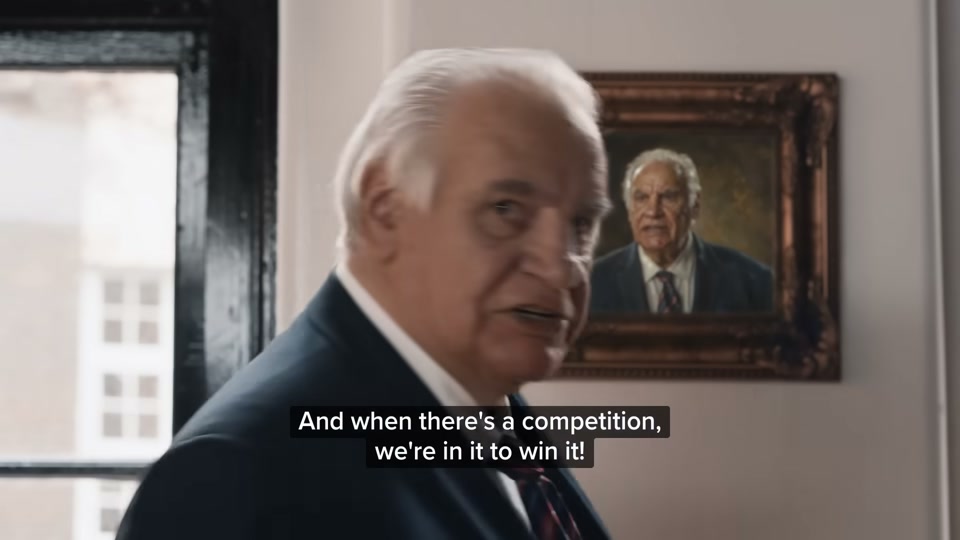
00:28 · reveal Kekovich paces his office angrily, looking at a portrait of himself. His aides look worried. In the background, a taxidermied kangaroo wearing boxing gloves is visible. -
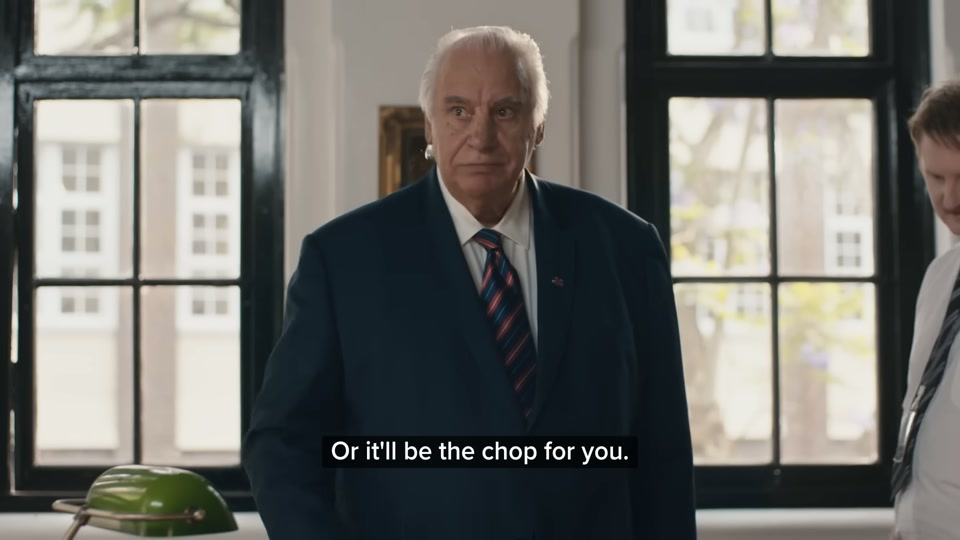
00:36 · reveal Kekovich paces his office angrily, looking at a portrait of himself. His aides look worried. In the background, a taxidermied kangaroo wearing boxing gloves is visible. -

00:43 · reveal Kekovich paces his office angrily, looking at a portrait of himself. His aides look worried. In the background, a taxidermied kangaroo wearing boxing gloves is visible. -
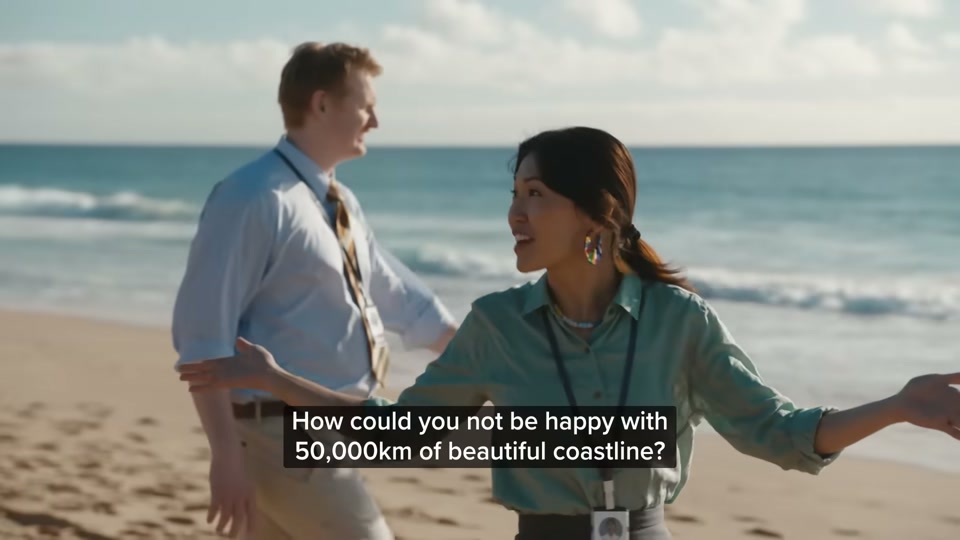
00:53 · standard The scene shifts to a vast, beautiful, and empty beach at sunrise. The two Australian aides walk with the three auditors. The auditors look unimpressed. -
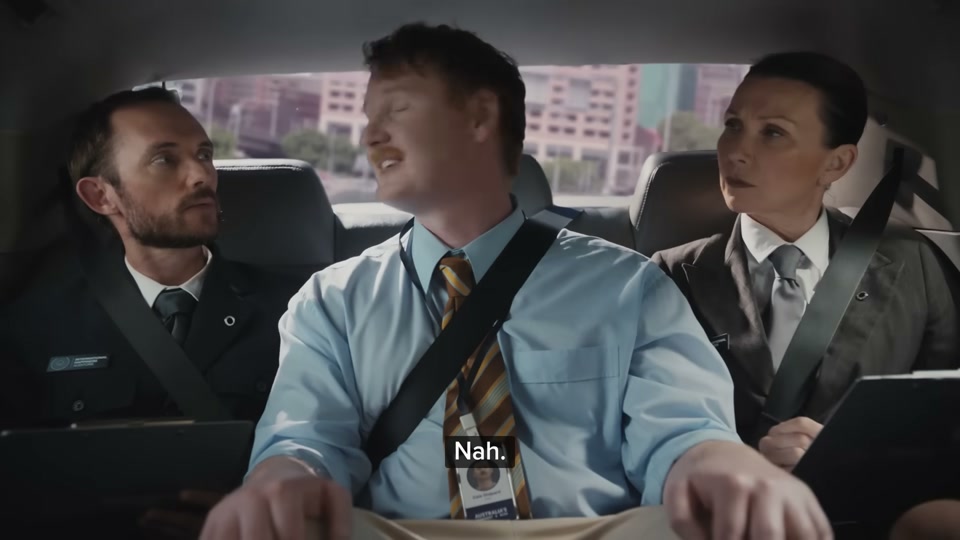
01:07 · standard The group is now in the back of the car, driving through a city. They then drive through a lush, green forest. Next, they are by a creek, where a park ranger is showing a male auditor a platypus. -
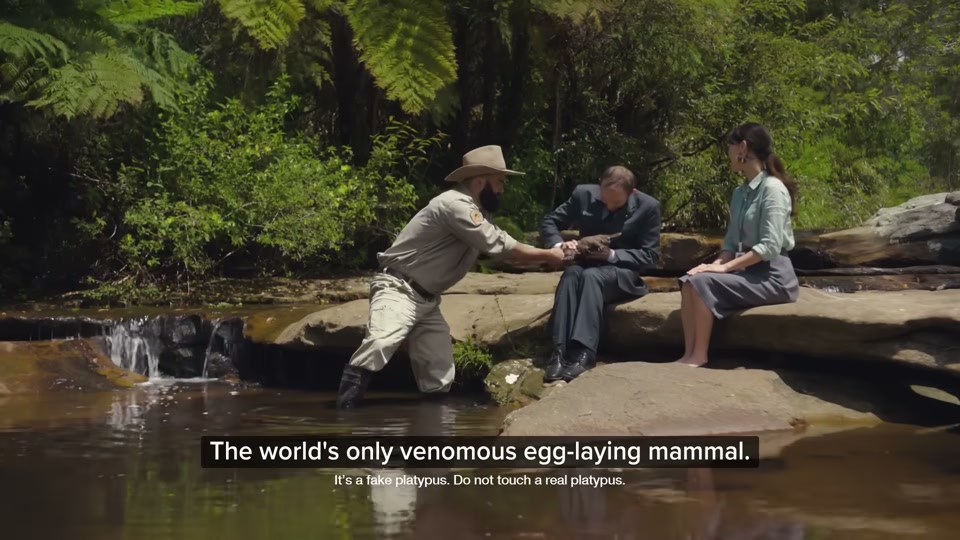
01:12 · standard The group is now in the back of the car, driving through a city. They then drive through a lush, green forest. Next, they are by a creek, where a park ranger is showing a male auditor a platypus. -
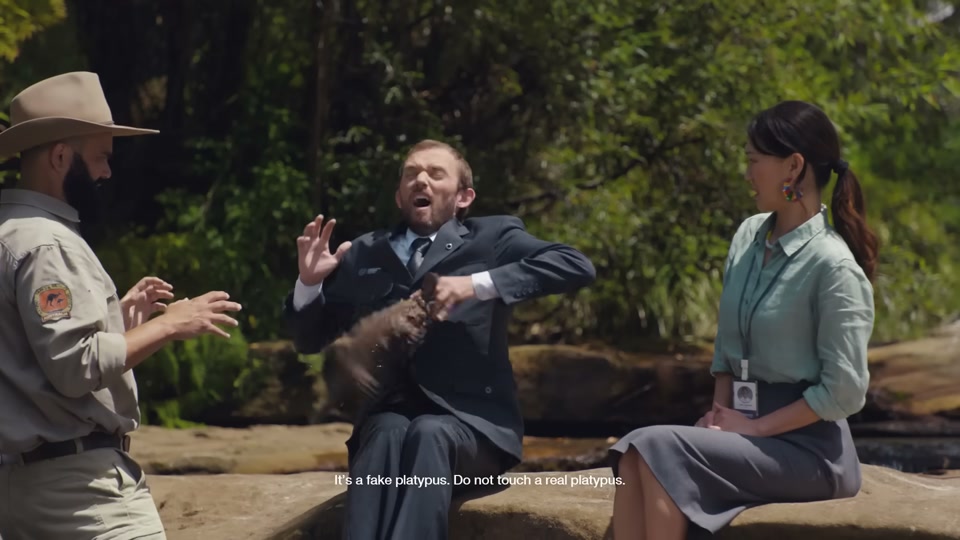
01:17 · standard The group is now in the back of the car, driving through a city. They then drive through a lush, green forest. Next, they are by a creek, where a park ranger is showing a male auditor a platypus. -
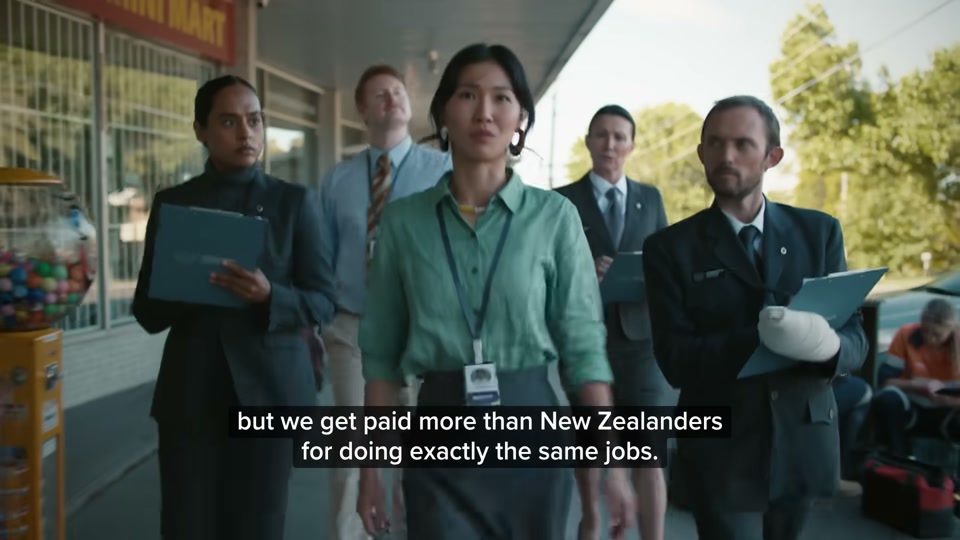
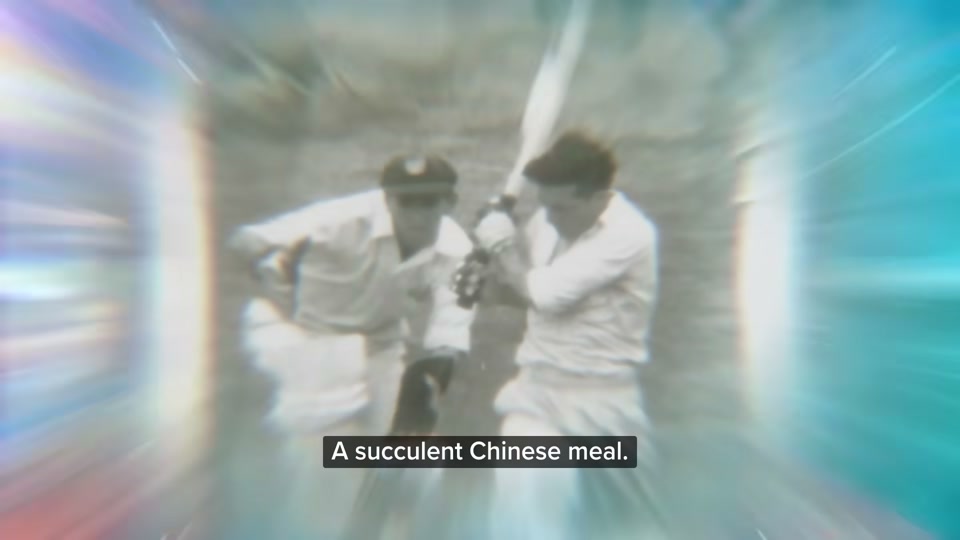
01:58 · food shot A rapid montage of Australian cultural scenes: - A classroom where an Indigenous elder is speaking. - The auditors in a car in a suburban setting. -
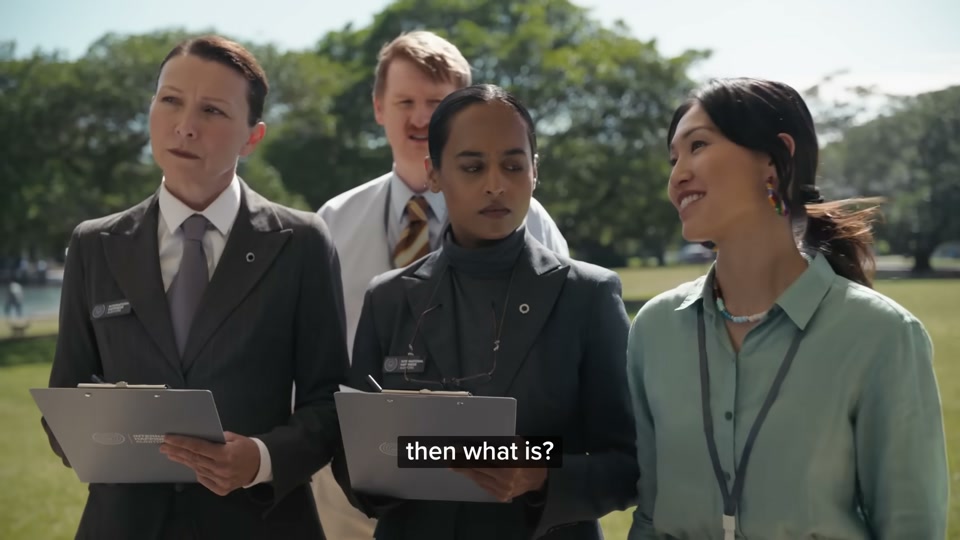
02:23 · brand frame The group arrives at a large, sunny park by the water, filled with a diverse crowd of people at a massive public barbecue. Sam Kekovich is at the centre, presiding over a large public grill laden with lamb. -
02:36 · brand frame The group arrives at a large, sunny park by the water, filled with a diverse crowd of people at a massive public barbecue. Sam Kekovich is at the centre, presiding over a large public grill laden with lamb. -
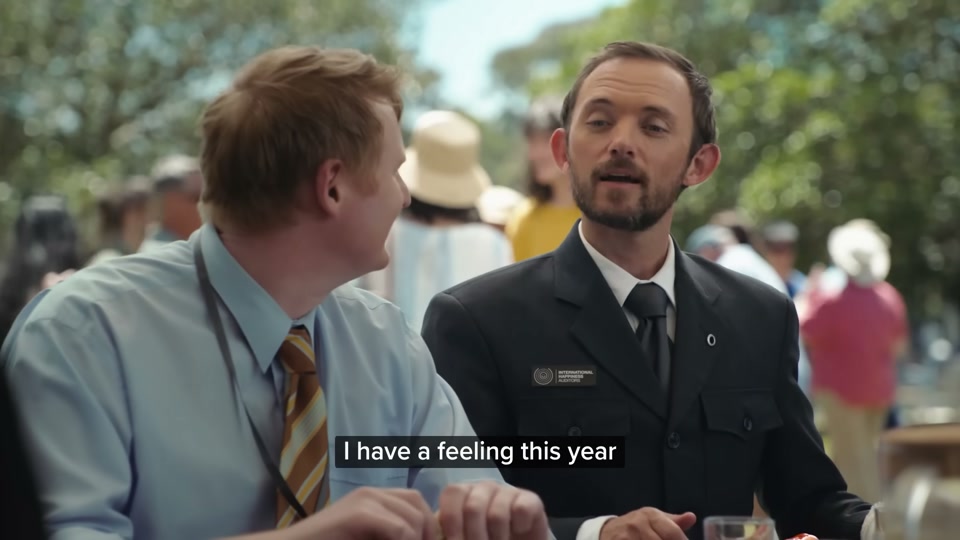
02:49 · brand frame The group arrives at a large, sunny park by the water, filled with a diverse crowd of people at a massive public barbecue. Sam Kekovich is at the centre, presiding over a large public grill laden with lamb.
Scene-by-scene account
Show full scene breakdown
00:00:00 - 00:00:21
Visuals
The scene opens in a stately, wood-panelled office. Three large windows look out onto a tree-lined street. An older man in a suit, Sam Kekovich, sits at a large wooden desk, looking sternly at paperwork. On his desk is an electric grill with lamb cutlets cooking on it. Flags stand behind him, including the Australian National Flag, the Aboriginal Flag, and the Torres Strait Islander Flag. A fourth flag appears to be the German flag. A young woman enters through a door with frosted glass.
Dialogue and audio
[Dramatic, cinematic music]
Kekovich (gruffly): What is it? I'm very busy.
Female aide 1 (hesitantly): Sir, we thought you should know.
Older female aide (interrupting): Know what? He's very busy.
Female aide 1: Australia has dropped out of the top 10 happiest countries list. For the first time... ever.
Kekovich (looks up in shock): That can't be right!
Older female aide: Is this real?
Male aide (peeking through the door, holding a newspaper): Yep. We're 11th. Look it up.
On-screen text
- (00:01) [Year counter rapidly scrolls, landing on] 2025
- (00:04) [On frosted glass door] Leader of Australia's Merriment & Bliss
- (00:06) [Desk nameplate] I'M SAM KEKOVICH
- (00:20) [Newspaper headline] THE AUSTRALIS REVIEW / AUSTRALIA OUT OF TOP 10 HAPPIEST COUNTRIES LIST
Meaning and context
Directly observable: The ad establishes its central conflict: Australia has fallen to 11th place in a global happiness ranking, a fact reported in a fictional newspaper, "The Australis Review." This event is treated as a national crisis within the fictional department of "Australia's Merriment & Bliss," headed by long-time Lamb "Lambassador" Sam Kekovich.
Likely interpretation at release: The scene satirises nationalistic pride and Australia's competitive nature by treating a subjective social science metric like a high-stakes sporting result. The grand title and office contrast humorously with Kekovich grilling lamb on his desk, immediately setting a tone of irreverence. The premise directly references real-world news from March 2025, when Australia was reported to have dropped to 11th place in the World Happiness Report.
Verification needed: The identity of the fourth flag (resembling the German flag) and its potential significance.
00:00:21 - 00:00:51
Visuals
Kekovich paces his office angrily, looking at a portrait of himself. His aides look worried. In the background, a taxidermied kangaroo wearing boxing gloves is visible. The scene transitions to the exterior of the building, a stately brick establishment, where a black sedan with a small light-blue flag pulls up. The car door reads "INTERNATIONAL HAPPINESS AUDITORS." A team of three stone-faced auditors emerges and is greeted awkwardly by Kekovich's aides.
Dialogue and audio
Older female aide: We're not behind the Poms, are we?
Female aide 1: God no.
Kekovich (pacing): How can any country be happier than Australia? Australia's the best country on Earth! And when there's a competition, we're in it to win it!
Older female aide (to junior aides): When those happiness auditors come next year, you show them we're a top 10 happy country.
Kekovich (threateningly, holding tongs): Or it'll be the chop for you. [Gestures with lamb chop on tongs] Not the succulent lamb kind.
Male aide: Got it. Oh, yes, boss.
[Scene change with "2026" on screen]
Male Aide (to auditors): G'day.
Auditor 1 (female, terse): Formal greetings. How was your flight?
Male Aide: Long...
Auditor 2 (female, stern): Please begin.
Female aide 1 (smiling brightly): Nothing would make us happier!
On-screen text
- (00:41) [Overlay] 2026
- (00:44) [On car door] INTERNATIONAL HAPPINESS AUDITORS
Meaning and context
Directly observable: The narrative jumps from 2025, when the bad news was delivered, to 2026 for the auditors' visit. Kekovich frames the task as a competition to be won. The auditors are depicted as stern, serious, and foreign, creating a clear cultural contrast with the more casual Australian aides.
Likely interpretation at release: This section continues the satire of treating happiness as a quantifiable, competitive ranking. The "chop for you" joke is a classic pun. The kangaroo with boxing gloves is a well-known symbol of Australia's "fighting spirit." The contrast between the stiff auditors and the informal Australian "G'day" highlights cultural differences that become a running joke.
00:00:51 - 01:02
Visuals
The scene shifts to a vast, beautiful, and empty beach at sunrise. The two Australian aides walk with the three auditors. The auditors look unimpressed. The camera then shows a series of warning signs on the beach for "DANGEROUS CURRENT," sharks, and other hazards.
Dialogue and audio
Female aide 1: How could you not be happy with 50,000 kilometres of beautiful coastline?
Male aide: You could say we're girt by it. [TXT says: "good for it"]
Auditor 2 (holding a clipboard): Can one swim here?
[The aides glance at the warning signs, looking uncomfortable]
Female aide 1 (forcing a smile): At your own peril! Let's move on.
Meaning and context
Directly observable: The aides present Australia's natural beauty (beaches) as a key reason for happiness. This is immediately undercut by visual evidence of numerous natural dangers, which the auditors note.
Likely interpretation at release: This is a joke based on self-deprecation. While proud of its natural beauty, Australia has an international reputation for dangerous wildlife and surf conditions. The line "girt by it" is a pun on the second line of the Australian national anthem, "Our home is girt by sea." The auditors' deadpan, literal approach contrasts with the Australians' attempt to gloss over the dangers.
1:03 - 1:22
Visuals The group is now in the back of the car, driving through a city. They then drive through a lush, green forest. Next, they are by a creek, where a park ranger is showing a male auditor a platypus. The auditor holds the (fake) platypus, which then "attacks" him, causing him to scream. The final shot is in the back of an ambulance with the injured auditor, his hand bandaged, while a paramedic checks his blood pressure.
Dialogue and audio Male aide (in car): You know what makes us happy? The Sydney Opera House. We should show you that. Male auditor: Your nation enjoys opera? Male aide: [Awkward laugh] Female aide 1 (by creek): And how could you not be happy holding a platypus? Auditor 2 (reading from clipboard): The world's only venomous egg-laying mammal. Male aide: Yeah, nah, mate, I wouldn't hold— Male auditor: [Screams as the platypus "stings" him] Female aide 1 (in ambulance, cheerfully): We also have free healthcare! Male aide: You should write that down!
Meaning and context Directly observable: The tour continues to backfire. The attempt to showcase high culture (the Opera House) reveals a lack of interest in opera itself. The "cute" native animal (platypus) is revealed to be venomous, leading to injury.
Likely interpretation at release: This sequence uses classic comedic bait-and-switch. The Opera House joke plays on the idea that Australians are proud of the building's architecture but less so of its intended purpose. The platypus scene again leans into the "dangerous Australia" trope. The punchline, "We also have free healthcare," pivots the disaster into a point of national pride, highlighting Australia's universal healthcare system (Medicare) as a genuine, if ironically presented, source of wellbeing.
01:22 - 02:10
Visuals A rapid montage of Australian cultural scenes:
- A classroom where an Indigenous elder is speaking.
- The auditors in a car in a suburban setting.
- A backyard with a Hills Hoist clothesline and a wheelie bin with cricket stumps painted on it.
- The car driving past a "Big Banana" (or similar "Big Thing").
- A sausage sizzle outside a hardware store (like Bunnings).
- Two construction workers (one a New Zealander).
- A man in "togs" (speedo-style swimsuit) and thongs walking into a bakery.
Dialogue and audio Female aide 1: Another reason we're happy is 'cause we're made up of many different cultures. Indigenous Elder: ...including the world's oldest living continuous cultures. Male aide: Sucked in, Egypt! ...Respectfully. [Montage of rapid-fire reasons for happiness] Female aide 1: We've got world-class Summer Olympians! Male aide: And well-meaning Winter Olympians. Female aide 1: ...backyard water parks... sporting equipment that doubles as bins... Male aide: You can call someone your mate even if they're not your mate. Female aide 1: And all our animals come with pockets! Male aide: And we've got giant monuments to fruit! Female aide 1: And hardware stores where sausages outsell tools! Man eating sausage: I didn't know they sold tools. Female aide 1: ...we get paid more than New Zealanders for doing exactly the same jobs. NZ worker: I'm 19 to 35% happier here. Female aide 1: And Sweden has saunas, but we've got Townsville! And Finland might enjoy unlimited parental leave, but can they pop down to the shops in their togs?
Meaning and context Directly observable: The aides bombard the auditors with a rapid-fire list of uniquely Australian cultural touchstones presented as sources of happiness. These range from the profound (ancient Indigenous culture) to the mundane and quirky (backyard cricket, "Big Things," sausage sizzles).
Likely interpretation at release: This is the core of the ad's cultural argument. It's a comedic list of what really constitutes happiness in Australia, in contrast to the formal metrics of the Happiness Index. The jokes rely on shared cultural knowledge:
- "Sucked in, Egypt!": A jingoistic, competitive celebration of the depth of Indigenous Australian history.
- "Well-meaning Winter Olympians": A gentle jab at Australia's limited success in winter sports compared to its summer dominance.
- Wheelie bin stumps/Bunnings sausage sizzle: Iconic elements of suburban Australian life.
- "Animals come with pockets": A childlike description of marsupials.
- Pay vs. New Zealand: A common point of trans-Tasman rivalry.
- "Togs at the shops": A classic sign of Australia's casual, beach-adjacent lifestyle, considered normal in some areas but strange elsewhere.
02:10 - 03:02
Visuals
The group arrives at a large, sunny park by the water, filled with a diverse crowd of people at a massive public barbecue. Sam Kekovich is at the centre, presiding over a large public grill laden with lamb. People are socialising, eating, and passing around plates of lamb chops and cutlets. The stern auditors observe, still taking notes. Kekovich approaches the injured male auditor and offers him a lamb cutlet on a pair of tongs. The auditor eats it and has a psychedelic, euphoric flashback montage of Australian imagery (the Twelve Apostles, Ramsay Street sign, old ads). He emerges enlightened. He and the other auditors finally smile.
Dialogue and audio
Female aide 1: Then, there's these... a national network of free, public barbecues. Kekovich: You wouldn't get that in Luxembourg. Male aide: If that's even a real country. Female aide 1: If this isn't top-ten happiness stuff, then what is? Male auditor: As I've explained many times, the list is based on complex economic— [Kekovich shoves a lamb cutlet into the auditor's mouth] Kekovich: Enjoy the taste of 100% real Australian happiness. [Psychedelic music and sound montage of classic Australian clips] Male auditor (transformed, holding a cutlet): Where did all these people come from? Female aide 1 (serving lamb): Nothing makes us happier than being together. And nothing brings us together like lamb. Male aide (to auditor): So, are we a top-ten happy country? Male auditor: I have a feeling this year that you will make the cut. [winks] Kekovich (yelling to the crowd): Just eat some lamb! Male aide (last line): Oh, we should show you Canberra! ...Actually, nah.
On-screen text
- (02:56) Share the Lamb
- (02:57) 100% AUSTRALIAN
Meaning and context
Directly observable: The ad's climax argues that the true source of Australian happiness is communal gathering, facilitated by lamb and public barbecues. This shared experience transcends the auditors' "complex economic" models. The taste of lamb literally provides the auditor with an epiphany, convincing him of Australia's worthiness.
Strongly implied message: The ad positions lamb as the essential catalyst for Australian unity and happiness. It argues that intangible cultural values (mateship, community, sharing food) are more important than the formal metrics used by international bodies. The final joke dismissing a trip to Canberra (Australia's capital city) reinforces the idea that true Australian culture is found in its everyday life and people, not in its political centres.
Verification and uncertainties
- The first advertisement in the corpus to prominently display the Aboriginal and Torres Strait Islander flags in Kekovich's office. First Nations peoples remain absent as protagonists across the corpus.
- Uncertain dialogue: The line "You could say we're girt by it" (00:56) is mis-captioned in the supplied TXT as "good for it." The audio strongly supports "girt by it," a pun on the national anthem.
- Unclear on-screen text: The name of the newspaper is "The Australis Review" (00:20), which is a fictional publication.
- Uncertain identities or references: The specific identity of the fourth flag in the opening scene is unclear.