The Comments Section
2025The advertisement begins with two dog groomers admiring their work on a small, fluffy white dog with a perfectly spherical haircut. When they share a photo online, they are transported into a massive stadium labeled "THE COMMENTS SECTION," where a crowd personifies the varied and increasingly argumentative reactions to the post. The on-screen text confirms the dialogue is sourced from real online comments.
The debate rapidly spirals from the dog's haircut to renewable energy, conspiracy theories about a flat Earth, AI-generated images, the proper way to make tea, and a viral dance. The arguments become increasingly heated and absurd, spreading from the stadium to a wind farm, to outer space, and a beach. Throughout the chaos, a few individuals try to inject reason, pointing out that the content isn't real, but they are shouted down.
The escalating division is finally interrupted by long-running Lambassador Sam Kekovich, who appears with a barbecue. He declares an end to the online bickering, yelling for everyone to "Get out of the comments and into the cutlets!" The entire crowd joyfully abandons the stadium to join a massive, harmonious outdoor barbecue. The ad concludes with the message that people are nicer in real life than online and that sharing lamb is the way to unite.
Watch the advertisement
Historical and topical context
Campaign year: 2025 Assumed or known release period: January 2025 Primary context year: 2024 Likely topical context window: July 2024 to January 2025 Confidence in those dates: High, based on the established annual release schedule of MLA summer campaigns.
The advertisement appears to be a direct response to the increasingly polarised and toxic nature of public discourse, particularly on social media, which was a major feature of the national and global mood in 2024.
Reference: Pervasive online arguments and "culture wars." Evidence in the ad: The entire premise of the ad is a literalisation of a toxic online comment section, where any topic, no matter how trivial, becomes a source of intense division (00:08-2:12). Likely relevance at release: By late 2024, social media platforms were widely seen as amplifiers of division. Debates over politics, social issues, and even minor cultural disagreements frequently descended into hostility. The ad satirises this by showing arguments over dog grooming, tea-making, and flat-earth theories with the same intensity as debates on the environment. This reflects a public weariness with constant online conflict. Confidence: High External verification needed: No
Reference: Artificial Intelligence (AI) generated content. Evidence in the ad: A commenter dismisses a picture of the flat Earth as potential AI (1:02), before another points to an impossibly muscular man and declares, "No, that's AI" (1:03). The end card also jokingly refers to an "AI Kochie". Likely relevance at release: Throughout 2023 and 2024, AI image and video generators (like Midjourney, DALL-E, and Sora) became incredibly sophisticated and widely accessible. This led to a mainstream conversation about what is "real" online, with AI-generated images frequently causing confusion and debate. The ad's reference is a very timely comedic nod to this widespread technological anxiety. Confidence: High External verification needed: No
Reference: Anonymous Trolls and "Keyboard Warriors." Evidence in the ad: A character in a black balaclava and sunglasses is shown making vicious comments (1:36) and is immediately identified by another character as a "keyboard warrior" (1:40). Likely relevance at release: The concept of the anonymous "troll" or "keyboard warrior" has been part of internet culture for years, but the ad's visual representation gives it a potent, satirical form. It speaks to the common frustration with individuals who use anonymity to spread negativity and abuse without consequence. Confidence: High External verification needed: No
Campaign meaning
Creative premise
The campaign personifies the chaotic, absurd, and toxic nature of online comment sections by imagining them as a physical stadium where people shout real internet comments at each other. This escalating spiral of digital division is then contrasted with the simple, unifying power of a real-world Australian lamb barbecue.
Message
Explicit message:
- The dialogue in the film is based on 100% real online comments (00:25).
- People are generally nicer in real life than they are online (2:56).
- The solution to online division is to "eat some lamb" (3:04) and "Share the Lamb" (3:06).
Strongly implied message:
- Online discourse has become divorced from reality, turning trivial matters into toxic battles and preventing meaningful connection.
- Constantly arguing online is unproductive and exhausting; true community is found in face-to-face interaction.
- The quintessential Australian act of a lamb barbecue is the antidote to digital-age division and a way to reaffirm a positive, shared national identity.
Tentative interpretation:
- The ad suggests a weariness with the "culture wars" and a longing for a return to a more unified, less politically-charged sense of community.
Role of lamb
Lamb functions as the deus ex machina of the story. It is the great unifier and the symbol of authentic, real-world connection. When introduced at the height of the conflict (2:16), its aroma and taste instantly break the spell of online rage. Lamb is positioned not just as a food product, but as the solution to societal division and the catalyst for bringing people "out of the comments and into the cutlets"—from the toxic digital world to the harmonious real one.
Worldview evidence
Real-world connection is superior to digital life
Classification: Explicit Evidence: The entire narrative structure contrasts the miserable, argumentative stadium ("The Comments Section") with the joyful, united barbecue in the park. The line "I think everyone's a lot nicer in real life than we are online" (2:56) states this directly. Meaning at release: This taps into a widespread sentiment of digital fatigue and a desire for more authentic, face-to-face human connection after years of increasing online immersion.
A shared meal can bridge any divide
Classification: Strongly implied Evidence: The introduction of barbecued lamb instantly resolves all the complex and absurd arguments that have been escalating for over two minutes (2:16 onwards). People who were mortal enemies moments before are seen happily sharing food (2:43). Meaning at release: This reinforces a foundational belief in Australian culture (and many others) about the social power of sharing food. The barbecue is presented as the ultimate forum for reconciliation, a secular sacrament that washes away conflict.
National identity is found in simple, shared pleasures
Classification: Strongly implied Evidence: The ad dismisses a huge range of divisive modern debates (environmentalism, conspiracy theories, identity) as noise. The thing that finally "unites us" is not a grand idea but the simple, sensory pleasure of a lamb barbecue (2:12-2:35). Meaning at release: The ad proposes that true "Australianness" is not about winning arguments or adhering to a specific ideology, but about participating in shared, down-to-earth rituals. It positions lamb as central to this identity.
Humour, tone and satire
- Tone: The ad's tone is epic and satirical, starting small and escalating to a global, then cosmic, scale before returning to a simple, human resolution. The music shifts from light and curious to chaotic and aggressive, then finally to triumphant and warm.
- Principal joke mechanisms:
- Literalism: The core joke is making the abstract "comment section" a physical place.
- Escalation and Absurdity: The arguments spiral from a dog's haircut to the shape of the planet in under a minute (00:08-00:58).
- Satire and Parody: The ad satirises numerous online archetypes: the sanctimonious commenter, the conspiracy theorist, the "well actually" guy, the spammer, and the anonymous troll.
- Meta-humour: The ad acknowledges it is using "100% real comments" and ends with a character hoping the ad itself will receive nice comments, breaking the fourth wall.
- Targets of satire: The primary target is the culture of online commentary itself—its toxicity, absurdity, and disconnection from reality. It satirises everyone who gets caught up in it, suggesting we are all guilty of participating in this madness to some degree. The criticism is broad rather than aimed at a specific political group.
Campaign evidence summary
Core message
Online discourse has become a toxic and divisive force that separates us. We should reject these pointless digital battles, log off, and come together in the real world, because sharing a lamb barbecue is the one thing that can truly unite all Australians.
Values supported by this ad
- Real-world community over digital isolation.
- Unity and harmony over division and conflict.
- Simple, sensory pleasures over complex, abstract arguments.
- A sense of humour and perspective about our differences.
Role of lamb
Lamb is the hero of the story. It is the ultimate peacemaker and social lubricant, possessing an almost magical power to end conflict and restore social harmony. It represents a return to what is "real" and universally good in a world lost to digital abstraction.
Most important topical or historical elements
- The pervasive toxicity of online comment sections and "culture wars" in the mid-2020s.
- The rise of mainstream AI-generated content and the resulting confusion about what is real.
- The cultural trope of the anonymous "keyboard warrior" or troll.
Uncertainties
The advertisement's release year is assumed based on common MLA release patterns and the topicality of its references. While the evidence points strongly to a January 2025 release, this is not explicitly stated in the provided materials.
Themes and connections
This advertisement belongs to Era 5 — Social Fragmentation and Platform Critique.
Keyframe gallery
13 representative frames, in chronological order.
-
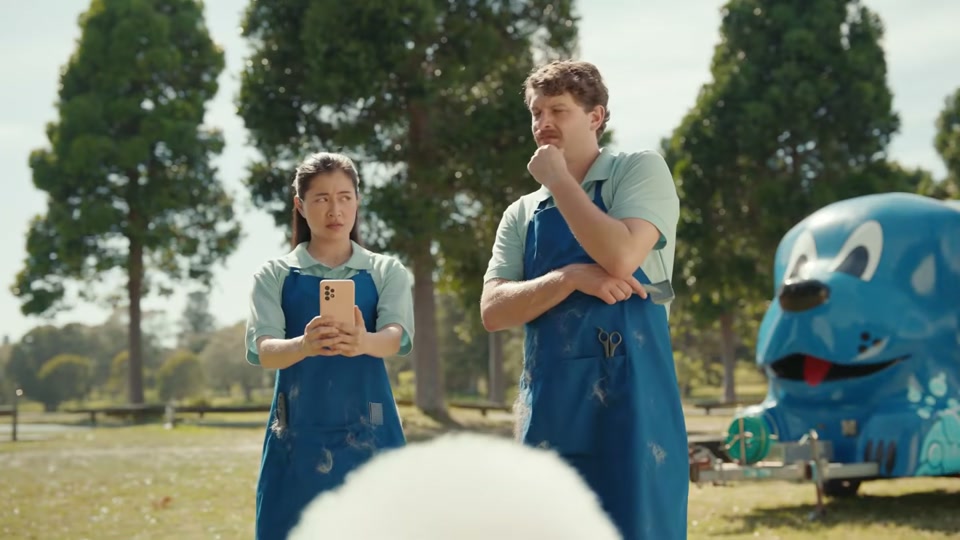
00:04 · opening Two professional dog groomers, a man and a woman, stand in a park admiring their work. They are dressed in matching light green polo shirts and blue aprons. -
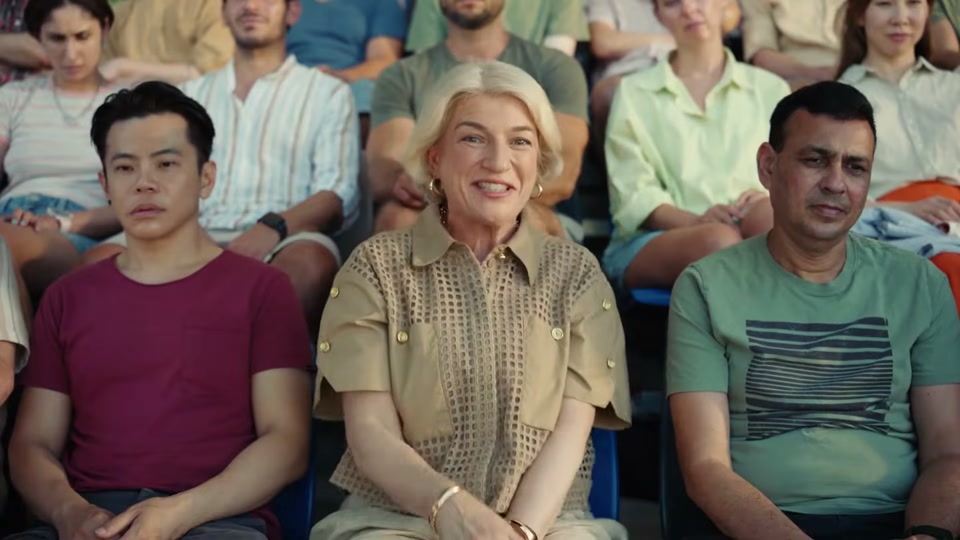
00:13 · title card The groomers look up, startled. The camera pulls back to reveal they are now standing on a stage before a colossal stadium grandstand filled with thousands of people. -
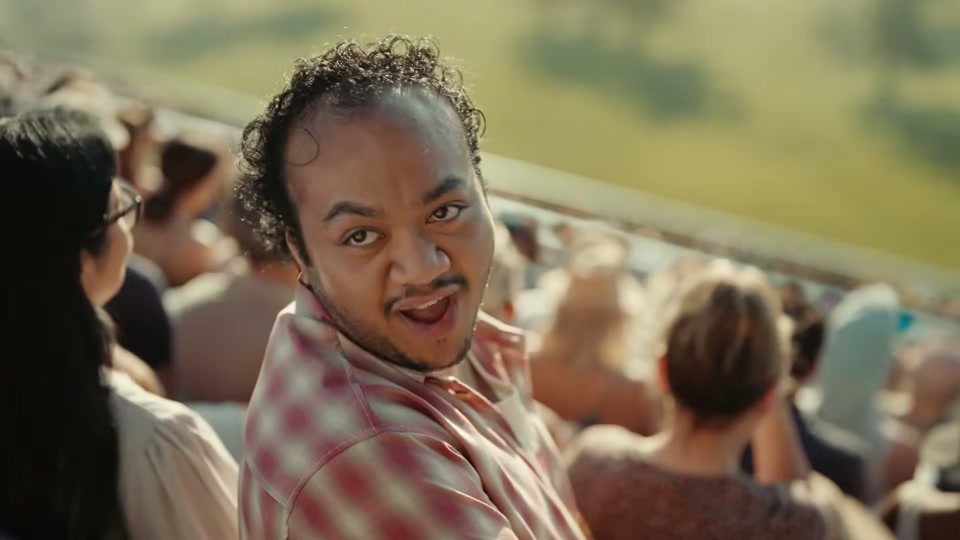
00:19 · title card The groomers look up, startled. The camera pulls back to reveal they are now standing on a stage before a colossal stadium grandstand filled with thousands of people. -
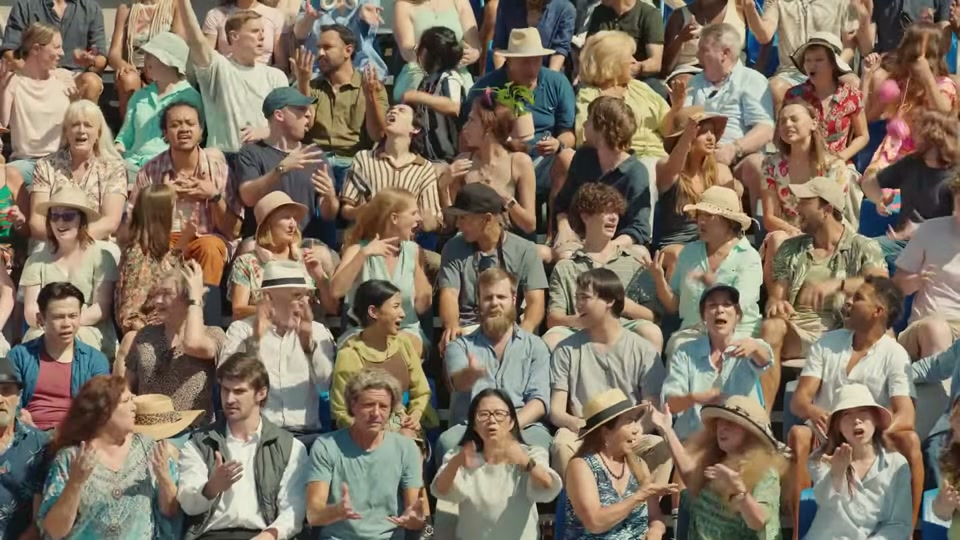
00:24 · title card The groomers look up, startled. The camera pulls back to reveal they are now standing on a stage before a colossal stadium grandstand filled with thousands of people. -

00:37 · title card The groomers look up at the sky, concerned. The scene shifts to an aerial shot of a wind turbine on a rolling green hill by the sea. The entire stadium grandstand is now superimposed on the hill. -
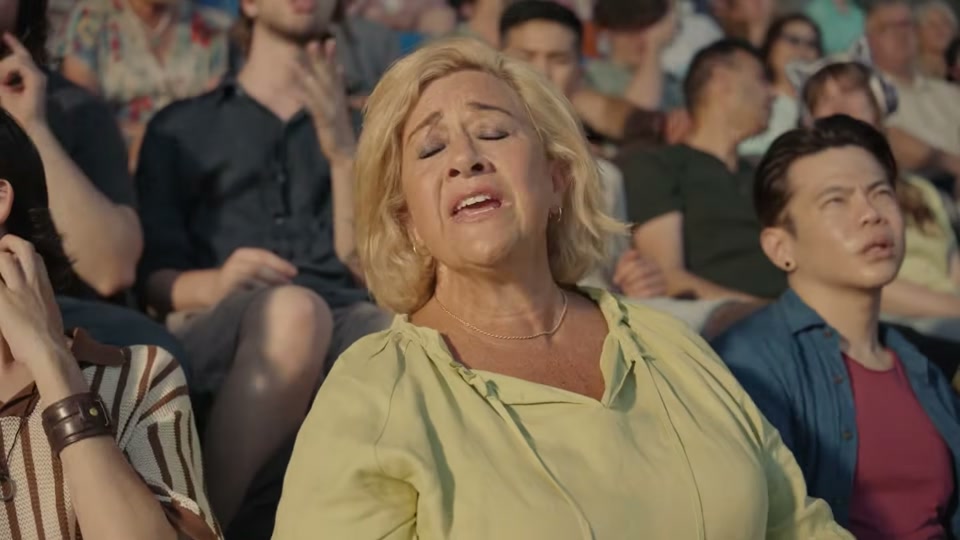
00:44 · title card The groomers look up at the sky, concerned. The scene shifts to an aerial shot of a wind turbine on a rolling green hill by the sea. The entire stadium grandstand is now superimposed on the hill. -
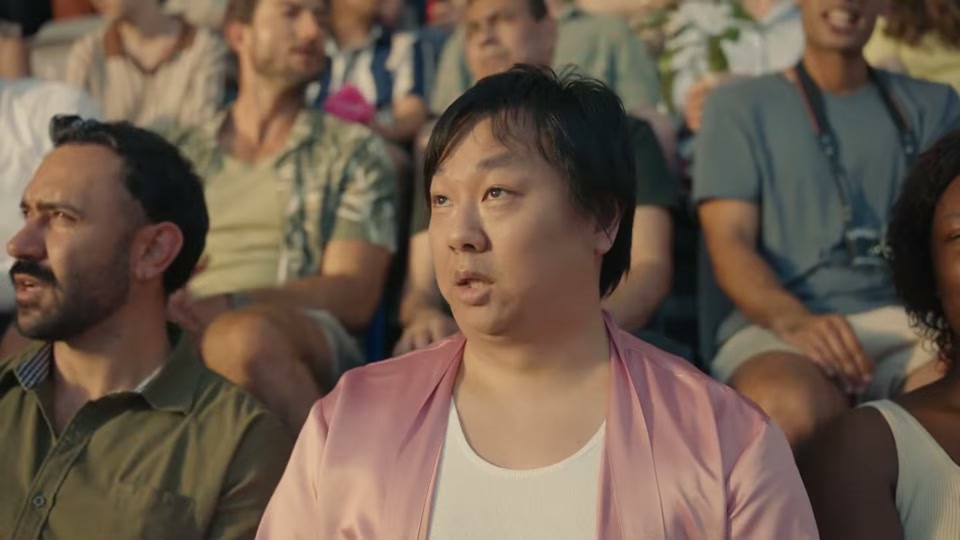
00:51 · title card The groomers look up at the sky, concerned. The scene shifts to an aerial shot of a wind turbine on a rolling green hill by the sea. The entire stadium grandstand is now superimposed on the hill. -

01:05 · standard The scene shifts to a man with a heavily muscled, artificial-looking physique flexing on a beach, with the comment section grandstand watching him. The debate shifts to whether his physique is natural or AI-generated. -
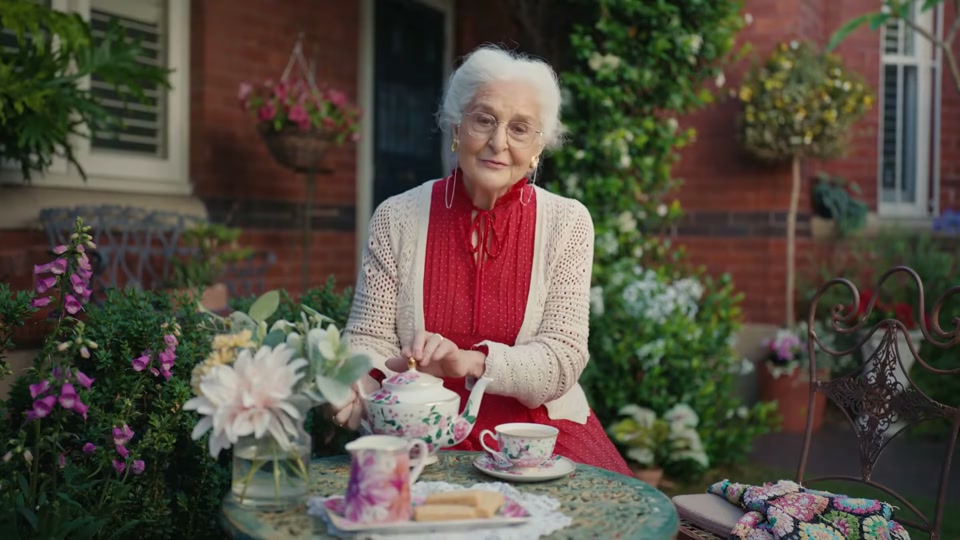
01:13 · standard The scene shifts to a man with a heavily muscled, artificial-looking physique flexing on a beach, with the comment section grandstand watching him. The debate shifts to whether his physique is natural or AI-generated. -
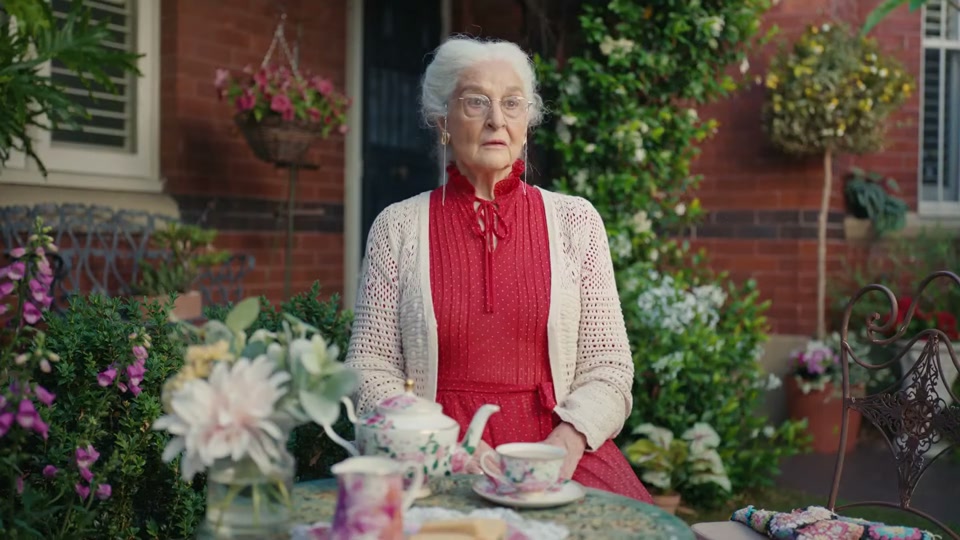
01:20 · standard The scene shifts to a man with a heavily muscled, artificial-looking physique flexing on a beach, with the comment section grandstand watching him. The debate shifts to whether his physique is natural or AI-generated. -
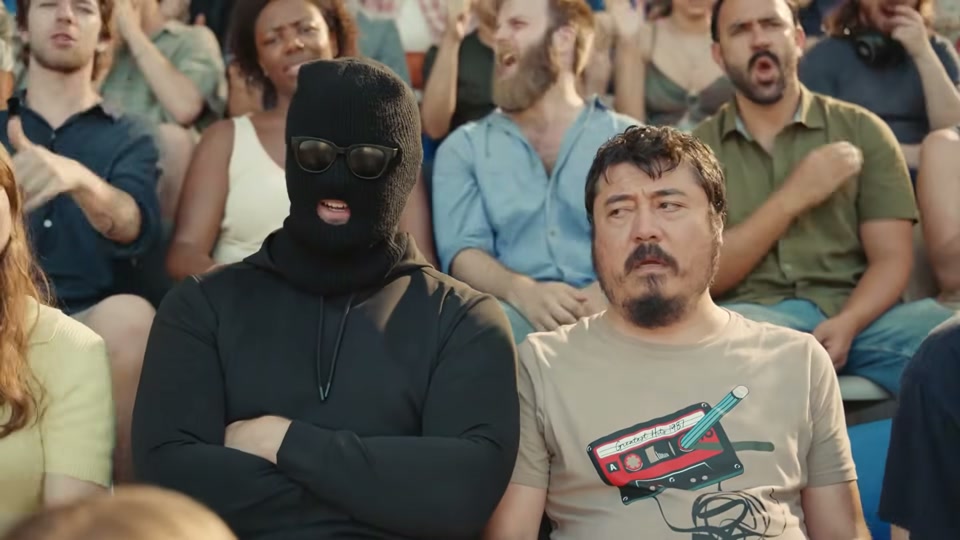
01:39 · standard A young woman in a green tracksuit appears on the central stage and begins to perform a jerky, awkward dance. -
02:34 · title card The chaos in the stadium reaches its peak. Suddenly, a man in a business suit is seen in the distance, standing over a smoking kettle barbecue. -
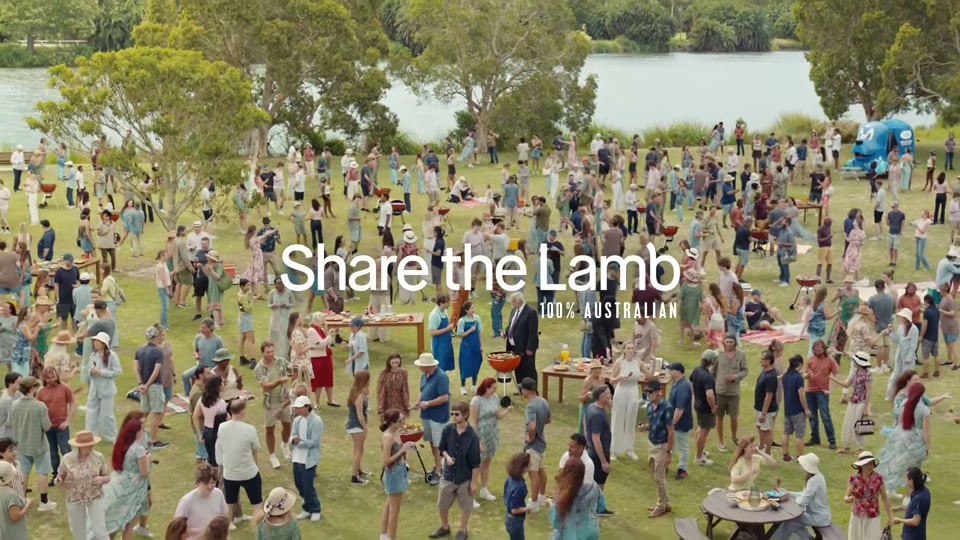
03:06 · brand frame The entire crowd joyfully streams out of the stadium grandstand and into the sunny park from the beginning of the ad. A massive, happy barbecue is underway.
Scene-by-scene account
Show full scene breakdown
00:00–00:08
Visuals
Two professional dog groomers, a man and a woman, stand in a park admiring their work. They are dressed in matching light green polo shirts and blue aprons. The subject is a small white dog (a Bichon Frise) on a grooming table, its head shaved into a perfect, cloud-like sphere. The man is contemplative; the woman takes a photo with her phone. In the background is a large, cartoonish blue dog-shaped mobile grooming trailer.
Dialogue and audio
- Male Groomer: "What do you reckon?"
- Female Groomer: "Don't know."
- (She takes a photo and taps her phone)
- Female Groomer: "And share."
- (A sudden, loud chorus of voices is heard).
On-screen text
None.
Meaning and context
Directly observable: An unusual, stylised dog haircut is created and a picture of it is shared online, triggering an immediate and overwhelming audience response.
Likely interpretation at release: The scene establishes the catalyst for the ad's core theme: the instant and unpredictable nature of online reactions to even the most innocuous content. The perfectly spherical haircut is a visual gag designed to be absurd and memorable.
00:08–00:30
Visuals
The groomers look up, startled. The camera pulls back to reveal they are now standing on a stage before a colossal stadium grandstand filled with thousands of people. A large sign above the crowd reads "THE COMMENTS SECTION." Various audience members, representing different demographics, begin shouting comments. One man tries to reason with the crowd. The camera cuts back to the groomers looking bewildered. A title card appears over the angry crowd.
Dialogue and audio
- Woman 1 (shouting from the crowd): "Oh my god! That's the funniest thing I've seen all week!"
- Woman 2: "No notes."
- Woman 3: "Who would do that to a dog?"
- Man 1: "That looks like a dog I drew in grade two."
- Man 2 (tagging someone): "@GinaSmith, this is literally you."
- Woman 4 ("Gina Smith"): "It's literally me."
- Man 3 (with headphones): "Everyone calm down. It's fake."
- (Crowd erupts into unintelligible shouting and argument).
On-screen text
- Stadium Sign: THE COMMENTS SECTION
- Title Card (over crowd): THIS FILM WAS MADE WITH 100% REAL ONLINE COMMENTS
Meaning and context
Directly observable: The online "comments section" is literalised as a physical crowd of people who react with a full spectrum of emotion: delight, outrage, sarcasm, and personal identification. The ad explicitly states these are real comments.
Likely interpretation at release: This is the central creative premise. It satirises the performative and often contradictory nature of social media feedback. The use of real comments grounds the satire, highlighting that the absurd dialogue is not an exaggeration but a reflection of actual online behaviour. The character yelling "It's fake" represents the voice of reason that is often ignored in online pile-ons.
00:30–00:58
Visuals
The groomers look up at the sky, concerned. The scene shifts to an aerial shot of a wind turbine on a rolling green hill by the sea. The entire stadium grandstand is now superimposed on the hill. The comments continue, now arguing about renewable energy. The scene shifts again to the grandstand floating in space, high above the Earth, as the argument devolves into a flat-earth conspiracy theory.
Dialogue and audio
- Male Groomer: "Wow, this comment section is getting toxic."
- Female Groomer: "Do you think this is happening everywhere?"
- Woman 5 (at wind farm): "Madness! We're killing the environment!"
- Man 4: "We're saving the environment!"
- Woman 6: "They only work when there's enough wind."
- Man 5 (non-sequitur): "I made $5,000 in a week working from home with this one simple trick."
- Man 6: "You're right. Next thing you'll tell me the Earth is flat."
- (Scene cuts to space)
- Man 7 (shouting): "See! Flat as!"
Meaning and context
Directly observable: The advertisement shows how an online discussion can pivot wildly from one topic to another, escalating in absurdity. The argument moves from dog grooming to environmental policy, online scams, and finally to conspiracy theories.
Likely interpretation at release: This sequence satirises "thread drift" and the tendency for any online space to become a battleground for unrelated, polarising debates. The non-sequitur about a "work from home" scam is a humorous nod to the prevalence of spam and grifters in comment sections. The jump to a flat-earth debate represents the endpoint of irrational online discourse.
00:58–1:28
Visuals
The scene shifts to a man with a heavily muscled, artificial-looking physique flexing on a beach, with the comment section grandstand watching him. The debate shifts to whether his physique is natural or AI-generated. The scene then cuts to an elderly woman peacefully having tea in her garden. The comment section is now a nearly empty stadium, where a few people argue passionately about the correct way to make tea and eat cereal.
Dialogue and audio
- Man 8 (about flat earth image): "That could be AI."
- Man 9 (pointing to bodybuilder): "No, that's AI."
- Man 10: "It's achievable naturally. I have a body similar to that."
- Elderly woman: "...and that's the way you make a perfect cuppa."
- Man 11 (in stadium): "Milk before tea? This is a crime!"
- Woman 7: "Same as with cereals. Milk first."
- Woman 8: "You are a psycho!"
- Man 12: "Oh, we're fighting over tea now."
Meaning and context
Directly observable: The comment section finds new, increasingly trivial topics to argue about, from AI-generated bodies to the proper order of adding milk to tea and cereal.
Likely interpretation at release: This section highlights the sheer pettiness of many online arguments. The debate over AI imagery was highly topical for the 2024-2025 period, as AI generators became mainstream. The argument over tea and cereal is a classic example of a low-stakes "holy war" that can consume online forums, showing that the toxicity is not limited to major issues but applies to any topic imaginable.
1:28–2:12
Visuals
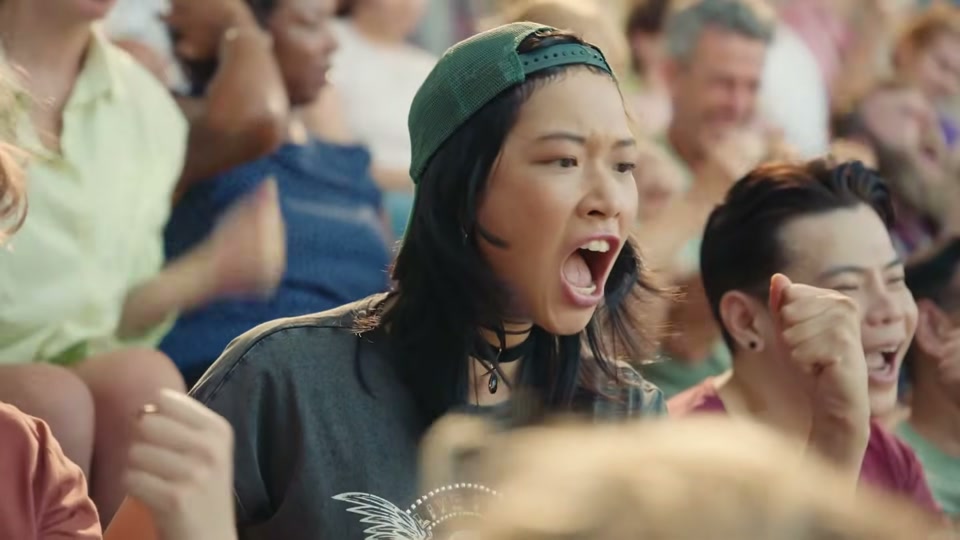
A young woman in a green tracksuit appears on the central stage and begins to perform a jerky, awkward dance. The crowd's reaction is swift and brutal, with comments ranging from praise to confusion to intense personal insults. A man in a balaclava, representing an anonymous troll, heckles her. The original dog groomers have now been pulled into the crowd and are seated in the grandstand, looking distressed.
Dialogue and audio
- Woman 9: "She broke dancing!"
- Man 13: "I don't get it."
- Man in Balaclava (troll): "If cringe could kill ya, this'd be a lethal dose."
- Man 1 (same man from start): "Ooh, another keyboard warrior."
- (Comments become a cacophony of insults): "She sucks!", "You suck!", "Blocked and reported!"
- Male Groomer (in crowd): "Whoa!"
- Female Groomer: "Sorry, I just got caught up in whatever this is."
Meaning and context
Directly observable: A person sharing a creative act (dancing) is met with immediate and harsh judgment, including insults and threats of being "blocked and reported." The anonymous "troll" in a balaclava is explicitly identified as a "keyboard warrior."
Likely interpretation at release: This scene directly addresses the human cost of online toxicity and cyberbullying. The dancer represents anyone who puts themselves out there online, only to be torn down. The "keyboard warrior" in a balaclava is a powerful symbol of the cowardly anonymity that fuels online abuse. The female groomer's apology for getting "caught up" shows how easily people can be swept into mob mentality.
2:12–2:42
Visuals
The chaos in the stadium reaches its peak. Suddenly, a man in a business suit is seen in the distance, standing over a smoking kettle barbecue. It is Sam Kekovich, the long-running "Lambassador." He holds up a pair of tongs with a sizzling lamb cutlet and raises it like a torch. The crowd's angry roar subsides as they see him. He passes the cutlet to one of the women in the crowd, who eats it and gives a thumbs up. The crowd erupts in cheers. Kekovich shouts a final command.
Dialogue and audio
- Male Groomer: "There's gotta be something that unites us."
- (He sees the BBQ. Triumphant, orchestral music begins)
- (A woman eats the lamb and gives a thumbs up. The crowd cheers wildly.)
- Man 14: "I love lamb!"
- Sam Kekovich (shouting): "Come on everyone! Get out of the comments, and into the cutlets!"
Meaning and context
Directly observable: The sight and taste of a barbecued lamb cutlet instantly silences the arguments and unites the entire crowd in joyous agreement. Sam Kekovich, a recognisable figure from previous campaigns, acts as the master of ceremonies who offers lamb as the solution.
Strongly implied message: Lamb is the great unifier. It has the power to cut through all the division and anger of the modern world and bring people together in a shared, positive, real-world experience. Kekovich's line is the ad's central thesis.
Verification needed: The man in the suit is almost certainly Sam Kekovich, the famous "Lambassador" for MLA since 2005.
2:42–3:15
Visuals
The entire crowd joyfully streams out of the stadium grandstand and into the sunny park from the beginning of the ad. A massive, happy barbecue is underway. People from all sides of the previous arguments are now smiling, talking, and eating lamb together. The troll in the balaclava is seen having a friendly chat. The two groomers are at the barbecue with Kekovich. The final shot is of another character from the crowd holding up a lamb cutlet and smiling.
Dialogue and audio
- Female Groomer: "I think everyone's a lot nicer in real life than we are online."
- Male Groomer: "I guess the anonymousness of the internet..."
- Sam Kekovich (interrupting): "Yeah, we get it. Just eat some lamb."
- Final Character (winking at the camera): "I hope people post nice comments about this ad."
On-screen text
- End Card: Share the Lamb
- Super: 100% AUSTRALIAN
Meaning and context
Directly observable: Leaving the "comment section" for a real-life lamb barbecue resolves all conflicts. The ad explicitly states its moral: people are nicer in person, and lamb is the catalyst for this positive interaction.
Likely interpretation at release: This is the classic resolution for an MLA lamb ad: no matter how divided the nation is, a lamb barbecue is the solution that unites everyone. Kekovich's interruption is a humorous, meta-commentary, cutting off a pretentious analysis to deliver the simple, direct product message. The final line is another meta-joke, acknowledging the ad itself will be subject to the very online commentary culture it has just satirised.
Verification and uncertainties
- Campaign Year: Confirm the exact release date of this advertisement. While analysis points to January 2025, external verification is needed to be certain.
- Identities: Confirm the man with the barbecue is Sam Kekovich. (Model background knowledge suggests this is certain, but per the rules, it requires external verification).
- Dialogue: The TXT transcript contains minor errors and amalgamations. For instance, the line "[TXT says: what do you reckon don't know]" is clearly two different speakers. The audio has been prioritised in the descriptive transcript.
- Topical claims: The connection to the "vibe" of 2024 (online division, AI anxiety) is a strong interpretation but relies on an understanding of the cultural context of that period.