Address to the Nation (GFC Rally)
Work title in the source analysis: "Address to the Nation".
2009The advertisement is framed as a satirical "Address to the Nation" by a strongman political figure, reacting to a major economic crisis. The speaker, sitting in a mock stock exchange called the "Australian Chop Exchange", blames the world's financial woes on "un-Australianism" and the greed of corporate elites. He embarks on a march out of the city, gathering a diverse crowd of followers representing everyday Australians. He preaches that the path to national salvation lies not in complex financial "rescue packages" but in returning to the egalitarian values embodied by the simple, barbecued lamb chop. The ad culminates in a mass rally at a beach, where the speaker leads the crowd—all of whom now have his face digitally superimposed—in a parody of Barack Obama's "Yes We Can" slogan, before urging Australians to serve lamb on Australia Day.
Watch the advertisement
Historical and topical context
Campaign year: 2009 Assumed or known release period: January 2009 (Assumed) Primary context year: 2008 Likely topical context window: July 2008 to January 2009 Confidence in those dates: High
The advertisement is a direct satirical response to the dominant global and national event of the preceding year: the 2008 Global Financial Crisis (GFC). The national mood in Australia during late 2008 and early 2009 was one of economic anxiety and growing distrust of financial institutions and corporate greed.
Reference: The Global Financial Crisis (GFC) Evidence in the ad: Explicit references to "the world economy is rooted", "Wall Street wankers", "short-selling", "corporate crooks", "credit crunch", and the "rescue package". Likely relevance at release: This was the single biggest news story of the period. The ad taps directly into public anger and confusion, positioning lamb as a simple, honest alternative to a corrupt, complex system. Confidence: High External verification needed: No
Reference: Barack Obama's 2008 US Presidential Campaign Evidence in the ad: The crowd chanting "Yes we can!" (1:21) Likely relevance at release: Obama's campaign and his victory in November 2008 were a global phenomenon representing hope and change. The ad borrows this hugely famous slogan for its satirical climax, contrasting Obama's grand vision with the comically parochial goal of eating lamb. Confidence: High External verification needed: No
Reference: The film Australia (2008) Evidence in the ad: Speaker explicitly complains about spending "$130 million on a three-hour movie called Australia". (0:28) Likely relevance at release: Baz Luhrmann's film was released in late November 2008. Its large budget and ambition to define the Australian story made it a major cultural event and a target for debate and parody. The ad cleverly uses it as an example of a bloated, "un-Australian" extravagance compared to the simple BBQ. Confidence: High External verification needed: Yes (to confirm budget and release date).
Reference: 2008 Beijing Olympics Evidence in the ad: "Our Olympians sold themselves, flogging undies and waterproof laptops while the Poms were flogging us on the medals table." (0:21) Likely relevance at release: The Olympics took place in August 2008. The reference to athlete endorsements and the friendly sporting rivalry with Great Britain ("Poms") would have been immediately recognisable. Confidence: High External verification needed: Yes (to confirm context of medal tally rivalry).
Campaign meaning
Creative premise
The ad uses the creative premise of a satirical "Address to the Nation" from a populist "Lambassador." This figure co-opts the language of political crisis and economic turmoil (specifically the 2008 GFC) to humorously diagnose Australia's problems as a moral failing—"un-Australianism"—that can only be cured by returning to the egalitarian simplicity of eating lamb.
Message
Explicit message:
- The world economy is in crisis due to greed and "un-Australian" behaviour. (0:01-0:06)
- Australians should eat lamb chops, the national dish. (0:38)
- Australians should serve lamb on Australia Day. (1:23)
Strongly implied message:
- True Australian values are egalitarian, simple, and authentic, not materialistic or elitist.
- Financial elites, corporate interests, and out-of-touch cultural projects have betrayed the common Australian.
- The real solution to national problems isn't a complex government "rescue package" but a return to basics and community, symbolised by the shared ritual of a lamb barbecue.
Tentative interpretation:
- The ad might be subtly suggesting that populist, strongman rhetoric itself is simplistic and slightly absurd, as shown by the comical visual of everyone turning into a clone of the speaker.
Role of lamb
Lamb functions as the central symbol of authentic Australian identity and values. It is:
- The Great Equaliser: A food that "tastes the same" for the rich and the poor, representing egalitarianism.
- The National Dish: Positioned as the embodiment of the nation's character.
- The "Real" Rescue Package: A tangible, honest, and simple solution to the "credit crunch," contrasting with opaque and unpopular government bailouts.
- A Call to Action: The act of eating lamb on Australia Day becomes a patriotic duty to restore the nation's soul.
Worldview evidence
Egalitarianism is the core Australian value
Classification: Explicit Evidence: 0:35 - "We need to return to the egalitarian values that made Australia great." and 0:41 - "A chop tastes the same in a designer outfit as it does in stubbies and thongs." Meaning at release: This presents a belief that Australian society should be classless, where a person's worth isn't defined by their wealth or status. The lamb chop is the symbol of this ideal.
Distrust of elites and institutions
Classification: Explicit Evidence: 0:07 - "Wall Street wankers and bottom-feeding billionaire bankers"; 0:53 - "short-selling, rogue-trading corporate crooks"; 0:47 - "overpaid, talentless parasite from a millionaire's factory." Meaning at release: This reflects a deep-seated populist resentment towards the financial sector, the wealthy, and the entertainment industry, blaming them for the nation's economic and moral problems.
Authenticity and simplicity are superior to materialism
Classification: Strongly implied Evidence: The ad contrasts complex, "un-Australian" things (internet fridges, expensive movies, corporate finance) with the simple, authentic ideal of "a chop and a cold one" (0:52) and a "rescue package... wrapped in butcher's paper" (1:06). Meaning at release: The ad argues that Australia has been "seduced" by consumerism and complexity, and happiness lies in returning to simpler, more genuine pleasures.
Parochial Nationalism
Classification: Explicit Evidence: The central problem is defined as "un-Australianism" (0:06), and the solution is to "unite as a nation" (1:20) by embracing a nationalistic food ritual on Australia Day. Meaning at release: The ad frames the global crisis through a nationalist lens, suggesting Australia's problems are unique to its own identity crisis and require a uniquely Australian solution.
Humour, tone and satire
- Tone: The tone is bombastic, mock-serious, and aggressively populist. It perfectly mimics the style of a ranting talk-back radio host or a charismatic but belligerent political leader.
- Principal joke mechanisms:
- Parody: The ad is a sustained parody of a political address, complete with a "Yes We Can!" slogan parody.
- Satire: It satirises the financial industry ("Australian Chop Exchange"), government responses to the GFC ("rescue package"), and grand nation-defining projects (the film Australia).
- Exaggeration and Absurdity: The central premise that lamb can solve the GFC is absurd, culminating in the surreal visual of the entire nation turning into Sam Kekovich clones.
- Vernacular Language: The use of colloquialisms like "rooted," "wankers," "battlers," "Poms," and "stubbies and thongs" creates an authentically Australian comedic voice.
- Targets of satire: The primary targets are the global financial elite and corporate greed. Secondary targets include consumerism, the commercialisation of sport, and cultural pretension.
- Affectionate parody versus genuine criticism: The criticism of bankers and corporate greed feels genuine, tapping into real public anger. The parody of Australian culture (the "ocker" stereotype embodied by Kekovich, the obsession with sporting prowess) is more affectionate and self-deprecating.
Campaign evidence summary
Core message
In the face of the 2008 Global Financial Crisis, caused by the greed of "un-Australian" elites, the nation must reject complex solutions and materialism. Instead, Australia can save itself by returning to its core egalitarian values, symbolised by the simple, unifying act of eating lamb chops on Australia Day.
Values supported by this ad
- Egalitarianism
- Authenticity and simplicity
- Populism and distrust of elites
- Parochial nationalism
- Community and shared rituals
Role of lamb
Lamb is the symbolic cure for the nation's ills. It is the great equaliser, the "real" economic rescue package, and the embodiment of simple, authentic Australian values, making its consumption on Australia Day a patriotic act.
Most important topical or historical elements
- The 2008 Global Financial Crisis (GFC) and the language of "rescue packages" and "credit crunch".
- Barack Obama's 2008 "Yes We Can" campaign slogan.
- The November 2008 release of the movie Australia.
- The 2008 Beijing Olympics.
Uncertainties
- While the ad's message is clear, the final visual of the "Kekovich clones" could be interpreted as either a straightforward celebration of populist unity or a subtle, self-aware joke about the absurdity and conformity of that same populism.
Themes and connections
This advertisement belongs to Era 1 — The Kekovich Doctrine.
Keyframe gallery
8 representative frames, in chronological order.
-
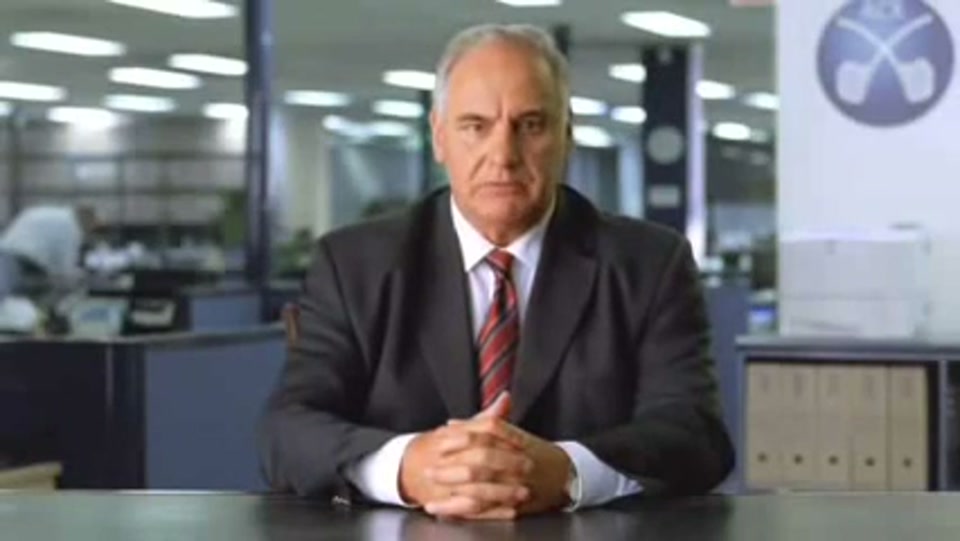
00:06 · opening The ad opens with a tight, head-and-shoulders shot of a stern-looking, middle-aged man in a dark suit and red-striped tie, seated at a desk. The setting is a modern, open-plan office. -
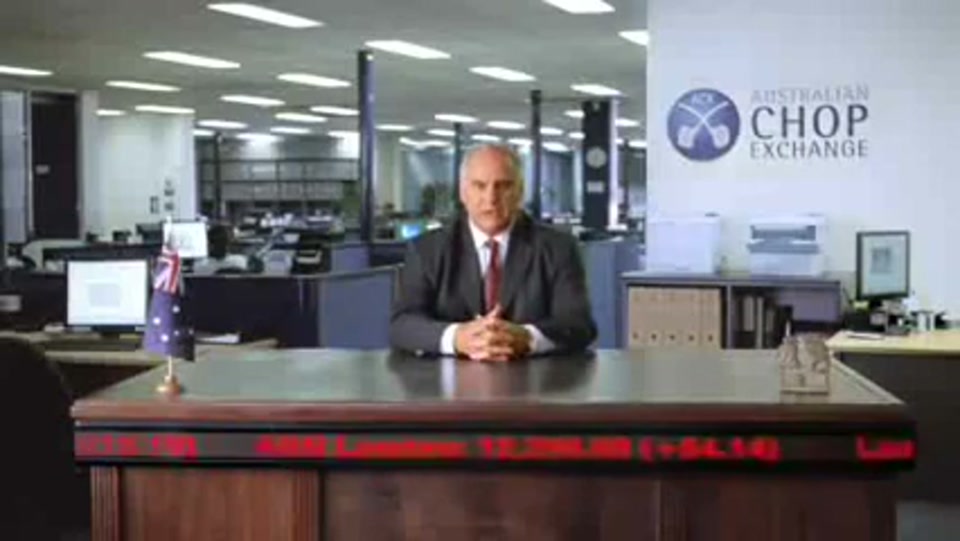
00:18 · reveal The camera pulls back to reveal the speaker's desk is fronted by a scrolling red-light stock ticker. An Australian flag sits on the desk. -
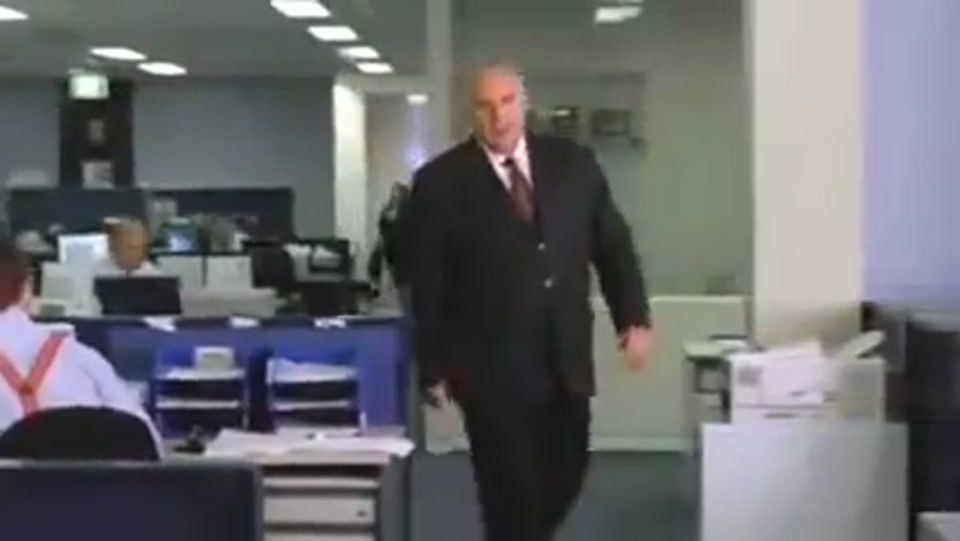
00:23 · reveal The camera pulls back to reveal the speaker's desk is fronted by a scrolling red-light stock ticker. An Australian flag sits on the desk. -

00:28 · reveal The camera pulls back to reveal the speaker's desk is fronted by a scrolling red-light stock ticker. An Australian flag sits on the desk. -

00:43 · food shot The speaker, now with a small entourage of office workers, walks out of the glass doors of a modern office building. -

00:57 · standard The procession, now a larger crowd, marches away from the city and down a tree-lined suburban road. The followers now include people in casual clothes, jogging outfits, etc. -

01:21 · brand frame The scene cuts to a vast rally on a grassy area by a beach, with a large bay filled with boats in the background. The speaker stands at a lectern which is actually a barbecue laden with lamb chops. -
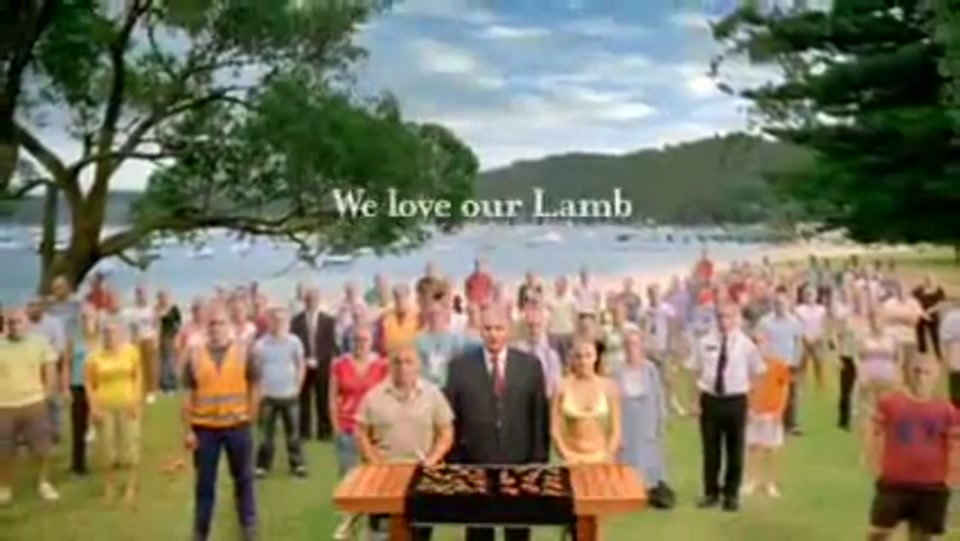
01:25 · brand frame The scene cuts to a vast rally on a grassy area by a beach, with a large bay filled with boats in the background. The speaker stands at a lectern which is actually a barbecue laden with lamb chops.
Scene-by-scene account
Show full scene breakdown
[00:00 - 00:13]
Visuals The ad opens with a tight, head-and-shoulders shot of a stern-looking, middle-aged man in a dark suit and red-striped tie, seated at a desk. The setting is a modern, open-plan office. Behind him on the wall is a circular logo featuring two crossed meat cleavers. He speaks directly and seriously to the camera.
Dialogue and audio Speaker: "My fellow Australians. The world economy is rooted. And it's all due to one thing: un-Australianism. Wall Street wankers and bottom-feeding billionaire bankers stuffing their wallets at the expense of battlers... it's about as un-Australian as it gets. Sadly, Australia is not immune."
On-screen text None.
Meaning and context Directly observable: The speaker adopts the tone and framing of a political leader addressing the nation during a crisis. He explicitly blames the economic downturn on "un-Australian" behaviour, specifically targeting the financial sector ("Wall Street wankers," "billionaire bankers") for profiting at the expense of ordinary working people ("battlers").
Likely interpretation at release: This is a clear and direct satire of political responses to the 2008 Global Financial Crisis (GFC). The use of classic Australian vernacular like "rooted" (broken, ruined) and "battlers" immediately frames the crisis in a local, populist context. The concept of "un-Australianism" is being used satirically to critique greed.
Verification needed:
- Identity of the speaker. (Model background knowledge — external verification needed: The speaker is Sam Kekovich, a former Australian Rules Football player and media personality who was the long-running "Lambassador" for the campaign).
[00:13 - 00:34]
Visuals The camera pulls back to reveal the speaker's desk is fronted by a scrolling red-light stock ticker. An Australian flag sits on the desk. A sign on the wall behind him is now fully visible: "AUSTRALIAN CHOP EXCHANGE" with the acronym "ACX". The speaker stands and begins walking purposefully through the office. A younger man in a shirt and red suspenders (a stereotypical "Gordon Gekko" style stockbroker) looks up and then follows him.
Dialogue and audio Speaker: "We've been seduced by 48-month interest-free internet fridges that are smarter than the average stockbroker. Our Olympians sold themselves, flogging undies and waterproof laptops while the Poms were flogging us on the medals table. And how could you splurge 130 million on a three-hour movie called Australia and not spend one cent on showing a lamb Barbie? What a load of bulldust!" [Slightly triumphant, dramatic music begins to swell.]
On-screen text
- Sign: AUSTRALIAN CHOP EXCHANGE / ACX
- Stock Ticker: Illegible red text and numbers scrolling continuously.
Meaning and context Directly observable: The setting is a parody of the Australian Stock Exchange (ASX), rebranded as a "Chop Exchange." The speaker critiques several aspects of contemporary Australian life: consumerism (interest-free deals), the commercialisation of sport (Olympians' endorsements), and perceived cultural cringe or misdirected national pride (the expensive film Australia).
Likely interpretation at release: This section connects the financial crisis to a broader moral crisis of materialism and misplaced priorities.
- Olympians: A reference to the 2008 Beijing Olympics. "Poms" (the English) beating Australia on the medal table was a point of media discussion.
- Australia film: A direct and topical reference to Baz Luhrmann's epic film Australia, which was released in November 2008 to huge media attention and debate about its cost and portrayal of the nation.
- Bulldust: A classic Australian euphemism for "bullshit," reinforcing the speaker's persona as a plain-speaking man of the people.
Verification needed:
- Release date and budget of the film Australia.
- Results of the 2008 Beijing Olympics medal tally (specifically UK vs Australia).
- The "Gordon Gekko" appearance of the follower as a satirical trope.
[00:34 - 00:52]
Visuals The speaker, now with a small entourage of office workers, walks out of the glass doors of a modern office building. The group begins to attract more followers, including a security guard and construction workers in hard hats, creating a cross-section of society. They march together down a city street.
Dialogue and audio Speaker: "We need to return to the egalitarian values that made Australia great, embodied in our national dish: the barbecued lamb chop. A chop tastes the same in a designer outfit as it does in stubbies and thongs. Which reminds us, you don't need to be an overpaid, talentless parasite from a millionaire's factory to be truly happy. You just need a chop and a cold one."
Meaning and context Directly observable: The speech pivots from critique to solution. The speaker explicitly champions "egalitarian values" and nominates the "barbecued lamb chop" as the national dish and symbol of that equality. He creates a clear dichotomy between the working class ("stubbies and thongs") and the elite ("designer outfit," "overpaid parasite").
Likely interpretation at release: This is the core message of the campaign. Lamb is positioned as the great social equaliser, a food that transcends class divides. "Stubbies and thongs" (work shorts and flip-flops) are iconic items of casual Australian attire. "Millionaire's factory" is likely a generic pejorative for a system that produces wealthy, out-of-touch celebrities or executives. "A cold one" is a common term for a beer.
[00:52 - 1:13]
Visuals The procession, now a larger crowd, marches away from the city and down a tree-lined suburban road. The followers now include people in casual clothes, jogging outfits, etc. The speaker continues his address, pointing and gesticulating angrily.
Dialogue and audio Speaker: "The short-selling, rogue-trading corporate crooks might disagree with me. But they can go jump! And if they don't know the way, I'll push them in the right direction! So the message is clear: the only rescue package we need is wrapped in butcher's paper and filled with nice, juicy lamb chops. Because there's only one way to beat the credit crunch: munch lamb!"
Meaning and context Directly observable: The speaker directly attacks the financial industry again using period-specific terms ("short-selling," "credit crunch"). He offers lamb as a simple, authentic alternative to complex government financial interventions.
Likely interpretation at release: This is a pointed satire of the government "rescue packages" and bank bailouts that were central to the response to the GFC in late 2008. The ad contrasts the opaque, unpopular world of high finance with the tangible, honest, and universally understood value of a lamb chop from the butcher. The phrase "they can go jump" is a common, dismissive Australian insult.
Verification needed:
- Specifics of the Australian government's economic stimulus or "rescue package" announced in late 2008.
[1:13 - 1:30]
Visuals The scene cuts to a vast rally on a grassy area by a beach, with a large bay filled with boats in the background. The speaker stands at a lectern which is actually a barbecue laden with lamb chops. Beside him stand two followers—a man in a khaki work shirt and a woman in a yellow bikini. Uncannily, both now have the speaker's head digitally composited onto their bodies. He addresses the huge crowd. As the camera pulls back, it's revealed that every single person in the massive crowd has the same digitally-copied face as the speaker. They all raise their fists in unison.
Dialogue and audio Speaker: "...not just me, an every Australian! The whole bloody lot of you! Taking up the tongs and being Sam Kekovich. Can we change things if we all unite as a nation?" Crowd (in unison): "YES WE CAN!" Speaker: "So don't be un-Australian. Serve lamb on Australia Day. You know it makes sense." Crowd (chanting): "WE ARE SAM KEK-O-VICH!" [Orchestral music swells to a climax.]
On-screen text
- (1:25)
We love our Lamb
Meaning and context Directly observable: The speaker explicitly names himself as "Sam Kekovich". The ad climaxes with a call-and-response that directly parodies a famous political slogan. The final visual punchline is that national unity is achieved by everyone literally becoming Sam Kekovich, a uniform army of lamb-eaters. The final instruction is to eat lamb on Australia Day.
Likely interpretation at release:
- "Yes We Can!": This is an unmistakable and highly topical parody of Barack Obama's campaign slogan from his successful 2008 US presidential run. His victory in November 2008 was a massive global media event.
- The Kekovich Clones: This surreal visual joke is the ad's satirical peak. It suggests that the populist unity he calls for is absurdly conformist. It's both a celebration and a gentle mockery of the "typical Aussie" archetype he represents.
- Australia Day: This directly links the entire message to the campaign's ultimate commercial goal: making lamb the essential food for Australia's national day on January 26th.
Verification and uncertainties
- Uncertain Dialogue: None. Dialogue is clear.
- Likely TXT Errors: The supplied TXT is messy, but the speaker's audio is clear and has been used for the transcript in this analysis. The line "being Sam kovich" (01:18) is clearly "being Sam Kekovich".
- Uncertain Identities: Confirm the speaker is Sam Kekovich.
- Topical Claims:
- Verify the specifics of the Australian government's 2008 economic stimulus package to confirm the "rescue package" context.
- Verify the release date and approximate budget ($130m) of Baz Luhrmann's Australia.
- Verify the context of the Australia vs Great Britain medal tally at the Beijing 2008 Olympics.
- Remembered Background Facts: The identification of Sam Kekovich as the long-running "Lambassador" requires external verification. The characterisation of the man in suspenders as a "Gordon Gekko" stereotype is an interpretation based on common cultural tropes of the time.