Make Lamb Not Walls
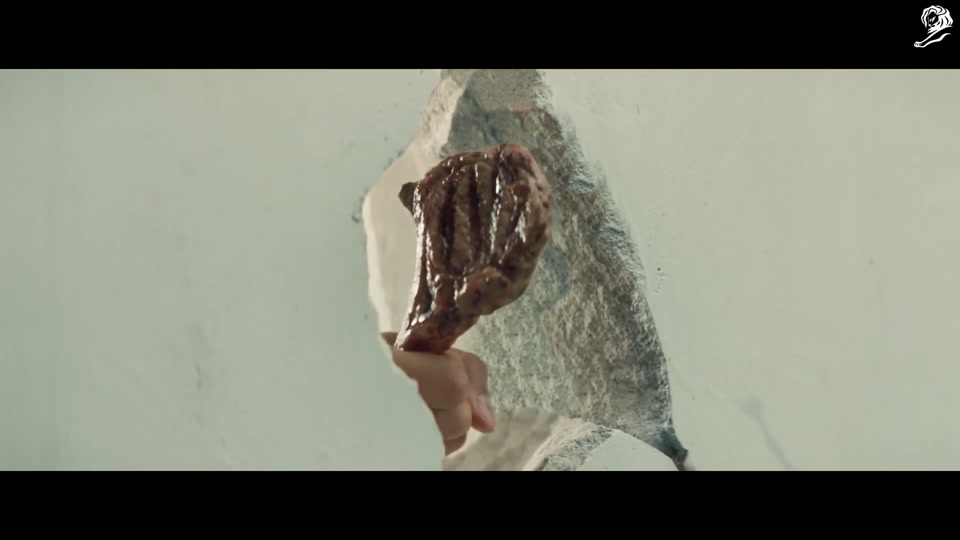
2021Set in a satirical, dystopian "Australia 2031", the advertisement depicts a nation physically divided by enormous concrete walls built along state lines. A decade of separation has amplified interstate rivalries and created a grim, segregated society. The narrative follows an elderly man who, drawn by the smell of a barbecue, discovers a small hole in the wall. Through it, he is offered a piece of grilled lamb from the other side.
This simple act of sharing inspires him and his neighbours to start tearing down the wall. The movement spreads rapidly across the continent, with citizens from all states joining in to demolish the barriers using everything from tractors and backyard tools to a military tank. The various state-based factions, including a late-arriving group from Western Australia and a tiny contingent from Tasmania, eventually reunite in a massive park gathering. They celebrate their renewed unity with a huge lamb barbecue, culminating in the realisation that they are not a collection of divided states, but simply "Australia". The ad ends with a final joke at the expense of a politician arriving late to the celebration.
Watch the advertisement
Historical and topical context
- Campaign year: 2021
- Assumed release period: January 2021
- Primary context year: 2020
- Likely topical context window: July 2020 to January 2021
- Confidence in those dates: High
The ad is a direct satirical response to the national mood of Australia in 2020. The primary context is the COVID-19 pandemic and, specifically, the unprecedented and prolonged closures of state borders. This policy, while implemented for public health reasons, created significant social, economic, and political friction. State premiers became dominant figures, and state identities and rivalries were amplified in public discourse. The ad channels the frustration and absurdity many Australians felt about being separated from family, friends, and fellow citizens.
Reference: COVID-19 State Border Closures. Evidence in the ad: The central premise of giant walls dividing the states; dialogue about "Queenslanders" being different; news report of Victorians seeking "weather asylum". Likely relevance at release: This was the dominant national experience of 2020. The ad directly parodied the "us vs. them" mentality that arose between states like NSW, Victoria, Queensland, and especially Western Australia. Confidence: High External verification needed: No
Reference: Western Australian "Hard Border" and Secessionism. Evidence in the ad: The news chyron "WA STILL RESISTING"; the WA character tunnelling in late and apologising for "trying to become our own country. Again." Likely relevance at release: WA Premier Mark McGowan's "hard border" was the most stringent in the nation and was immensely popular within his state. This fed into a long-standing cultural trope of WA separatism ("WAxit"), making the joke immediately recognizable and topical. Confidence: High External verification needed: No
Reference: Prime Minister Scott Morrison's 2019 Hawaii Holiday. Evidence in the ad: The final scene with a man in a Hawaiian shirt and lei getting off an "Aloha Airlines" plane and asking, "What have I missed?" Likely relevance at release: This was a major political scandal from December 2019, during the Black Summer bushfires. The PM's absence during a national crisis and his subsequent attempts to manage the fallout (including the line "I don't hold a hose, mate") were deeply embedded in the public consciousness. The joke positions him as being absent and out of touch during another moment of national significance. Confidence: High External verification needed: No
Reference: US President Donald Trump's Border Wall. Evidence in the ad: The use of a massive, physical wall as the central metaphor for division. Likely relevance at release: While the ad's focus is domestic, the imagery of "The Wall" was globally synonymous with the political agenda of Donald Trump, whose presidency concluded in the same month the ad was released (January 2021). The ad uses this potent international symbol and reapplies it to a domestic Australian context. Confidence: High External verification needed: No
Campaign meaning
Creative premise
The ad uses a dystopian sci-fi premise to satirise the real-world divisions caused by Australia's state border closures in 2020. It imagines a future where these divisions have become permanent, physical walls, only to show that the simple, unifying ritual of a shared lamb barbecue is powerful enough to tear them down and reunite the nation.
Message
Explicit message:
- "Share the Lamb."
- Australian Lamb is "100% Australian."
Strongly implied message:
- Australians are one people, and our shared identity is more important than state-based divisions.
- Political division is absurd and destructive, but it can be overcome by simple acts of community and generosity.
- The ritual of a lamb barbecue is a quintessential and powerful symbol of Australian unity.
Tentative interpretation:
- The ad gently mocks the parochialism of state leaders who championed hard borders, suggesting their actions were ultimately contrary to the national spirit.
- The campaign positions lamb not just as a food, but as a social and political peacemaker.
Role of lamb
Lamb is the catalyst and the symbol of reunification. Its smell is the first thing to cross the border, sparking curiosity and desire. A shared lamb chop is the first act of reconciliation. The final celebration is a massive lamb barbecue. Lamb is therefore the plot device that resolves the central conflict, representing a shared culture that transcends artificial political boundaries.
Worldview evidence
National Unity as the Ultimate Good
Classification: Strongly implied Evidence: The entire narrative arc, which frames division as a dystopia and unity as a joyous, utopian resolution. The final line, "It's just Australia," reinforces this. Meaning at release: In a year marked by unprecedented internal division, the ad strongly asserts that national unity is the proper and desirable state for Australia.
The Power of the Common Person and Shared Ritual
Classification: Strongly implied Evidence: The uprising is a grassroots movement started by an ordinary citizen (00:27), not by leaders. The resolution is a communal BBQ, not a political treaty. Meaning at release: True Australian identity and unity are found in its people and their shared, simple cultural rituals, which are more powerful than the decrees of politicians.
Affectionate Scepticism of Authority
Classification: Strongly implied Evidence: The menacing but ultimately powerless security guard (00:41), the mocking depiction of the politician in the tank (01:46), and the final jab at the Prime Minister (02:27). Meaning at release: The ad taps into a classic Australian "larrikin" worldview that is suspicious of authority figures and bureaucratic rules, especially when they get in the way of community and common sense.
Humour, tone and satire
- Tone: The ad shifts from a grim, cinematic, dystopian tone to an exuberant, chaotic, and ultimately warm and celebratory one.
- Principal joke mechanisms: Satirical exaggeration (the walls), parody (of political events and state rivalries), stereotypes (WA, Tasmania), pop culture references (Apocalypse Now, Beatles, Pink Floyd), and visual gags (newspaper headlines, merchandise).
- Targets of satire: The primary targets are the state premiers of 2020 and their hard border policies. A secondary, but very direct, target is Prime Minister Scott Morrison. The satire is aimed at the absurdity of the situation and the perceived disconnect of the political class.
- Affectionate parody versus genuine criticism: The parody of state stereotypes (WA's isolation, Sydney's arrogance, Tasmania's size) is affectionate and inclusive, framing them as family in-jokes. The criticism of political figures, while still humorous, is more pointed and critical, especially the final scene.
Campaign evidence summary
Core message
Divisions between Australians are artificial and absurd. The simple, shared ritual of a lamb barbecue can cut through political barriers and remind us that we are one nation, united by a common culture.
Values supported by this ad
- National unity
- Community and mateship
- Generosity (sharing)
- Optimism
- A healthy scepticism of authority
Role of lamb
Lamb is the catalyst for peace and reunification. It functions as a symbol of a shared Australian culture powerful enough to overcome political division, and as the centrepiece of the ritual (the BBQ) that cements this renewed unity.
Most important topical or historical elements
- The 2020 COVID-19 state border closures.
- Prime Minister Scott Morrison's 2019 Hawaii holiday scandal.
- The ongoing cultural trope of Western Australian secessionism ("WAxit").
- The global political discourse surrounding Donald Trump's border wall.
Uncertainties
- While the reference is clear, the ad does not explicitly name Scott Morrison.
- The politician in the tank is a generic archetype, not a specific individual.
Themes and connections
This advertisement belongs to Era 4 — Division, COVID and Reunion.
Keyframe gallery
7 representative frames, in chronological order.
-
00:13 · opening The ad opens with a man on a ladder using a paint roller to apply black paint to a colossal concrete wall that stretches to the horizon. The on-screen text "NEW SOUTH WALL" is stencilled onto it. -
00:20 · opening The ad opens with a man on a ladder using a paint roller to apply black paint to a colossal concrete wall that stretches to the horizon. The on-screen text "NEW SOUTH WALL" is stencilled onto it. -
00:49 · standard An elderly man, carrying grocery bags, walks along the wall. He stops and sniffs the air, intrigued. He discovers a small hole in the concrete. He kneels down to peer through it. -
01:00 · standard An elderly man, carrying grocery bags, walks along the wall. He stops and sniffs the air, intrigued. He discovers a small hole in the concrete. He kneels down to peer through it. -
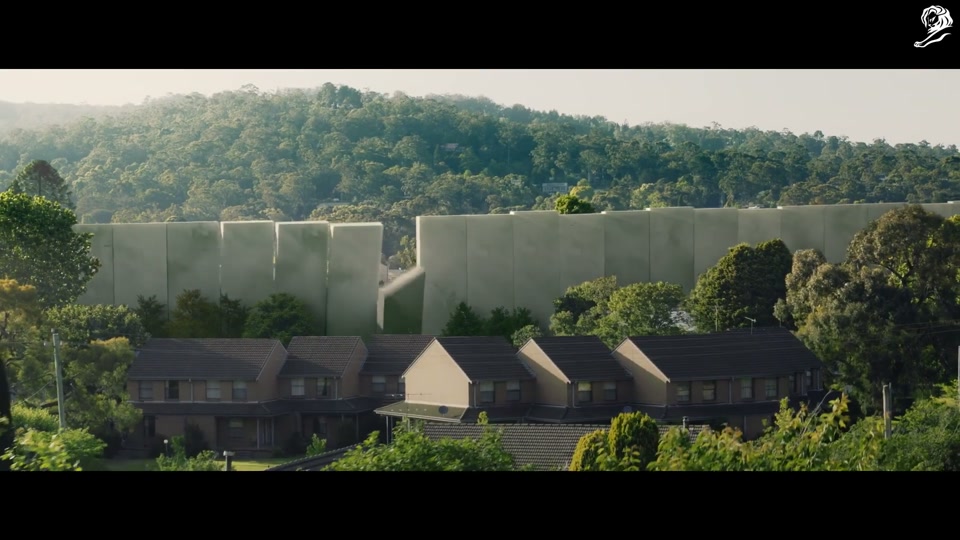
01:38 · food shot The crowd of onlookers charges towards the wall, armed with household items, sporting equipment, and garden tools. An elderly woman on a mobility scooter joins the charge. -
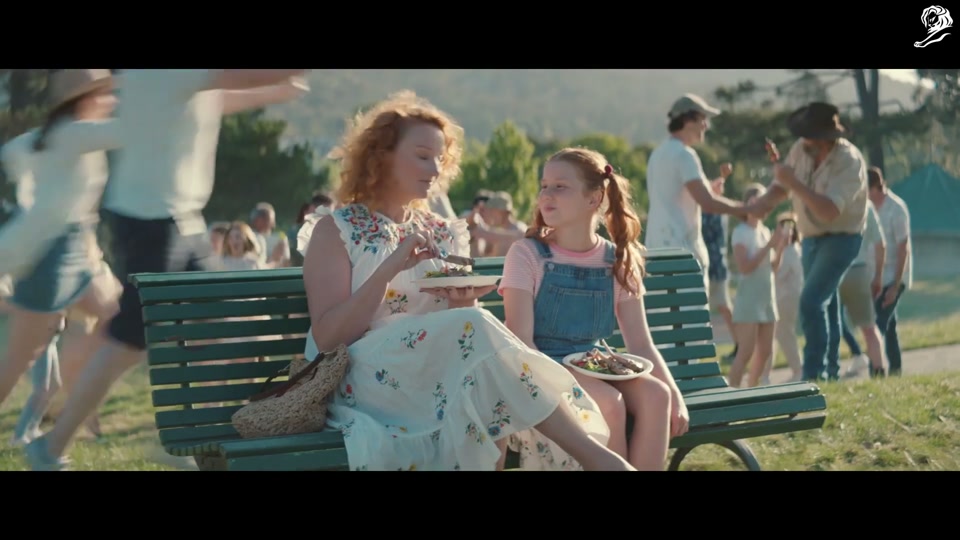
01:59 · reveal The walls are gone. A huge, diverse crowd mingles joyfully in a park, centered around multiple barbecues. Smoke fills the air. People are hugging and reuniting. -
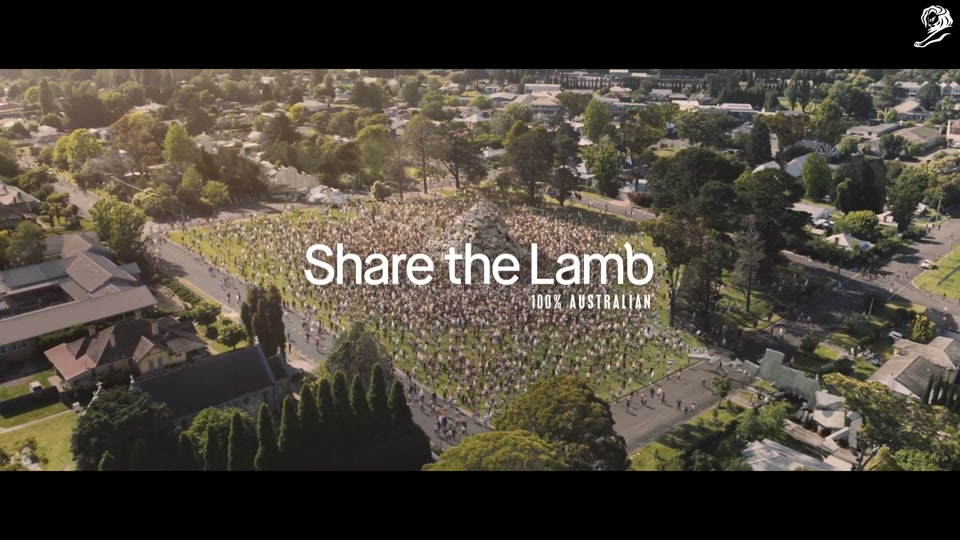
02:25 · brand frame The crowd celebrates together, holding lamb chops. A chef stands on a pile of rubble, barbecuing. A young girl, smiling, tells the old man, "We did it." He smiles back, holding his lamb chop.
Scene-by-scene account
Show full scene breakdown
00:00 - 00:27
Visuals
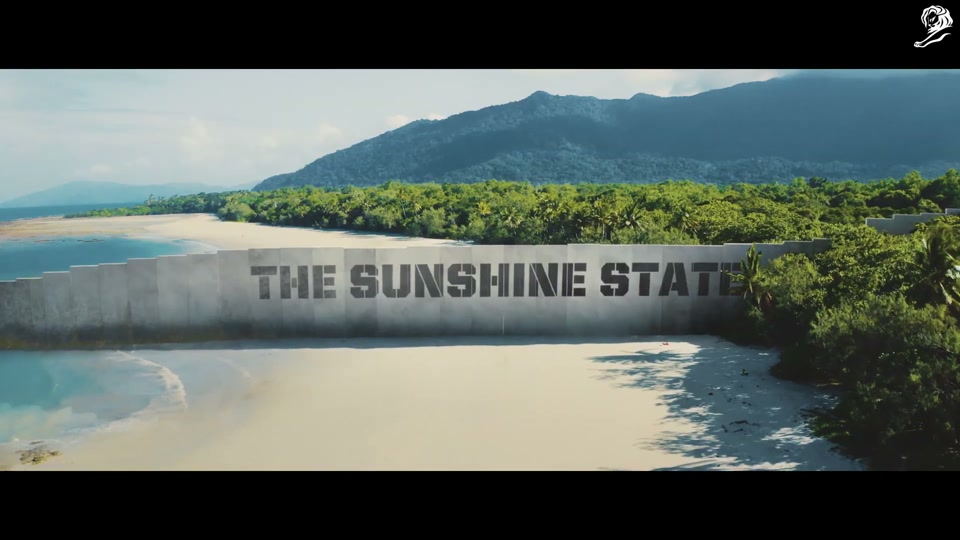
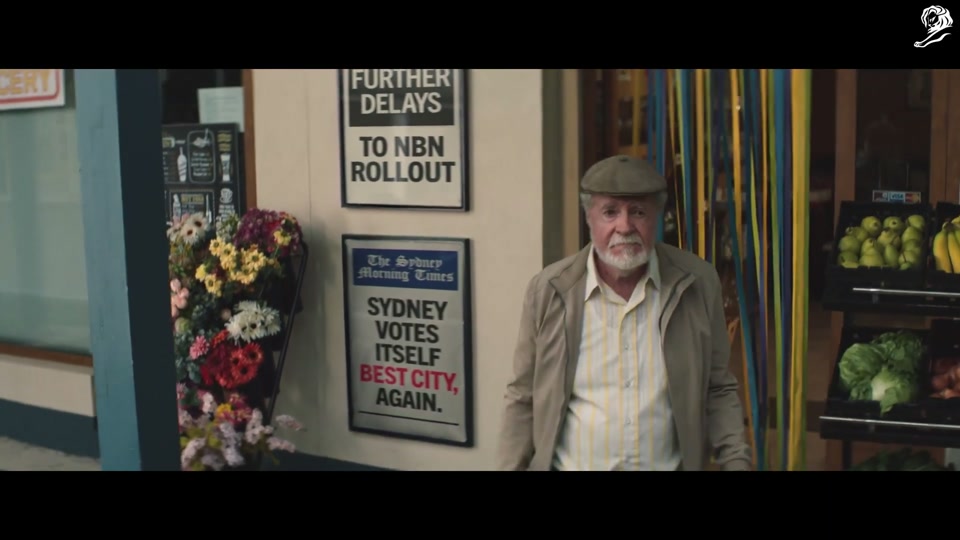
The ad opens with a man on a ladder using a paint roller to apply black paint to a colossal concrete wall that stretches to the horizon. The on-screen text "NEW SOUTH WALL" is stencilled onto it. An aerial shot reveals the wall cutting through a barren, red-earth landscape with the text "AUSTRALIA 2031". The setting shifts to a dreary-looking border town, where a "Welcome to Albury-Wodonga" sign is broken in half against the wall. Another shot shows a wall cutting a tropical beach in half, labelled "THE SUNSHINE STATE". In a drab town, we see a "BIG WALL GROCERY" store. Framed newspaper front pages on the wall read "FURTHER DELAYS TO NBN ROLLOUT" and "SYDNEY VOTES ITSELF BEST CITY, AGAIN." A woman at a street stall sells merchandise with wall-themed puns like "WALL YOU NEED IS LOVE," "I ❤️ WALL," and "ANOTHER BRICK IN THE...".
Dialogue and audio
A female newsreader provides a voiceover against a backdrop of dramatic, slightly melancholic music.
Newsreader (V.O.): "Today marks 10 years since our once-united nation was divided by the great state walls. As tensions continue to escalate, an increasing number of Victorians have applied for weather asylum in the Northern Territory..."
On-screen text
- 00:05: NEW SOUTH WALL
- 00:08: AUSTRALIA 2031
- 00:11: Welcome to Albury-W[odonga]
- 00:13: THE SUNSHINE STATE
- 00:16: BIG WALL GROCERY
- 00:18: [Newspaper 1] FURTHER DELAYS TO NBN ROLLOUT
- 00:19: [Newspaper 2] The Sydney Morning Times: SYDNEY VOTES ITSELF BEST CITY, AGAIN.
- 02:25: [T-shirt 1] WALL YOU NEED IS LOVE
- 02:26: [T-shirt 2] I ❤️ WALL
- 02:25: [T-shirt 3] ANOTHER BRICK IN THE...
Meaning and context
Directly observable: The ad establishes a near-future dystopia where Australia's states are physically and culturally separated by massive walls. Life in this divided nation appears drab and commercially exploited.
Likely interpretation at release: The premise is a direct and satirical exaggeration of the hard state border closures enacted during the 2020 COVID-19 pandemic. The year 2031 sets the story ten years after the ad's 2021 release, implying the divisions of 2020 became permanent. The "weather asylum" joke references Melbourne's notoriously bad weather compared to the tropical north. The newspaper headlines and merchandise are running gags about long-standing Australian issues (the NBN rollout) and cultural rivalries (Sydney's perceived arrogance). The wall-themed merchandise parodies famous pop culture references ("All You Need Is Love" by The Beatles, Pink Floyd's "Another Brick in the Wall").
Verification needed: Confirming the specific premiers and border policies of 2020 that are being satirised.
00:27 - 01:11
Visuals
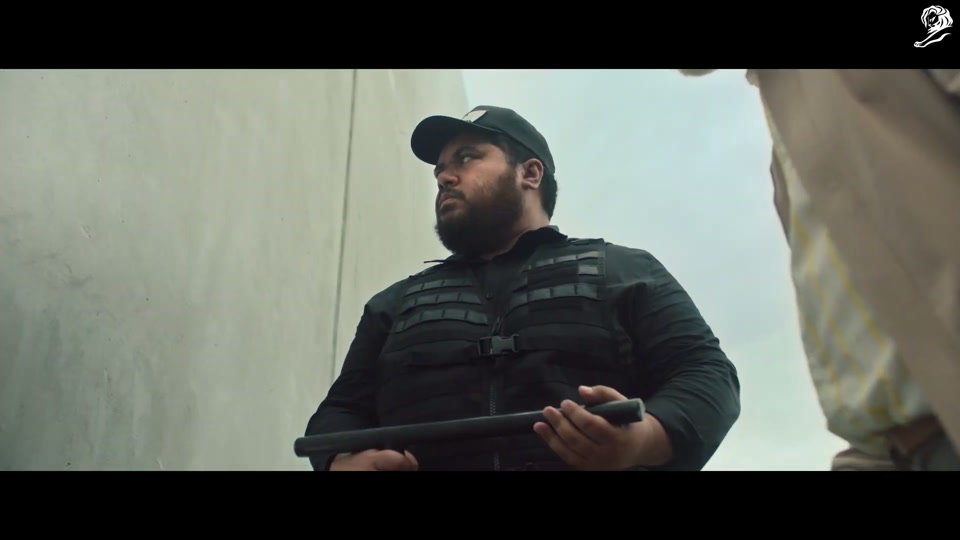
An elderly man, carrying grocery bags, walks along the wall. He stops and sniffs the air, intrigued. He discovers a small hole in the concrete. He kneels down to peer through it. A security guard approaches him menacingly. Nearby, a mother and daughter watch. The guard, holding a baton, prepares to intervene.
Dialogue and audio
The music becomes tense and emotional.
Daughter: "What's on the other side, Mummy?" Mother: "They're called... Queenslanders."
The old man, ignoring the guard, continues to investigate the hole. The guard raises his baton but then hesitates.
Meaning and context
Directly observable: An ordinary citizen is drawn by a scent from the other side of the wall, creating a moment of tension with authority. The dialogue shows that people on the other side are now viewed as a strange, almost alien group.
Likely interpretation at release: The scene satirises the fear and "othering" of fellow Australians that occurred across state borders in 2020. The mother's hushed, fearful mention of "Queenslanders" is a joke about how interstate rivalries were amplified to the point of absurdity. The old man represents a generation that remembers a united country, and his curiosity (driven by the smell of lamb) overrides the new culture of fear.
01:11 - 01:48
Visuals
The crowd of onlookers charges towards the wall, armed with household items, sporting equipment, and garden tools. An elderly woman on a mobility scooter joins the charge. The man who started it all is interviewed by a news reporter. Others attack the wall with shovels, sledgehammers, and barbecue tongs. A separate group pulls on a mural of a Queensland lifeguard, causing the crotch area of his "budgie smugglers" to break open. Elsewhere, a woman in a tractor pulls down a section of the wall. A couple posing for a selfie is interrupted as a tank bursts through the wall behind them. A politician-like figure emerges from the tank's hatch.
Dialogue and audio
A powerful, driving rock anthem begins.
Man with shovel: "What's he think's in here?" [TXT says: "so Syne see"] Reporter: (to the old man) "...reporting live with the man who started it all." Old Man: "I just wanted some lamb." Politician in tank: "I love the smell of lamb in the morning!"
On-screen text
- 01:27: [Live news chyron] BREAKING NEWS: GREAT AUSSIE WALLS COMING DOWN. WA STILL RESISTING.
- 01:33: [Mural text] NOWHERE ELSE BUT QUEENSLAND
Meaning and context
Directly observable: The act of sharing lamb inspires a nationwide, chaotic, and joyful popular uprising to destroy the walls. People from all walks of life participate. The news reports that Western Australia is resisting the reunification.
Likely interpretation at release: This sequence is the core of the ad's message: the simple, shared pleasure of lamb can unite the nation. The use of everyday items as weapons is a classic Australian "make-do" trope. The news chyron "WA STILL RESISTING" is a direct joke about Western Australia's premier, Mark McGowan, who maintained the country's hardest border policy in 2020, feeding a long-standing narrative of WA secessionism ("WAxit"). The politician's line is a parody of the famous "I love the smell of napalm in the morning" from the film Apocalypse Now. The tank bursting through the wall is a visual metaphor for the overwhelming power of the people's will.
Verification needed: The exact details of WA's 2020 border policy. The identity of the politician in the tank, though likely a generic figure.
01:48 - 02:11
Visuals
The walls are gone. A huge, diverse crowd mingles joyfully in a park, centered around multiple barbecues. Smoke fills the air. People are hugging and reuniting. A woman named Doreen tearfully reunites with a man named Leo. She introduces her husband to a man named Julio. A miner-like figure emerges from a tunnel in the ground, representing Western Australia. A small, bedraggled group wearing life vests arrives, representing Tasmania.
Dialogue and audio
The music is celebratory and uplifting.
Doreen: "Leo!" Leo: "Doreen! I waited for you." Doreen: "So, this is Julio." Old Man: "WA, you made it!" WA Miner: "Yeah! Sorry for trying to become our own country. Again." Reporter: "And here the Tasmanians have arrived. Where are the rest of you?" Tasmanian Man: "This is all of us."
On-screen text
- 02:06: [Live news chyron] TASMANIANS ARRIVE
Meaning and context
Directly observable: People from all states, identifiable by stereotype, have come together. Western Australians arrive by tunnelling and apologise for their separatism. The entire population of Tasmania is shown as just four people.
Likely interpretation at release: This is the utopian resolution. The jokes are based on well-established state stereotypes. The WA character digging her way out reinforces the "WAxit" theme and the state's geographical and political isolation. The joke about Tasmania's tiny population is a classic Australian gag. The emotional reunions underscore the ad's core theme of overcoming division.
02:11 - 02:30
Visuals
The crowd celebrates together, holding lamb chops. A chef stands on a pile of rubble, barbecuing. A young girl, smiling, tells the old man, "We did it." He smiles back, holding his lamb chop. In a post-credits scene, a man in a Hawaiian shirt and floral lei, holding a cocktail, steps out of an "Aloha Airlines" plane onto the tarmac, looking confused.
Dialogue and audio
Girl: "We did it. The United States of Australia!" Old Man: "Nah. It's just Australia." Chef: "We should celebrate this day every year." Man in Hawaiian shirt: "What have I missed?"
On-screen text
- 02:23: Share the Lamb. 100% Australian.
Meaning and context
Directly observable: The reunification is complete. The characters reject a new, formal name, preferring the simple identity of "Australia." The ad ends with the slogan "Share the Lamb." The final scene shows a man in holiday attire arriving late and confused.
Likely interpretation at release: The old man's correction from "The United States of Australia" to "It's just Australia" is the key message: Australian identity is singular and should not be fractured. The chef's line "We should celebrate this day every year" is a nod to the campaign's traditional release around Australia Day. The final scene is a pointed and widely understood satirical reference to Prime Minister Scott Morrison, who took a secret family holiday to Hawaii during the catastrophic 2019-20 bushfire season, a major political scandal. His line, "What have I missed?" lampoons his perceived disconnect from the national crisis.
Verification needed: Confirmation of the public sentiment and media coverage surrounding Scott Morrison's Hawaii trip in December 2019.
Verification and uncertainties
- Uncertain dialogue: The supplied TXT transcript at 01:19 reads "so Syne see". The audio is clearly a man with a shovel saying, "What's he think's in here?" This should be corrected in any final analysis.
- Topical claims needing release-period research:
- The specific dates and public rhetoric surrounding the 2020 state border closures by premiers like Mark McGowan (WA), Annastacia Palaszczuk (QLD), and Daniel Andrews (VIC).
- Media coverage and public polling regarding Scott Morrison's Hawaii trip to confirm the persistence of this issue into January 2021.
- Remembered background facts requiring external verification:
- The ad is widely known as the "Make Lamb, Not Walls" campaign from 2021. This assumed title and year should be verified against official campaign materials.
- The timing of the campaign's release in relation to Australia Day (January 26th).