Australia Day Address
2008In a satirical national address, former AFL footballer and media personality Sam Kekovich, styled as a politician, declares it is his "solemn duty" to abolish Australia Day. He argues that a single day is insufficient to celebrate the nation and combat a rising tide of "un-Australianism." The solution, he proclaims, is to replace it with "Australia Week," a seven-day "Lamathon."
From a desk placed in a series of iconic and absurdly majestic Australian landscapes—the red-dirt outback, a golden wheat field, a lush rainforest, a desert, a billabong, and finally atop the Sydney Harbour Bridge—Kekovich delivers a bombastic, politically incorrect speech. He rails against contemporary social issues, including the tearful apologies of misbehaving footballers, and compares Australia's single day of celebration unfavourably to multi-day events like the Olympics and even the APEC summit.
He dismisses protesters as "placard-waving, police-bashing, weed-worshippers" and suggests anyone "un-Australian" enough to refuse lamb should be sent to the Nauru refugee processing centre. Kekovich calls on all Australians to take the week off, fill their fridges with lamb, and defy any boss who objects. The ad concludes with the on-screen text, "We love our Lamb."
Watch the advertisement
Historical and topical context
Campaign year: 2005 Assumed or known release period: January 2005 Primary context year: 2004 Likely topical context window: July 2004 to January 2005 Confidence in those dates: High
The advertisement was released into an Australia governed by the Liberal-National Coalition under Prime Minister John Howard, who had secured a fourth term in the federal election on October 9, 2004. The national mood was shaped by ongoing debates about national identity, security in the post-9/11 era, and controversial government policies.
Reference: The "Pacific Solution" and Nauru Evidence in the ad: "send 'em to Nauru. The refugee processing centre has plenty of palm trees they can hug." (0:59) Likely relevance at release: This was a highly topical and provocative reference. The Howard government's policy of processing asylum seekers in offshore centres on Nauru and Manus Island (PNG) was a major political issue. While the last detainees had left Manus Island in 2004, the Nauru facility and the overall policy remained a point of intense public and political debate, particularly during the 2004 election campaign. The line was designed to be deliberately inflammatory and align the brand with a tough, anti-establishment, and politically incorrect stance. Confidence: High External verification needed: No
Reference: APEC Summit Evidence in the ad: "...even APEC gets a week, and that's just a bunch of blokes in funny shirts!" (0:40) Likely relevance at release: The APEC Leaders' Summit was held in Santiago, Chile, in November 2004. The tradition of world leaders posing for a photo in matching shirts or jackets provided by the host nation was a well-known visual, making the "funny shirts" jibe instantly recognisable. The reference positions the ad's proposed "Lamathon" as being more important than a major international political summit. Confidence: High External verification needed: No
Reference: Helen Clark Evidence in the ad: "...apart from Helen Clark, who does a passable impersonation of a bloke anyway." (0:44) Likely relevance at release: Helen Clark was the Prime Minister of New Zealand from 1999 to 2008. As a prominent female leader, she was a well-known figure in Australia. The joke, while sexist by today's standards, was typical of the cross-Tasman banter and the ad's provocative style. Confidence: High External verification needed: No
Reference: Misbehaving Footballers Evidence in the ad: "...if I see another binge-drinking, pill-popping, powder-sniffing footballer making a tearful television apology, I'll blow a fuse." (0:12) Likely relevance at release: Player misbehaviour, particularly in the Australian Football League (AFL) and National Rugby League (NRL), was a recurring media theme. The trope of the public, tearful apology had become a cliché. While no single event from late 2004 stands out as the sole trigger, the reference taps into a general public weariness with scandals involving high-profile, highly-paid athletes. Confidence: High External verification needed: Yes (to identify specific prominent incidents in the context window that would have been front-of-mind for audiences).
Reference: The "New PM" Evidence in the ad: "I'll be petitioning our new PM to officially recognise Australia Week." (1:05) Likely relevance at release: John Howard's Coalition government won the federal election on October 9, 2004. His opponent, Labor leader Mark Latham, subsequently resigned from politics in January 2005. The ad, released in January 2005, appeared just after the start of Howard's new term. The reference to a "new PM" is therefore likely a satirical flourish referring to the new governmental term, or part of the fictional narrative in which Kekovich himself is a political force. Confidence: Medium External verification needed: No
Campaign meaning
Creative premise
The advertisement uses the creative premise of a satirical "State of the Nation" address. It positions a well-known, loud-mouthed media personality, Sam Kekovich, as a pseudo-political leader delivering a bombastic and politically incorrect manifesto from a series of visually absurd, iconic Australian locations. This format allows the campaign to parody political discourse while aggressively inserting its product—lamb—into the centre of a debate about national identity.
Message
Explicit message:
- Australians should eat lamb during the week of Australia Day. [1:21]
- The slogan is "We love our Lamb." [1:27]
- Being "un-Australian" is a problem that needs to be addressed. [0:07, 1:20]
- One day is not enough to celebrate Australia; it should be a week. [0:19]
Strongly implied message:
- Eating lamb is a patriotic duty and the ultimate expression of Australian identity.
- "True" Australian values include larrikinism, a healthy disrespect for authority (bosses, politicians), and plain speaking.
- Political correctness, intellectualism, and protesting are "un-Australian" activities.
- The official observation of Australia Day is inadequate; a more authentic, grassroots celebration revolving around barbecues is required.
Tentative interpretation:
- The ad positions itself against a perceived "elite" culture (politicians, protesters) and sides with a "mainstream" or "battler" culture that just wants to enjoy a barbecue.
- By using such over-the-top political incorrectness, the ad suggests that the national conversation has become too serious and needs a dose of irreverent humour.
Role of lamb
In this advertisement, lamb is elevated from a mere food product to a powerful cultural symbol. It functions as:
- A patriotic sacrament: Eating lamb becomes a ritual of national identity, the primary way to prove one's "Australianness."
- A social unifier: Lamb is the centrepiece of the barbecue that brings "the rest of us" together, defining an "in-group" against those who are "un-Australian."
- The solution to national problems: Kekovich presents lamb consumption as the cure for "un-Australianism," a decline in national character, and insufficient patriotism.
- A plot device: The entire premise of extending Australia Day to "Australia Week" is justified by the need for more "lamb meal opportunities."
Worldview evidence
[Patriotism as Consumption]
Classification: Strongly implied Evidence: The entire ad, culminating in "So don't be un-Australian! Serve lamb this Australia Week!" (1:20) Meaning at release: The ad directly equates the act of eating a specific product with fulfilling a patriotic duty. It satirically suggests that national character can be measured and improved by the consumption of lamb. Possible contemporary difference: This link might be seen as more overtly commercial and less humorous in a contemporary context where consumerism and national identity are more frequently scrutinised.
[Larrikinism and Anti-Authoritarianism]
Classification: Explicit Evidence: "Any boss that won't let you is a bum! Just chuck a week of sickies instead." (1:14) Meaning at release: This celebrates a classic Australian "larrikin" archetype: one who casually defies authority for the sake of a good time. Telling viewers to lie to their employer is a deliberately anti-establishment and rebellious message.
[Rejection of 'Political Correctness' and Protest]
Classification: Explicit Evidence: "The placard-waving, police-bashing, weed-worshippers may protest about it..." (0:48); the joke about Helen Clark (0:44); the suggestion to send objectors to Nauru (0:59). Meaning at release: The ad adopts a deliberately provocative and politically incorrect tone, using derogatory stereotypes to dismiss dissent and alternative viewpoints. This was a key part of its "edgy" humour and its appeal to an audience tired of what they might perceive as "political correctness."
[A Singular, Monolithic Australian Identity]
Classification: Strongly implied Evidence: The recurring binary of "Australian" versus "un-Australian," and the call for everyone to unite around a single activity (eating lamb). Meaning at release: The ad humorously posits a very narrow and prescriptive definition of what it means to be Australian, excluding vegetarians, protesters, and anyone else who doesn't conform. It parodies the very idea of a single national identity while simultaneously promoting one based on lamb.
Humour, tone and satire
- Tone: The tone is bombastic, deadpan, and satirical. Kekovich's unwavering seriousness in delivering an absurd message is the central driver of the humour. The score is majestically cinematic, further heightening the parody of a serious political broadcast.
- Principal joke mechanisms:
- Juxtaposition: The formal desk and suited politician in wild, natural landscapes.
- Exaggeration: The proposal to abolish Australia Day and institute a seven-day "Lamathon" with 21 meal opportunities.
- Satire: The ad is a direct satire of political speeches, nationalistic rhetoric, and media clichés (e.g., the tearful footballer apology).
- Politically incorrect and topical humour: Jokes about specific politicians (Helen Clark) and controversial issues (Nauru) were designed to be provocative and generate buzz.
- Targets of satire: The primary targets are politicians, the media, "wowsers" (killjoys), protesters, and the very notion of a neatly defined national identity. The satire is broad, targeting figures and groups across the cultural spectrum.
- Affectionate parody versus genuine criticism: The ad affectionately parodies the "Aussie larrikin" (by embodying it) while directing more genuine, albeit satirical, criticism towards figures of authority and those perceived as taking themselves too seriously (politicians, protesters).
Campaign evidence summary
Core message
The core message is that eating lamb is a fundamental, non-negotiable part of the Australian identity. The ad humorously argues that this patriotic duty is so important that the national holiday should be extended to a week-long "Lamathon" to ensure sufficient consumption, and that anyone who disagrees is "un-Australian."
Values supported by this ad
- Irreverence and larrikinism
- A singular, traditional view of national identity
- Disdain for political correctness and authority
- Patriotism expressed through consumption
- The barbecue as a central cultural institution
Role of lamb
Lamb is positioned as the sacrament of Australian identity. It is not just meat; it is the great unifier, the solution to national ills, and the ritual that separates true Australians from the "un-Australian." The entire ad is a hyperbolic justification for eating more of it.
Most important topical or historical elements
- The direct, provocative reference to the Howard government's "Pacific Solution" and the Nauru detention centre.
- Satirical jabs at the 2004 APEC summit and the-then Prime Minister of New Zealand, Helen Clark.
- The context of the October 2004 federal election, won by John Howard against Mark Latham.
Uncertainties
- The specific identity of the green-and-white flag on Kekovich's desk.
- The specific footballer scandals of 2004 that may have inspired the line, though the reference works as a general trope.
Themes and connections
This advertisement belongs to Era 1 — The Kekovich Doctrine.
Keyframe gallery
7 representative frames, in chronological order.
-
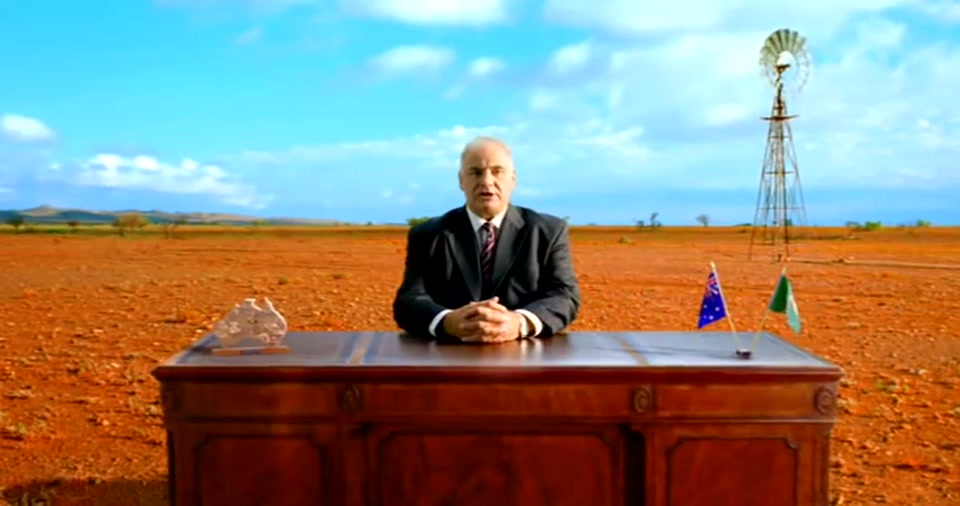
00:06 · opening Sam Kekovich, a middle-aged man in a dark suit and tie, sits at a large, formal wooden desk. He looks directly at the camera with a serious, resolute expression. -
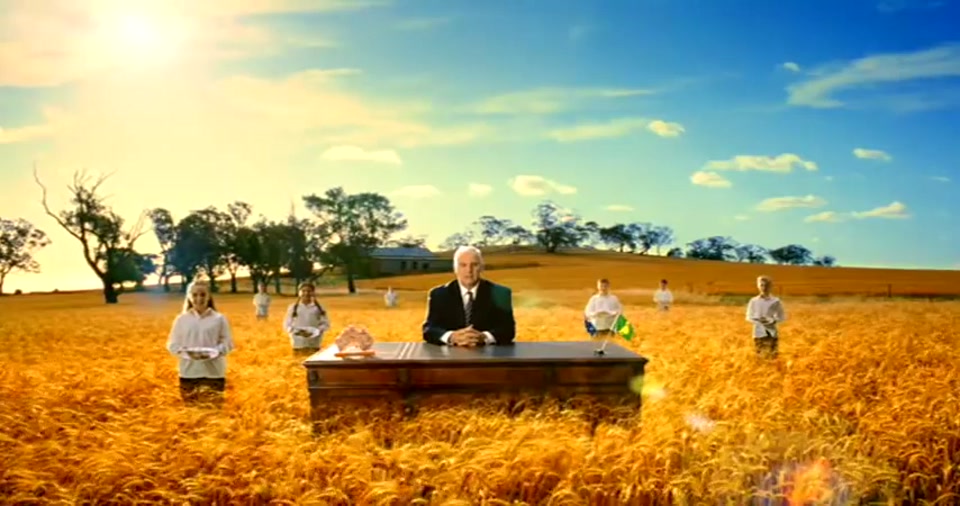
00:27 · food shot The scene abruptly changes. Kekovich and his desk are now in the middle of a vast, sun-drenched golden wheat field. -
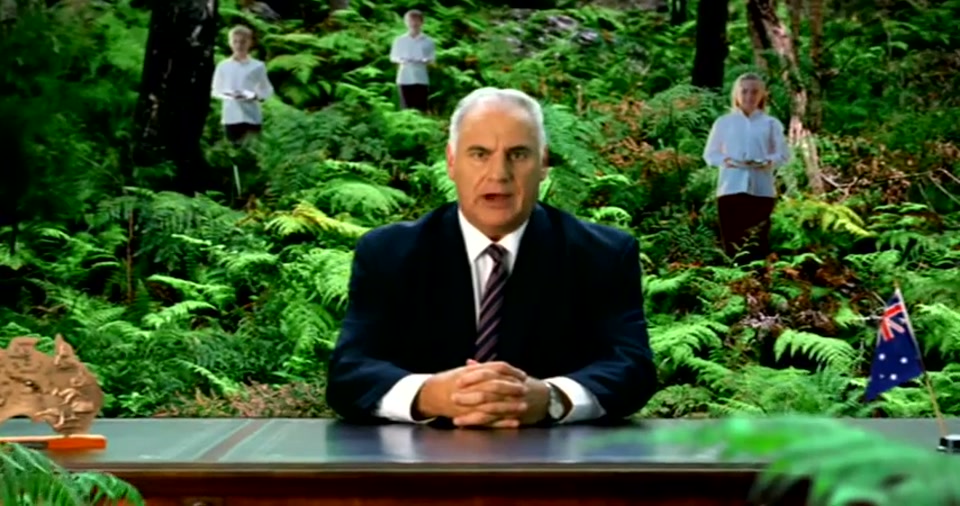
00:44 · standard The setting changes again to a lush, green fern gully or rainforest. The lighting is darker and cooler. The "waiters" are still present, scattered among the ferns. -
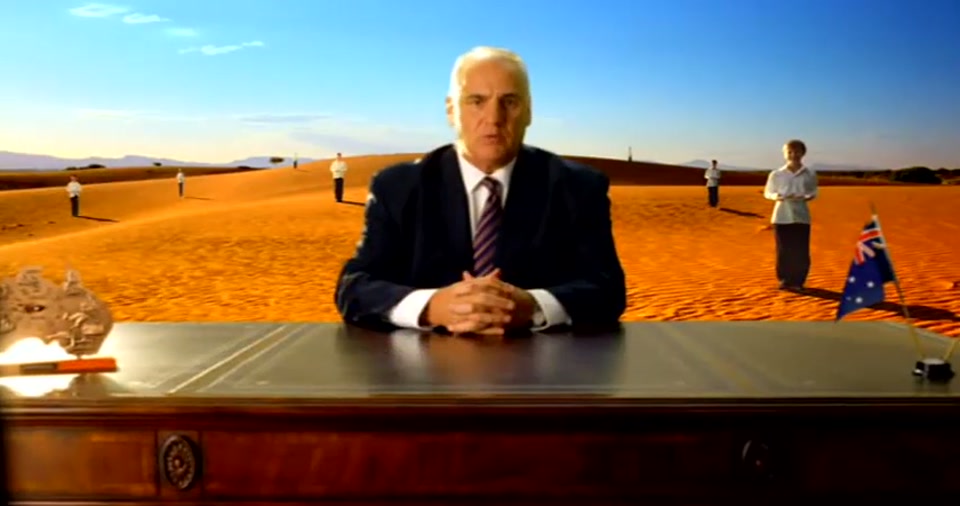
00:53 · standard The scene shifts to a vast, undulating desert of golden sand dunes. The "waiters" are positioned on the dunes in the distance. The shot is wider, emphasizing the isolation and grandeur of the setting. -
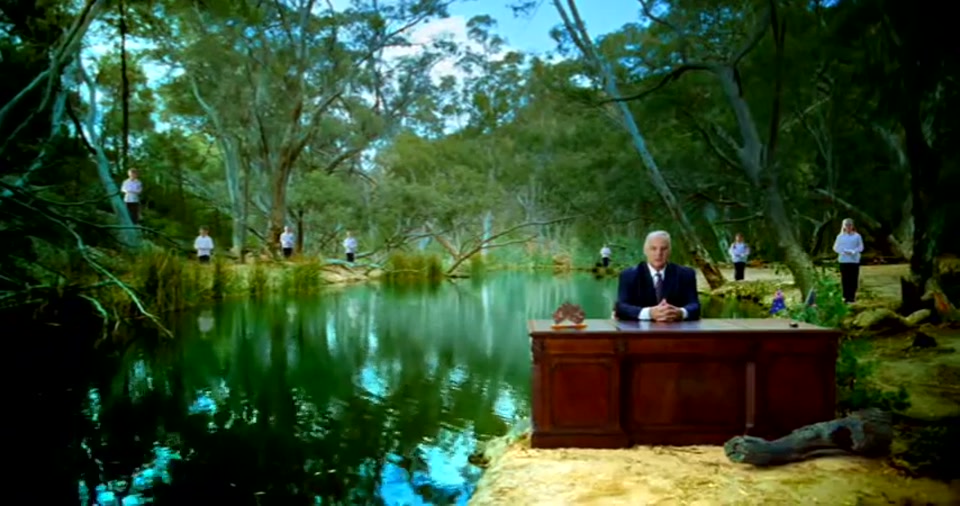
01:00 · standard The desk is now beside a calm river or billabong, surrounded by eucalyptus trees. This is a classic "bush" setting. A kookaburra figurine is now visible on the desk. -
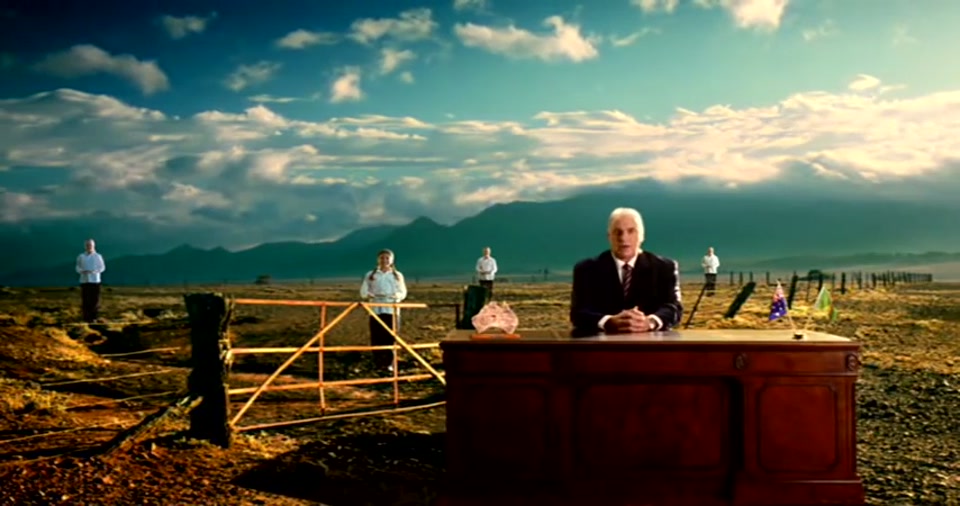
01:19 · brand frame A montage of increasingly grand and absurd locations: Kekovich's desk is on a dramatic cliff edge overlooking a valley; then behind a farm gate in a rural landscape; finally, the camera pulls back to reveal him and his… -
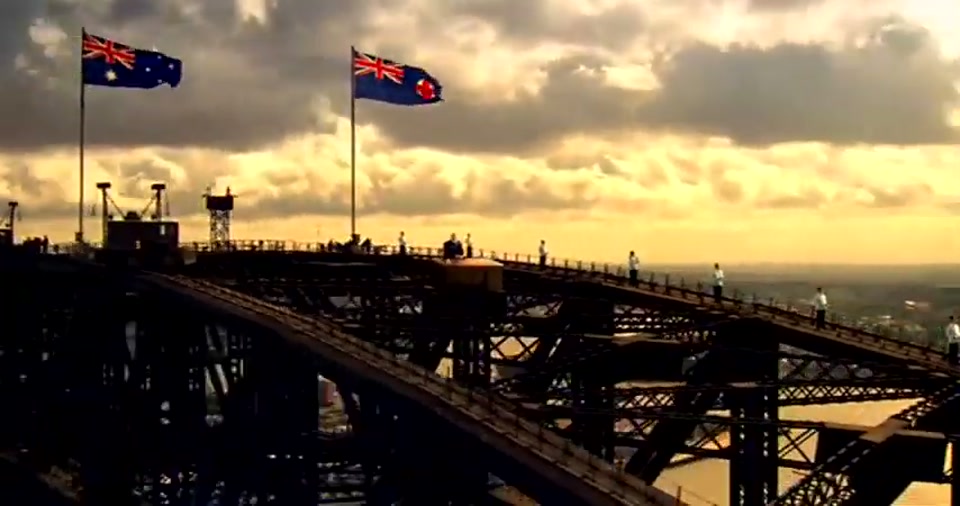
01:25 · brand frame A montage of increasingly grand and absurd locations: Kekovich's desk is on a dramatic cliff edge overlooking a valley; then behind a farm gate in a rural landscape; finally, the camera pulls back to reveal him and his…
Scene-by-scene account
Show full scene breakdown
00:00–00:25
Visuals Sam Kekovich, a middle-aged man in a dark suit and tie, sits at a large, formal wooden desk. He looks directly at the camera with a serious, resolute expression. The desk is incongruously placed in the middle of a vast, flat, red-dirt Australian outback under a bright blue sky. A classic metal windmill stands in the distance. On his desk are a small Australian flag, an unidentifiable green and white flag, and a rock-like map of Australia.
Dialogue and audio Speaker: Sam Kekovich "My fellow Australians. It is my solemn duty to inform you that it's time to abolish Australia Day. Our annual Lambfest hasn't stopped un-Australianism racing through the land like horse flu through a Japanese jockey club. For example, if I see another binge-drinking, pill-popping, powder-sniffing footballer making a tearful television apology, I'll blow a fuse. Australia Day has had its day. We need Australia Week, a seven-day Lamathon, to properly celebrate our great nation."
On-screen text None.
Meaning and context Directly observable: An authority figure, dressed as a politician, delivers a formal, satirical speech in a quintessentially Australian but absurd setting. He proposes abolishing Australia Day in favour of a week-long lamb festival to combat "un-Australianism." He specifically criticises the public apologies of footballers.
Likely interpretation at release: The scene parodies the gravitas of political addresses like the "state of the nation." Kekovich is instantly recognisable to many Australians as a brash, outspoken media figure, not a politician, creating immediate satirical tension. The term "un-Australian" is a culturally loaded phrase often used to criticise behaviour seen as contrary to national values. The critique of footballers' scandals was a highly topical reference to recurring events in popular sports codes like AFL and NRL.
Verification needed:
- Identity of the green and white flag.
- Specific "binge-drinking, pill-popping" footballer scandals in the 2004 context year.
00:25–00:35
Visuals The scene abruptly changes. Kekovich and his desk are now in the middle of a vast, sun-drenched golden wheat field. Several people dressed in white, resembling waiters or cult members, stand motionless in the background, each holding what appears to be a plate. The sun is low, creating a warm, idyllic glow.
Dialogue and audio Speaker: Sam Kekovich "Instead of one public holiday, we need seven. Instead of one lamb Barbie, we need 21 lamb meal opportunities, not including snacks. Which imbecile thought one day was long enough anyway?"
[TXT says: “instead of one lamb Barbie we need 20 one L meal opportunities not including snacks which imile thought one day was long enough anyway”]
On-screen text None.
Meaning and context Directly observable: The location shifts to another iconic Australian landscape, "from the outback to the golden plains," continuing the visual parody. The proposal escalates from a week-long holiday to a specific, exaggerated number of lamb meals. The mysterious figures in the background add to the surreal, cult-like atmosphere of his "movement."
Likely interpretation at release: This scene leverages the classic imagery of Australia as a land of plenty ("plains of gold"). The joke relies on mathematical absurdity (7 days x 3 meals = 21 "lamb meal opportunities") to frame the argument in mock-serious, logistical terms. The figures in the background enhance the parody of a political or religious leader with his devoted followers.
Verification needed: None.
00:35–00:48
Visuals The setting changes again to a lush, green fern gully or rainforest. The lighting is darker and cooler. The "waiters" are still present, scattered among the ferns. Kekovich continues his address, maintaining his stern demeanor. The Australian flag remains on his desk.
Dialogue and audio Speaker: Sam Kekovich "Look at the Olympics, Oktoberfest, the Turkish oil wrestling festival... even APEC gets a week, and that's just a bunch of blokes in funny shirts! Apart from Helen Clark, who does a passable impersonation of a bloke anyway."
[TXT says: “the Turkish o wrestling Festival even ape gets a week and that just a bunch of BLS in funny shirts apart from Helen Clark who does a possible impersonation of a bloke anyway”]
On-screen text None.
Meaning and context Directly observable: The visual tour of Australian landscapes continues, moving to a temperate rainforest. Kekovich compares his proposed "Australia Week" to other multi-day global events, including APEC. He makes a specific, pointed joke about Helen Clark, the then-Prime Minister of New Zealand.
Likely interpretation at release: The comparison to real festivals adds a layer of pseudo-logic to his absurd proposal. The reference to APEC (Asia-Pacific Economic Cooperation) and its leaders in "funny shirts" (a reference to the tradition of leaders wearing matching outfits from the host nation) was topical; the APEC summit was held in Chile in November 2004. The joke at the expense of Helen Clark taps into a long tradition of trans-Tasman rivalry and was considered edgy but humorous at the time.
Contemporary reading: The joke about Helen Clark's appearance would likely be received as more overtly sexist and inappropriate by a contemporary audience.
Verification needed:
- Confirm the tradition of "funny shirts" at APEC summits in or before 2004.
00:48–00:58
Visuals The scene shifts to a vast, undulating desert of golden sand dunes. The "waiters" are positioned on the dunes in the distance. The shot is wider, emphasizing the isolation and grandeur of the setting.
Dialogue and audio Speaker: Sam Kekovich "The placard-waving, police-bashing, weed-worshippers may protest about it, but it's nothing a few blasts from a water cannon can't fix. They could do with a wash. And if they're still too un-Australian to chomp a few chops with the rest of us..."
On-screen text None.
Meaning and context Directly observable: The setting is now a desert. Kekovich dismisses potential protesters with derogatory labels and suggests using water cannons on them. He frames their opposition as being "un-Australian."
Likely interpretation at release: This section satirises the dismissive attitude of conservative commentators and politicians towards protesters. The "placard-waving..." stereotype was a common trope used to caricature left-wing or environmental activists. The suggestion of using water cannons is deliberately authoritarian and hyperbolic for comedic effect. This plays into the ad's politically incorrect tone.
Verification needed: None.
00:58–1:07
Visuals The desk is now beside a calm river or billabong, surrounded by eucalyptus trees. This is a classic "bush" setting. A kookaburra figurine is now visible on the desk.
Dialogue and audio Speaker: Sam Kekovich "...send 'em to Nauru. The refugee processing centre has plenty of palm trees they can hug. I'll be petitioning our new PM to officially recognise Australia Week."
[TXT says: “send them to through the refugee processing center has plenty of palm trees I can hug I'll be petitioning a new pm to officially recognize Australia”]
On-screen text None.
Meaning and context Directly observable: The scenery changes to a riverbank. Kekovich suggests sending those who won't eat lamb to Nauru, explicitly identifying it as a refugee processing centre. He mentions petitioning the "new PM."
Likely interpretation at release: This is the most politically pointed joke in the ad. The reference to the Nauru detention centre and the "Pacific Solution" was a direct and highly controversial topical reference. The Howard government's offshore processing policy was a major political issue throughout the early 2000s and a key topic in the October 2004 federal election. The line "plenty of palm trees they can hug" is a satirical jab at environmentalists, conflating them with the protesters mentioned earlier and asylum seekers. The "new PM" reference is slightly ambiguous; John Howard had just been re-elected for a fourth term in October 2004, defeating Mark Latham. It could refer to the newly commenced term of government or simply be part of the ad's fictional political premise.
Contemporary reading: This joke's direct reference to a controversial and widely criticised human rights issue would likely be seen as far more shocking and less humorous today.
Verification needed:
- Clarity on the "new PM" reference in the context of the October 2004 election.
1:07–1:31
Visuals A montage of increasingly grand and absurd locations: Kekovich's desk is on a dramatic cliff edge overlooking a valley; then behind a farm gate in a rural landscape; finally, the camera pulls back to reveal him and his desk perched on the very top arch of the Sydney Harbour Bridge at sunset. Two large Australian flags fly behind him. The "waiters" are lined up along the bridge's arch.
Dialogue and audio Speaker: Sam Kekovich "If you still call Australia home, stack the fridge full of lamb, take the week off and celebrate with me. Any boss that won't let you is a bum! Just chuck a week of sickies instead. What could be more Australian than that? So don't be un-Australian! Serve lamb this Australia Week! You know it makes sense! I'm Sam Kekovich!" (Music swells triumphantly)
On-screen text (1:27) We love our Lamb
Meaning and context Directly observable: The ad climaxes with a call to action, delivered from Australia's most iconic man-made structure. Kekovich encourages viewers to take a week off work, calling bosses who refuse "bums" and advocating for "chucking a sickie" (calling in sick dishonestly). The ad ends with his name and the campaign slogan.
Likely interpretation at release: This final sequence reinforces the ad's core themes of larrikinism and a casual disregard for authority ("any boss...is a bum," "chuck a sickie"). These are celebrated as quintessentially Australian traits. Placing Kekovich on the Harbour Bridge is the ultimate visual gag, cementing his status as a mock-national leader. The ad explicitly links eating lamb with patriotism ("Don't be un-Australian"). This ad was the first in a long-running and famous series featuring Kekovich as the "Lambassador".
Verification needed: None.
Verification and uncertainties
- The analysis file's internal metadata labels the campaign year as 2005; the archive filename (2008) is treated as canonical. The master analysis flags the topical context as most consistent with 2007 (Sydney APEC) rather than 2004.
- The analysis records a Helen Clark gender joke; the Lamb Brain guardrails classify this as a deprecated execution.
- Uncertain dialogue: None. Transcript has been corrected against audio.
- Likely TXT errors: Corrected (e.g., "un-Australianism," "imbecile," "Nauru").
- Unclear on-screen text: The green and white flag on the desk. It could be a fictional "Lamb" flag or a real one out of context.
- Uncertain identities or references: While the references are clear, deeper context on specific 2004 footballer scandals would add texture.
- Topical claims needing release-period research: The cultural status of "chucking a sickie" in 2004 versus today. The general public mood regarding the "Pacific Solution" in January 2005 after the election.
- Remembered background facts requiring external verification: The ad is widely known as Sam Kekovich's first for MLA, which external sources confirm.