Barbie Girl Chop Song
2012In a parody of a serious political address, former AFL footballer and "Lambassador" Sam Kekovich speaks to the nation from a formal office, resembling the US White House's Oval Office. He laments the decline of Australian values, which he attributes to an obsession with "un-Australian" popular culture. He cites a litany of 2011 celebrity events, including the public's fascination with Pippa Middleton, Shane Warne's makeover, Lady Gaga's meat dress, and the trials of Charlie Sheen and Michael Jackson's doctor.
Declaring popular culture "so un-Australian," Kekovich announces his solution: the creation of "Chopular Culture." The somber office setting dramatically transforms into a high-energy pop concert. Kekovich, now in a powder-blue suit and gold chain, performs a parody of Aqua's "Barbie Girl" titled "The Chop Song," surrounded by backup dancers. The ad concludes with a call to action for Australians to make lamb their number one choice on Australia Day, thereby restoring the nation's cultural integrity.
Watch the advertisement
Historical and topical context
- Campaign year: 2012.
- Assumed or known release period: January 2012.
- Primary context year: 2011.
- Likely topical context window: April 2011 – January 2012.
- Confidence in those dates: High. The specific events referenced in the ad firmly place its context in 2011.
The ad taps into a media environment saturated with international celebrity news and the rise of social media platforms like Facebook and Twitter, which accelerate gossip. It positions itself as a conservative, "common sense" backlash against this perceived cultural shift.
Reference: "pics of Pippa Middleton's rump on Facebook" Evidence in the ad: 00:09 - Explicit dialogue. Likely relevance at release: Following the Royal Wedding of Prince William and Kate Middleton in April 2011, Kate's sister Pippa Middleton became an overnight celebrity, with widespread media commentary focusing on her figure in her bridesmaid's dress. This was a major global pop culture event of 2011. Confidence: High External verification needed: No
Reference: "gossip mags have really gone googly-eyed over Shane Warne, who went from bowling overs to makeovers... Bleaching his pearlies for Hurley." Evidence in the ad: 00:17 - Explicit dialogue. Likely relevance at release: In mid-2011, Australian cricketer Shane Warne's relationship with British actress Elizabeth Hurley was a constant source of tabloid fascination. Warne underwent a significant physical transformation, including weight loss and a more styled appearance, which was widely dubbed his "makeover." Confidence: High External verification needed: No
Reference: "is it any wonder that Charlie Sheen's lost his sparkle when he's always off his chops?" Evidence in the ad: 00:29 - Explicit dialogue. Likely relevance at release: In early 2011, actor Charlie Sheen was fired from his hit show Two and a Half Men and engaged in a widely publicised media tour characterised by bizarre interviews where he claimed to have "tiger blood" and be "winning". The phrase "off his chops" is Australian slang for being intoxicated or behaving erratically, used here as a pun on lamb chops. Confidence: High External verification needed: No
Reference: "We go gaga over a lady that wears a dress made out of lamb, instead of eating it." Evidence in the ad: 00:37 - Explicit dialogue. Likely relevance at release: Lady Gaga wore a dress made of raw beef to the MTV Video Music Awards in September 2010. While this occurred just outside the primary 2011 context window, the "meat dress" remained a major cultural touchstone and point of discussion throughout 2011, especially as it was put on display that year. The ad humorously contrasts wearing meat with the "correct" Australian action: eating it (specifically lamb). Confidence: High External verification needed: No
Reference: "We gawk at Kim Kardashian's exposed nuptials." Evidence in the ad: 00:41 - Explicit dialogue. Likely relevance at release: In October 2011, Kim Kardashian filed for divorce from Kris Humphries after just 72 days of marriage. The wedding had been a major, highly publicised, two-part television special. The short-lived nature of the marriage was a dominant tabloid story in late 2011. Confidence: High External verification needed: Yes (Verification confirms the event and its timing).
Reference: "We salivate over the TV trial of Michael Jackson's doctor." Evidence in the ad: 00:45 - Explicit dialogue. Likely relevance at release: The trial of Dr. Conrad Murray for the involuntary manslaughter of Michael Jackson took place from September to November 2011. It was a heavily televised and reported global media event, culminating in a guilty verdict on November 7, 2011. Confidence: High External verification needed: No
Reference: "win one of those dancing talent shows without doing the Lambada" Evidence in the ad: 01:00 - Explicit dialogue. Likely relevance at release: This is a general critique of reality TV, a dominant format. It also serves as a pun, linking the 1980s dance craze "The Lambada" with the word "lamb." Confidence: High External verification needed: No
Campaign meaning
Creative premise
The campaign uses its established "Lambassador," Sam Kekovich, in a satirical "state of the nation" address. He diagnoses Australia's cultural sickness as an obsession with trivial foreign pop culture ("Un-Australianism") and prescribes a return to authentic Australian values by creating a new "Chopular Culture," which is literally just eating lamb on Australia Day. The premise pivots from political parody to pop-culture parody to hammer home the point.
Message
Explicit message:
- Australians have become distracted by frivolous international popular culture.
- A lack of lamb is the cause of this cultural decline.
- To be a true Australian, you should eat lamb on Australia Day.
- The campaign is releasing a "chop song" to promote this message.
Strongly implied message:
- True Australian identity is simple, authentic, and grounded, in contrast to the superficiality of global celebrity culture.
- Participating in the national ritual of an Australia Day lamb barbecue is a patriotic act that reaffirms one's Australianness and helps cure the nation's cultural ills.
- The campaign is self-aware, using the very tools of popular culture (a pop song and music video) it pretends to critique, suggesting the entire premise is tongue-in-cheek.
Tentative interpretation:
- There is a generation gap in cultural values, with the ad championing a more traditional, "old school" Australian mindset against modern, digitally-driven trends.
Role of lamb
Lamb is positioned as the cornerstone of Australian cultural integrity. It is both the product and the symbol of authentic national identity. In the ad's satirical logic, the absence of lamb consumption directly causes a decay in national character, leading to "lamentable behaviour." Eating lamb—specifically lamb chops on a barbecue—is therefore not just a meal choice but a patriotic ritual, a way to inoculate oneself and the nation against the "virus" of "Un-Australianism." Lamb is the hero and the cure.
Worldview evidence
[Authentic nationalism vs. global superficiality]
Classification: Strongly implied Evidence: The entire narrative arc (00:00-01:08), which contrasts a list of "un-Australian" foreign celebrity obsessions with the simple, "Australian" act of eating lamb. Meaning at release: The ad champions a form of cultural nationalism where "Australian" values (implicit: down-to-earth, no-nonsense, traditional) are seen as superior to and under threat from a decadent, trivial, and globalised popular culture. Possible contemporary difference: The term "Un-Australian" and the aggressive promotion of a singular national identity tied to Australia Day would be read in a more contested and political light today, given increased public debate over the date's meaning.
[The Larrikin as National Spokesperson]
Classification: Strongly implied Evidence: The casting of Sam Kekovich, a gruff, outspoken ex-footballer, as the "Lambassador" delivering a mock-presidential address. Meaning at release: The ad leverages the "larrikin" archetype—an irreverent, anti-authoritarian but fundamentally decent figure—as the most authentic voice of the nation. Having him parody a politician suggests a healthy Australian skepticism towards authority and a preference for plain-speaking common sense.
[Consumption as Patriotism]
Classification: Explicit Evidence: 01:22 - The call to "make lamb your number one on Australia Day" is presented as the direct conclusion and solution to the cultural crisis outlined in the speech. Meaning at release: The ad explicitly frames a consumer act (buying and eating lamb) as a patriotic duty. It humorously elevates a barbecue to an act of national salvation.
Humour, tone and satire
- Tone: The tone begins as mock-serious and bombastic, then transitions to deliberately cheesy, high-energy, and self-parodying.
- Principal joke mechanisms:
- Parody: The ad parodies two major genres: the serious political address (Oval Office setting) and the mainstream pop music video (costumes, dancers, bombastic visuals).
- Puns: The humour relies heavily on wordplay, such as "Chopular Culture," being "off his chops" (intoxicated/crazy), and the link between "Lambada" and lamb.
- Satirical juxtaposition: The core of the humour lies in treating trivial pop culture events with the gravity of a national security crisis.
- Caricature: Sam Kekovich performs a heightened version of his own public persona as a straight-talking, old-school Aussie bloke.
- Targets of satire: The primary targets are the vacuousness of 24/7 celebrity news cycles, reality television, and social media trends. It also gently satirises political rhetoric by mimicking its form to discuss trivial matters.
- Affectionate parody versus genuine criticism: The criticism of pop culture is the ad's overt premise, but the parody is affectionate and self-aware. By creating its own ridiculous pop song, the campaign shows it doesn't take itself too seriously and is willing to participate in the very culture it mocks.
Campaign evidence summary
Core message
This ad satirically argues that Australia has lost its way, distracted by frivolous international pop culture. It presents the patriotic act of eating lamb on Australia Day as the common-sense antidote, humorously reframing a barbecue as an act of national cultural restoration.
Values supported by this ad
- Authenticity over superficiality.
- National pride and tradition.
- Skepticism of celebrity and media hype.
- The importance of communal rituals (the barbecue).
- A sense of humour and not taking oneself too seriously.
Role of lamb
Lamb is the symbolic cure for Australia's cultural decline. It is positioned as the foundation of "Chopular Culture," an authentic alternative to vapid popular culture. Eating lamb on Australia Day is framed as a patriotic duty to restore the nation's character.
Most important topical or historical elements
- Parody of a presidential-style "state of the nation" address.
- Direct references to major 2011 celebrity news stories: Pippa Middleton's bridesmaid dress, Shane Warne's makeover, Charlie Sheen's public meltdown, and the trial of Michael Jackson's doctor.
- Satire of early 2010s pop music video aesthetics.
Uncertainties
- The precise reference intended by "a dead-set lam-o" spruiking "corners" instead of "car and Masterchef" is slightly ambiguous but appears to be a general critique of modern life's annoyances.
Themes and connections
This advertisement belongs to Era 1 — The Kekovich Doctrine.
Keyframe gallery
2 representative frames, in chronological order.
-
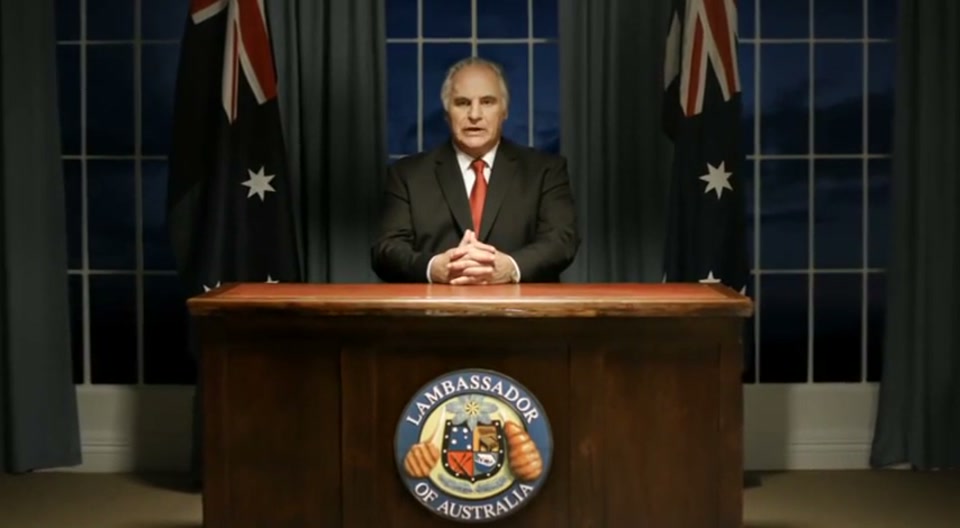
00:34 · opening The scene is a formal, dimly lit office, styled to look like the US President's Oval Office at night. Two large Australian flags flank a central window. A man in a dark suit and red tie sits behind a large wooden desk. -
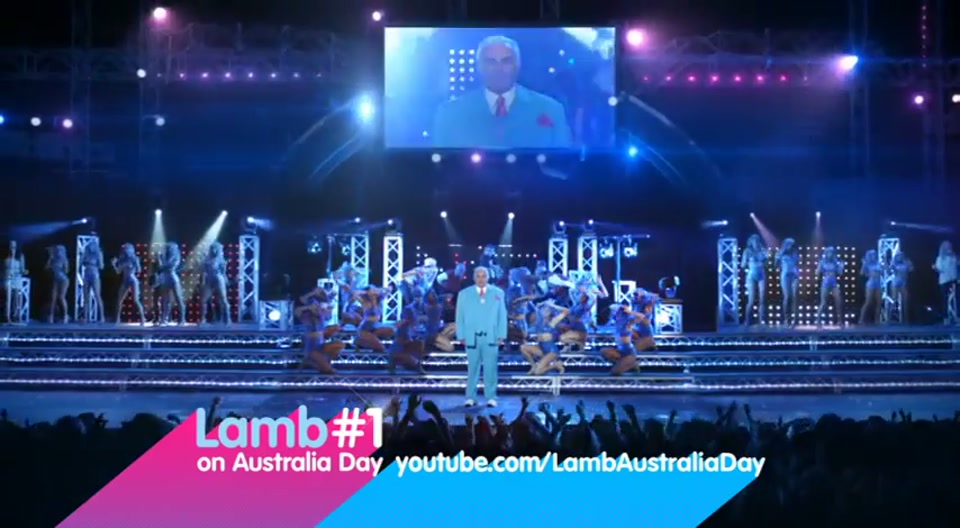
01:27 · brand frame The scene abruptly transitions. Kekovich stands up, and the back wall of the office splits apart to reveal a brightly lit concert stage.
Scene-by-scene account
Show full scene breakdown
00:00–01:08
Visuals
The scene is a formal, dimly lit office, styled to look like the US President's Oval Office at night. Two large Australian flags flank a central window. A man in a dark suit and red tie sits behind a large wooden desk. A seal on the desk reads "LAMBASSADOR OF AUSTRALIA," featuring a coat of arms with a cooked leg of lamb. The speaker, Sam Kekovich, maintains a serious, concerned expression throughout, delivering his speech directly to the camera. The camera slowly zooms in on him, heightening the mock-gravitas of the address.
Dialogue and audio
Speaker: Sam Kekovich (as the Lambassador)
"My fellow Australians. It's been a year of calamity. Natural disasters, revolutions, economic turmoil. And to top it off, Un-Australianism has gone viral. It's been spreading faster than pics of Pippa Middleton's rump on Facebook. And things have really hit rock bottom in popular culture. For example, the gossip mags have really gone googly-eyed over Shane Warne, who went from bowling overs to makeovers to get his leg over. Bleaching his pearlies for Hurley. The old Warney would never have chosen a salad over a cutlet, or tweeting over eating. And is it any wonder that Charlie Sheen's lost his sparkle when he's always off his chops? A lack of lamb has led to a litany of lamentable behaviour. We go gaga over a lady that wears a dress made out of lamb, instead of eating it. We gawk at Kim Kardashian's exposed nuptials. We salivate over the TV trial of Michael Jackson's doctor. If only Jacko had popped chops instead of pills, he might still be with us. And a lot less pale and anaemic. And don't get me started on reality television. What kind of society are we living in when you can win one of those dancing talent shows without doing the Lambada? Popular culture's so un-Australian. I've decided to create 'Chopular Culture' instead. So, I'm changing my tune."
[TXT says: "stallet" / audio appears to say: "salad"] [TXT says: "dead ing talent shows" / audio appears to say: "dancing talent shows"] [TXT says: "lambard" / audio appears to say: "Lambada"]
On-screen text
None.
Meaning and context
Directly observable: A figure of authority, the "Lambassador," is delivering a "state of the nation" style address. He lists a series of recent, real-world pop culture events as evidence of Australia's cultural decline, which he calls "Un-Australianism." He blames this decline on a "lack of lamb" and proposes his own form of culture, "Chopular Culture," as the solution.
Likely interpretation at release: The scene is a clear parody of a serious political speech, particularly the kind delivered by American presidents. Kekovich, a well-known, blokey sports personality, is humorously miscast as a statesman. The humour derives from treating trivial celebrity gossip with utmost seriousness and framing it as a national crisis. The list of grievances is a roll-call of major celebrity stories from 2011, establishing the ad's topicality. The term "Un-Australian" is used satirically to condemn things that are merely frivolous, not genuinely treasonous. The pun "Chopular Culture" is the central conceit, equating the consumption of lamb chops with the consumption of authentic culture.
Verification needed: Confirm the specific 2011 context for each celebrity reference (Middleton, Warne/Hurley, Sheen, Gaga, Kardashian, Jackson's doctor).
01:08–01:34
Visuals
The scene abruptly transitions. Kekovich stands up, and the back wall of the office splits apart to reveal a brightly lit concert stage. He walks forward as female backup dancers in blue wigs and shiny blue outfits emerge. The scene cuts to a wide shot of a massive stage with a cheering crowd. Kekovich's serious desk speech is visible on a large screen behind the stage. In a quick transformation, his dark suit is torn away to reveal a powder-blue suit, a matching waistcoat, and a large, dollar-sign-like "chop" medallion on a gold chain. He struts forward with the dancers, performing a pop song. The lighting is bombastic, with lens flares and confetti.
Dialogue and audio
Sam Kekovich: "I'm releasing my own chop song!"
(Music begins: a high-energy dance track parodying Aqua's "Barbie Girl")
Sam Kekovich (singing/rapping): "If a dead-set lam-o can spruik corners instead of car and Masterchef, why can't I reincarnate myself as a chop star? To be an Australian, get a barbie goin' to the top of the pops, and make lamb your number one on Australia Day! You know it makes sense! I'm Sam Kekovich."
[TXT says: "It's a de Lama can spr corers" / audio appears to say: "If a dead-set lam-o can spruik corners"] [TXT says: "camera Master ship" / audio appears to say: "car and Masterchef"] [TXT says: "get Barbie girl to the Chop of the pops" / audio appears to say: "get a barbie goin' to the top of the pops"]
On-screen text
- (01:22) "Lamb #1 on Australia Day" with a YouTube URL underneath: "youtube.com/LambAustraliaDay"
- (01:30) End-card with icons for "Replay," "Like Sam" (Facebook), and "Music Video."
Meaning and context
Directly observable: The "Lambassador" abandons his political persona to become a pop star. He launches his "Chop Song" in a full-scale music video production. His lyrics argue that if others can achieve fame, he can reinvent himself as a "chop star" to promote Australian values. The explicit goal is to make lamb "number one on Australia Day." The ad directs viewers to social media to continue the experience.
Likely interpretation at release: This section parodies the aesthetics and logic of early 2010s pop music and reality TV. Kekovich's transformation into a blinged-out pop star is deliberately absurd. The lyrics contain further topical and cultural references: "spruik corners" refers to the practice of street charity fundraisers (chuggers), while "car and Masterchef" likely refers to the ubiquity of car ads and the high-rating cooking show Masterchef Australia. The reference to a "dead-set lam-o" is a self-deprecating joke. The ultimate message is delivered with a wink: buying and eating lamb on Australia Day is the way to participate in this new, "authentic" 'Chopular Culture'. The use of a "Barbie Girl" parody connects to the Australian slang "barbie" for barbecue.
Verification needed: The exact phrasing of the lyrics needs to be carefully checked against the audio due to the poor quality of the TXT transcript.
Verification and uncertainties
- Uncertain dialogue / TXT errors: All major discrepancies between the TXT file and the audio have been corrected in the transcript section. Key corrections include: "bowling overs" not "Bing overs," "salad" not "stallet," "pearlies" not "PE," "dancing talent shows" not "dead ing talent shows," "Lambada" not "lambard," and the full reconstruction of the "Chop Song" lyrics.
- Uncertain identities or references: All celebrity identities and references have been confidently identified and linked to events in the primary context year of 2011.
- Topical claims needing release-period research: Research has confirmed the timing and public prominence of all key topical references (Middleton, Warne/Hurley, Sheen, Kardashian, Jackson/Murray).
- Campaign year, narrative year or context year: The campaign year is 2012, with the narrative and topical context being the preceding calendar year, 2011. This has been consistently applied.