Gods (You Never Lamb Alone)
Work title in the source analysis: "You Never Lamb Alone".
2017In a typical Australian backyard, a diverse group of gods, goddesses, prophets, and mythological figures from numerous world religions and belief systems gather for a barbecue. The conversation lightly touches on modern life, including dietary requirements, dating apps, social media followers, and designated drivers.
The deities interact with contemporary technology and social norms: Jesus performs a "reverse miracle" to help a designated driver, Aphrodite gets multiple matches on a dating app, Zeus is confused by emoji, and a Geisha photographs her food. The banter includes gentle ribbing between the figures, such as a tired joke directed at the elephant-headed god Ganesha and teasing Jesus about his "Christian rock" playlist.
The founder of Scientology, L. Ron Hubbard, tries to recruit a new member before being told not to discuss religion at the table. The prophet Muhammad calls to say he cannot attend because he has a "day care pick up".
The hostess reveals she has "no religion," citing census data that this is Australia's fastest-growing belief system, prompting Ganesha to lament their poor marketing efforts. The advertisement concludes with the group putting aside their differences to toast the one thing they can all agree on: lamb. The final on-screen text reads, "YOU NEVER LAMB ALONE."
Watch the advertisement
Historical and topical context
Campaign year: 2017 Assumed or known release period: Released 4 September 2017. Primary context year: 2017 Likely topical context window: June-September 2017
The advertisement appears to respond directly to the social and political climate of Australia in 2017. The national mood was heavily focused on issues of diversity, multiculturalism, and identity.
Reference: The rise of secularism in Australia.
- Evidence in the ad: The hostess explicitly states: "I'm no religion. Which is the fastest growing religion in Australia based on recently published census data." (01:42)
- Likely relevance at release: This was a major news story in mid-2017. The results of the 2016 Australian Census were released on 27 June 2017, revealing that for the first time, 'No Religion' was the most common response, overtaking Catholicism. The ad directly taps into this widely discussed national statistic.
- Confidence: High
- External verification needed: No
Reference: Debates on multiculturalism and social inclusion.
- Evidence in the ad: The entire premise of bringing together figures from Christianity, Judaism, Greek, Roman and Norse mythology, Hinduism, Buddhism, Scientology, and Islam (by proxy) to share a meal. The final toast is to "the meat we can all eat."
- Likely relevance at release: MLA campaigns of this era consistently promoted a message of unity through lamb, often in response to divisive social or political debates. This ad frames lamb as the solution to religious and cultural divides. The tagline "You Never Lamb Alone" reinforces this. The campaign's creative team explicitly stated the goal was to show that "people of all faiths and backgrounds can get along around a table".
- Confidence: High
- External verification needed: No
Reference: The controversy surrounding the ad itself.
- Evidence in the ad: The presence of the vegetarian deity Ganesha at a barbecue serving meat, and the joke "address the elephant in the room." (00:43)
- Likely relevance at release: Upon release, the ad drew significant complaints, particularly from the Hindu community, who found the depiction of Ganesha insensitive. The Advertising Standards Bureau launched an investigation. While this is a post-release context, the decision to include a vegetarian god was a deliberate, and ultimately controversial, creative choice intended to maximise the theme of inclusion.
- Confidence: High
- External verification needed: No
Campaign meaning
Creative premise
The advertisement uses the creative premise of a divine dinner party, where gods and prophets from a multitude of belief systems gather for a modern Australian barbecue. The humour and message derive from the juxtaposition of these ancient, powerful figures with contemporary settings, technologies (dating apps, smartphones), and social anxieties (dietary needs, drink driving, social media). By placing them all at one table, the ad creates a satirical but optimistic microcosm of a multicultural society searching for common ground.
Message
Explicit message:
- Lamb is a food that can be shared and enjoyed by people from all backgrounds. (Toast: "To lamb, the meat we can all eat." 02:01)
- You are never alone when you eat lamb; it fosters community. (Tagline: "YOU NEVER LAMB ALONE." 02:06)
Strongly implied message:
- In a world of increasing division and diverse beliefs, shared meals and simple pleasures like a lamb barbecue are a powerful unifying force.
- Australian society is proudly multicultural and increasingly secular, and these identities can coexist harmoniously.
- Don't take religion or yourself too seriously; a sense of humour is essential for getting along. (Irony of "Let's not get into religion at the table." 01:15)
Tentative interpretation:
- Organised religions are like competing brands that need better "marketing" to survive in a secular world. (Ganesha's line at 01:48)
- Even the most sacred figures and beliefs can be gently parodied in the service of a unifying, secular Australian identity.
Role of lamb
In this advertisement, lamb functions primarily as a social unifier and a symbol of secular communion. It is the one product that can bring together a table of otherwise incompatible figures. When toasts to "science" and other ideas fail to unite the group, the hostess's simple suggestion of toasting "lamb" is met with universal approval. Lamb transcends religious dogma and dietary specifics (even for the non-eaters present) to become the catalyst for harmony, embodying the campaign's core idea that sharing lamb is a ritual that creates community.
Worldview evidence
Multiculturalism as the default
- Classification: Strongly implied
- Evidence: The entire cast of characters, representing a vast array of global cultures and religions, sitting at a single table in a typical Australian setting.
- Meaning at release: The ad presents an idealized vision of Australian multiculturalism where diversity is not just tolerated but is the very fabric of social life. The ease with which these disparate figures interact suggests this is the normal, expected state of affairs.
Secularism and Irreverence
- Classification: Strongly implied
- Evidence: The hostess being an atheist (01:42), the rule "Let's not get into religion at the table" (01:15), and the general light-hearted, satirical treatment of divine figures.
- Meaning at release: The ad reflects and endorses a particularly Australian form of secularism where religion is a private matter and public life is governed by shared, non-religious rituals (like a barbecue). It suggests that a healthy, functioning society requires a degree of irreverence and a willingness not to take offence.
Modernity over tradition
- Classification: Strongly implied
- Evidence: Ancient gods are shown struggling with or adapting to modern phenomena like dating apps (00:34), social media (01:03), and contemporary slang (01:31). Modern problems like "day care pick up" (01:25) take precedence over divine gatherings.
- Meaning at release: The ad suggests that modern life, with its practical demands and social norms, is the great leveller. Tradition and ancient power must adapt to the realities of contemporary Australian life, not the other way around.
Humour, tone and satire
- Tone: The tone is light, irreverent, and comedic, but ultimately warm and optimistic.
- Principal joke mechanisms:
- Anachronism: Placing ancient figures in modern settings (e.g., Zeus wanting a dating app).
- Satire: Gently mocking the habits of organised religion (e.g., "Christian rock," "pamphlets") and contemporary social trends (e.g., food photography).
- Subversion: Reversing expectations, such as Jesus performing a "reverse miracle."
- Irony: The deep irony of a table full of gods being told not to discuss religion.
- Targets of satire:
- Organised religion's tendency towards self-importance and outdated marketing.
- The modern obsession with social media, followers, and digital trends.
- Scientology's reputation for recruitment.
- Affectionate parody versus genuine criticism: The parody is largely affectionate. While religions are teased, they are presented as part of a messy, vibrant family. The satire is aimed more at human behaviour (both ancient and modern) than at the core tenets of any specific faith. The exception is the slightly more pointed jab at Scientology.
Campaign evidence summary
Core message
This ad promotes the idea that in a diverse and increasingly secular Australia, sharing lamb is a powerful, unifying ritual that can bring people together regardless of their background or beliefs. It positions lamb as the ultimate social lubricant, capable of bridging even the most profound religious and cultural divides.
Values supported by this ad
- Inclusivity and multiculturalism
- Secularism and irreverence
- Humour as a social tool
- Community and togetherness
- Adaptation to modern life
Role of lamb
Lamb is the hero product that acts as the great unifier. It is the secular sacrament that allows a diverse group to find common ground, embodying the campaign slogan "You Never Lamb Alone."
Most important topical or historical elements
- The direct reference to the 2016 Australian Census results (released June 2017) showing a rise in Australians with "no religion."
- The ad functions as a commentary on contemporary Australian debates about multiculturalism, diversity, and social cohesion.
- The callback to the 1990 "Tom Cruise" lamb ad.
Uncertainties
- The specific identities of all background characters (e.g., the geisha, the alien, the Roman god).
- Whether the composite prophet figure is intended more as 'God' or 'Moses', as he is addressed as both.
Themes and connections
This advertisement belongs to Era 3 — Platform Advertising and Social Debate.
Keyframe gallery
11 representative frames, in chronological order.
-
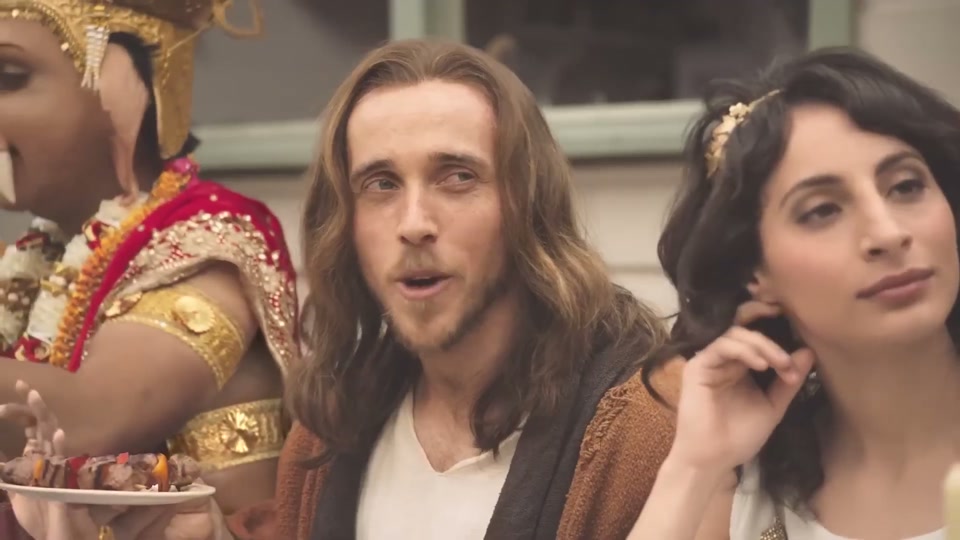
00:06 · opening The scene opens on a long dinner table in a brightly lit backyard patio. A man dressed as the Greek god Zeus, with a white beard, toga, and golden laurel wreath, is speaking to a man dressed as Jesus. -
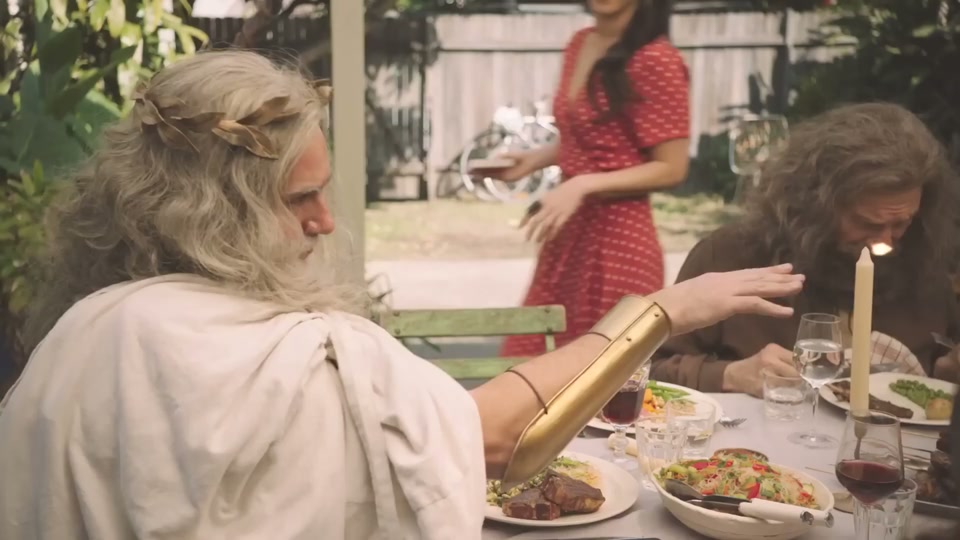
00:09 · opening The scene opens on a long dinner table in a brightly lit backyard patio. A man dressed as the Greek god Zeus, with a white beard, toga, and golden laurel wreath, is speaking to a man dressed as Jesus. -

00:16 · standard The hostess comments on the guests' dietary needs. Jesus notices Aphrodite being offered more wine. She declines, jingling her car keys. -
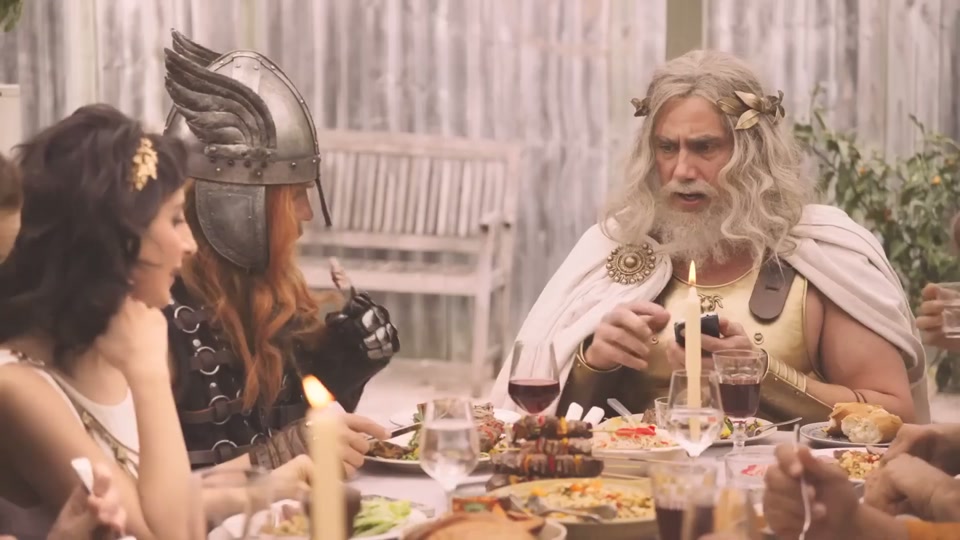
00:34 · reveal A phone vibrates on the table. The long-haired, bearded guest (henceforth referred to as 'God/Moses') tells Aphrodite it's hers. -

00:38 · reveal A phone vibrates on the table. The long-haired, bearded guest (henceforth referred to as 'God/Moses') tells Aphrodite it's hers. -
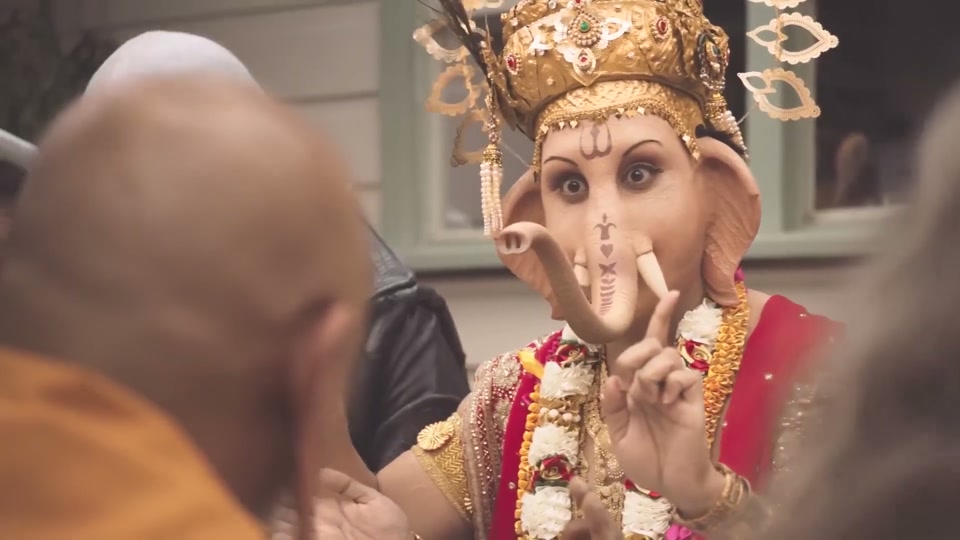
00:46 · title card A man dressed as Buddha speaks to the table. The camera focuses on Ganesha, who is wearing ornate Hindu attire and has an elephant head. Ganesha responds dryly. Buddha laughs. -

00:57 · food shot A man dressed as the Norse god Thor, with a Viking helmet and red beard, complains about the music. Aphrodite explains it's Jesus's playlist. The 'God/Moses' figure complains that Jesus's music is always about him. -
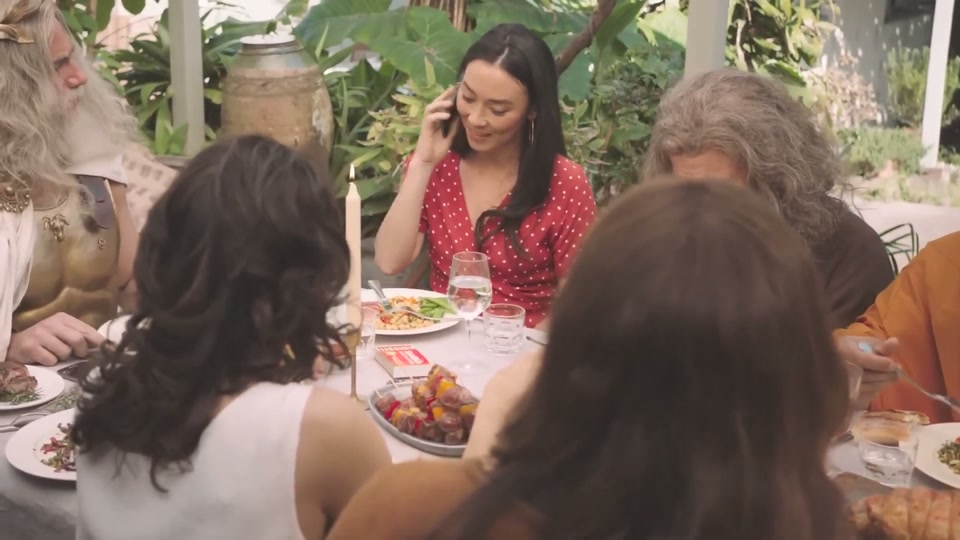
01:22 · standard The hostess answers her phone. The conversation implies the caller is the prophet Muhammad. -

01:31 · standard The hostess answers her phone. The conversation implies the caller is the prophet Muhammad. -
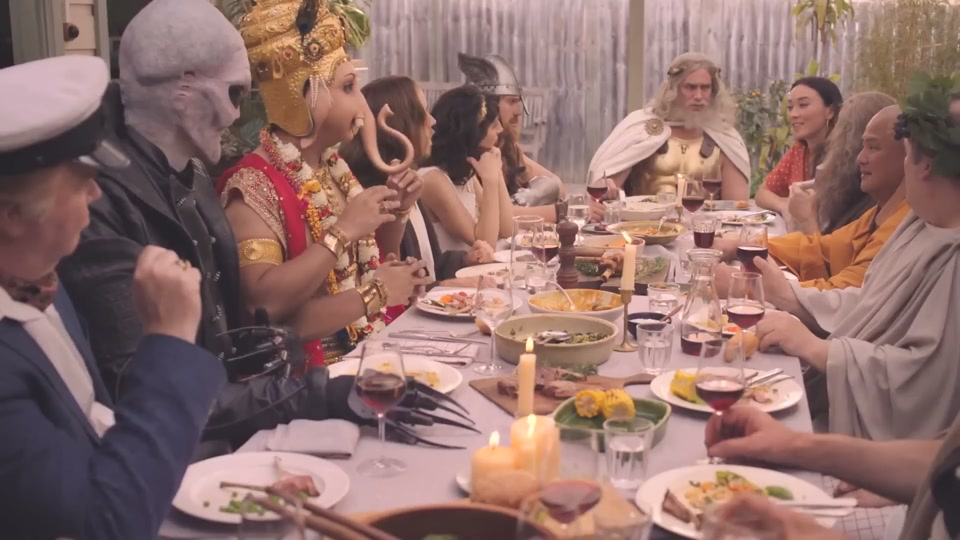
01:45 · reveal Zeus asks the hostess about her religion. She states she has no religion, which she notes is the fastest-growing demographic in Australia according to census data. -
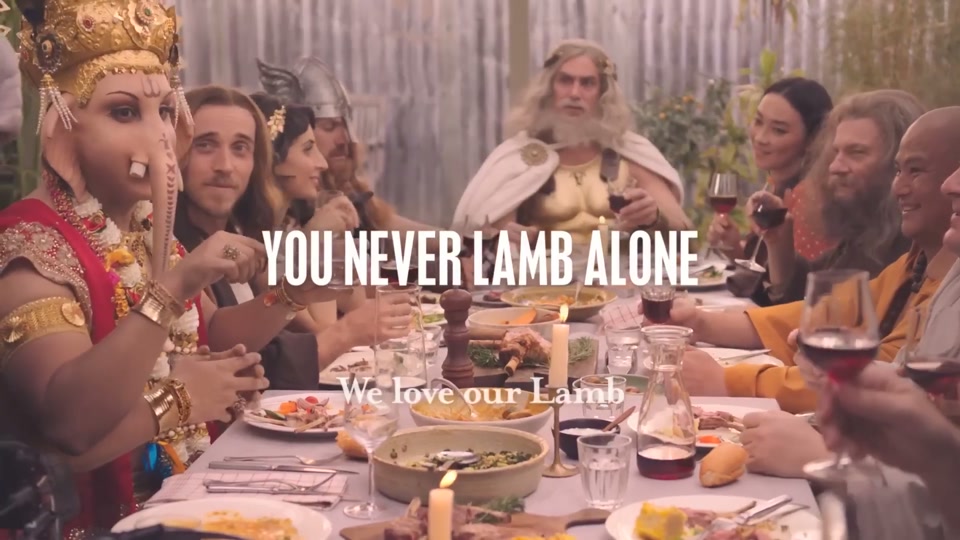
02:06 · brand frame The guests debate what to toast. L. Ron Hubbard proposes "science." An alien guest makes a gurgling sound. The hostess suggests toasting lamb itself. The entire table raises their glasses in agreement.
Scene-by-scene account
Show full scene breakdown
00:00–00:13
Visuals The scene opens on a long dinner table in a brightly lit backyard patio. A man dressed as the Greek god Zeus, with a white beard, toga, and golden laurel wreath, is speaking to a man dressed as Jesus. Other guests are seated around them. A woman in a red polka-dot dress (the hostess) approaches the table. A guest dressed as the Greek goddess Aphrodite is seated next to Jesus. The Hindu god Ganesha is visible in the background.
Dialogue and audio Background chatter of a party.
- Zeus: "Jesus. Where's your dad?"
- Jesus: "He's everywhere." (Zeus looks around, confused). "Just joking, he's working."
- A woman off-screen asks Zeus to light her cigarette. He holds up his finger, from which a small flame appears. She leans in to light her cigarette.
- Woman: "Thanks, Zeus."
- Aphrodite: (Looking at her plate) "God, I love this lamb."
- Group: (In unison) "You're welcome."
On-screen text None.
Meaning and context
- Directly observable: The ad establishes its premise by placing recognisable religious figures in a mundane, modern Australian setting. The humour comes from the contrast between their divine status and their casual, relatable behaviour. Zeus asks after God the Father, and Jesus gives a cheeky, modernised response. Zeus’s ability to conjure fire is used casually, like a lighter. The joke "You're welcome" is a collective response from the other deities to Aphrodite's exclamation of "God," playing on the multiple "gods" present.
- Likely interpretation at release: This scene immediately sets a tone of irreverent but affectionate parody. The casual depiction of major religious figures was a signature of MLA's campaigns, intended to be humorous and inclusive. The character addressed as "God" by Aphrodite is a generic, bearded, robed figure who will be identified as both 'God' and 'Moses' later in the ad, suggesting a composite Abrahamic prophet figure.
- Verification needed: The specific identity of the woman asking for a light. The exact identity of all background guests.
00:13–00:26
Visuals The hostess comments on the guests' dietary needs. Jesus notices Aphrodite being offered more wine. She declines, jingling her car keys. Jesus then places his hand over her full glass of red wine, which magically turns into clear water. He smiles. Another bearded, long-haired guest looks on with an impressed expression.
Dialogue and audio
- Hostess: "Well, that's a relief. It's a nightmare catering for you lot with all your dietary requirements."
- Aphrodite: (As Jesus pours wine) "Oh no, no, not for me. I'm designated driver." (She holds up car keys).
- Jesus: (As he turns her wine to water) "See that? Reverse miracle."
On-screen text None.
Meaning and context
- Directly observable: The scene plays on the biblical miracle of turning water into wine. Jesus performs the opposite, a "reverse miracle," to support a modern, responsible social practice (the designated driver). The hostess's comment about "dietary requirements" frames the central theme: lamb is a food that can unite people despite their differences.
- Likely interpretation at release: The joke is a clear subversion of a well-known Christian story, re-contextualised for a public safety message about drink-driving. It reinforces the ad's theme of ancient figures adapting to modern Australian social norms. The humour is gentle and character-based.
00:26–00:42
Visuals A phone vibrates on the table. The long-haired, bearded guest (henceforth referred to as 'God/Moses') tells Aphrodite it's hers. She picks it up, revealing a lock screen with multiple notifications from a dating app reading, "Congratulations! You have a new match." Zeus looks on with interest. In the background, a man dressed as Scientology founder L. Ron Hubbard, in a sea captain's uniform, is eating.
Dialogue and audio
- God/Moses: (As phone vibrates) "I think that's yours, Aphrodite."
- Zeus watches her swipe through notifications.
- Zeus: "How do I get that thing for myself?"
- L. Ron Hubbard: "Moses, can you pass those down?" (He gestures with his fork towards lamb skewers).
On-screen text
- On Aphrodite's phone: "12:30", multiple heart icons followed by "Congratulations! You have a new match".
Meaning and context
- Directly observable: The scene juxtaposes the ancient goddess of love, Aphrodite, with modern dating apps like Tinder. The humour lies in her universal appeal translating into digital "matches" and Zeus's naive desire to use the technology. L. Ron Hubbard addresses the composite prophet figure as "Moses."
- Likely interpretation at release: This continues the theme of gods engaging with contemporary culture. Aphrodite, the goddess of love, being successful on a dating app is a simple, effective gag. The identification of L. Ron Hubbard and the addressing of "Moses" adds another layer of religious diversity and satire to the gathering.
00:42–00:51
Visuals A man dressed as Buddha speaks to the table. The camera focuses on Ganesha, who is wearing ornate Hindu attire and has an elephant head. Ganesha responds dryly. Buddha laughs.
Dialogue and audio
- Buddha: "So, should we address the elephant in the room?"
- Ganesha: (Shakes his head and wags his finger) "Not funny two-and-a-half-thousand years ago, not funny now."
On-screen text None.
Meaning and context
- Directly observable: A literal and figurative "elephant in the room" joke. Buddha uses the common idiom, pointing directly to the elephant-headed god, Ganesha. Ganesha's weary response indicates he has heard this joke for millennia.
- Likely interpretation at release: This was one of the most noted and controversial jokes of the ad. While intended as a lighthearted, self-aware gag, it was seen by some in the Hindu community as disrespectful, particularly as Ganesha is a vegetarian deity depicted at a meat barbecue. The line humorously acknowledges the awkwardness of difference before dismissing it to move on.
00:51–01:18
Visuals A man dressed as the Norse god Thor, with a Viking helmet and red beard, complains about the music. Aphrodite explains it's Jesus's playlist. The 'God/Moses' figure complains that Jesus's music is always about him. A woman in a geisha costume takes a photo of her food. L. Ron Hubbard, seeing this, tries to recruit her into Scientology.
Dialogue and audio
- Thor: (Coughs) "What is this music?"
- Aphrodite: "It's his playlist." (Nods towards Jesus)
- Thor: "Christian rock."
- Jesus: "This one's about me."
- God/Moses: "They're all about you."
- God/Moses: (Watching the geisha) "I don't understand why people take photographs of food."
- Hostess: "You know, she probably has more followers than anyone at this table."
- L. Ron Hubbard: (Leaning toward the geisha) "Really? You're famous. Have you ever thought about Scientology?"
- God/Moses: (Interrupting Hubbard) "Ron, Ron. Let's not get into religion at the table."
- L. Ron Hubbard: (Muttering) "I gave up dinner with Tom Cruise for this."
On-screen text None.
Meaning and context
- Directly observable: This sequence layers multiple contemporary jokes: the cliché of "Christian rock," the narcissism of social media ("This one's about me"), the modern habit of food photography, the concept of "followers" as a measure of influence, and a satirical jab at Scientology's recruitment methods. The punchline, "Let's not get into religion at the table," is deeply ironic given the guest list.
- Likely interpretation at release: The Tom Cruise joke is a direct callback to a famous 1990 Australian lamb ad where a young Naomi Watts turns down a date with Tom Cruise for a lamb roast. It rewards long-time viewers of the campaigns. The satire of Scientology is pointed but brief. The rule against discussing religion is a classic Australian social convention, made absurd in this context.
01:18–01:36
Visuals The hostess answers her phone. The conversation implies the caller is the prophet Muhammad. After the call, Zeus, who has been using the dating app, shows his phone to the hostess, confused by an eggplant emoji in a message. The table erupts in laughter.
Dialogue and audio
- Hostess: (On phone) "No, sure... I'll see you next time."
- God/Moses: "Who was that?"
- Hostess: "Muhammad."
- Jesus: "Can't make an appearance?"
- Hostess: "Day care pick up."
- Jesus: "That is a shame."
- Zeus: (Excitedly) "Oh, I got a match! What does..." (He shows his phone) "...eggplants mean?"
- The table laughs loudly.
- Zeus: "What?!"
On-screen text None.
Meaning and context
- Directly observable: The ad cleverly avoids depicting the prophet Muhammad, which is forbidden in Islam, by having him call to cancel. The reason given — "day care pick up" — is a mundane, modern, and relatable excuse, humanising the figure without showing him. The eggplant emoji joke relies on the audience's knowledge of its common use in digital communication to signify male genitalia, a meaning lost on the ancient god Zeus.
- Likely interpretation at release: This was seen as a savvy way to include Islam while respecting religious sensitivities. The "day care" excuse fits the ad's theme of divine beings dealing with everyday family responsibilities. The eggplant emoji joke was a topical reference to modern digital slang and a source of humour based on generational/cultural misunderstanding.
01:36–01:54
Visuals Zeus asks the hostess about her religion. She states she has no religion, which she notes is the fastest-growing demographic in Australia according to census data. This prompts Ganesha to complain about his religion's marketing.
Dialogue and audio
- Zeus: "I don't mean to be rude, but what religion are you?"
- Hostess: "Oh, I'm no religion. Which is the fastest-growing religion in Australia based on recently published census data."
- A brief, surprised silence falls over the table.
- Ganesha: "We really need a better marketing team."
- Jesus: "I knew we shouldn't have spent all that money on pamphlets."
On-screen text None.
Meaning and context
- Directly observable: The hostess represents a secular, modern Australian. Her line about "no religion" is a direct topical reference to the 2016 Australian Census results, which were released in June 2017 and showed a significant increase in people reporting no religious affiliation. The gods' reaction is one of corporate-style disappointment, comically framing their religions as competing brands that are losing market share.
- Likely interpretation at release: This was the ad's most direct and timely topical reference. It tapped into a major national conversation about secularism and changing demographics in Australia. The joke about "marketing" and "pamphlets" satirises organised religion's attempts to remain relevant in a secularising world.
01:54–02:11
Visuals The guests debate what to toast. L. Ron Hubbard proposes "science." An alien guest makes a gurgling sound. The hostess suggests toasting lamb itself. The entire table raises their glasses in agreement. The ad ends with a wide shot of the diverse group sharing a meal together.
Dialogue and audio
- Another guest (dressed as Roman god Bacchus): "What should we toast to?"
- L. Ron Hubbard: "To science!"
- Alien guest: (Gurgles)
- Bacchus: (Toasting the alien) "L. Ron."
- Hostess: "What about just... lamb? The meat we can all eat."
- God/Moses: (Nods in agreement)
- Group: (Raising glasses) "To the lamb!"
- Ganesha: "We really should get together more often."
- Alien guest: "It would make the galaxy a better place."
On-screen text
- (02:06) "YOU NEVER LAMB ALONE"
- (02:07) "We love our Lamb"
Meaning and context
- Directly observable: The ad resolves the potential for division by finding a single, unifying point of agreement: lamb. The hostess, the secular everywoman, provides the solution. The final slogan, "You Never Lamb Alone," explicitly states the campaign's long-running message that lamb fosters community.
- Likely interpretation at release: This is the core message of the campaign. Despite all the differences in belief, background, and diet (as even the vegetarians are present and welcome), the shared ritual of a meal with lamb is presented as the ultimate social unifier. It positions lamb not just as a food, but as a cornerstone of Australian multiculturalism and harmony.
Verification and uncertainties
- A spring release rather than an Australia Day release, per the analysis.
- Likely TXT errors: The supplied transcript merges speakers and contains minor inaccuracies. The dialogue has been corrected in the scene-by-scene analysis based on the video's audio.
- Uncertain identities or references: The specific identities of some minor background characters (the alien, the figure in the blue tunic, the Geisha, the woman in the green head-dress) are not explicitly named and are open to interpretation. The main bearded figure being called both "God" and "Moses" is an inconsistency within the ad itself.
- Topical claims needing release-period research: The connection to the 2016 Census data has been confirmed by the timing of its release (June 2017) just before the ad's launch (September 2017).
- Remembered background facts requiring external verification: The callback to the 1990 Naomi Watts/Tom Cruise lamb ad is confirmed by external sources. The controversy surrounding the ad's depiction of Ganesha is also well-documented.